Thailand maintains deficit spending to support growth, economic stability

The Thai government estimates total revenue for fiscal 2027 at 3.145 trillion THB , up 2.7% from the previous year. The budget was prepared against a backdrop of moderate economic growth, with Thailand's economy projected to expand by 1.7–2.7% in 2027.

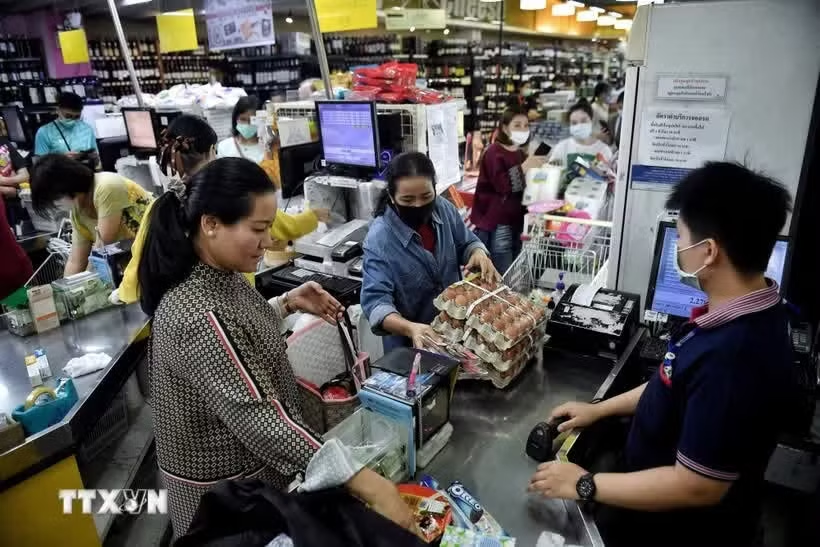
Customers shop at a supermarket in Bangkok, Thailand. (Photo: AFP/VNA)

Bangkok (VNA) – Thailand's government is pressing ahead with a 3.78 trillion THB (113.8 billion USD) budget for fiscal year 2027, including a 788 billion THB deficit, as it seeks to support a fragile economy while keeping public debt within the country's fiscal discipline ceiling.

Presenting the Fiscal Year 2027 Budget Bill to the House of Representatives on June 29, Deputy Prime Minister and Finance Minister Ekniti Nitithanprapas said the spending plan would serve as a key mechanism to drive economic growth and improve people's quality of life.

The proposed budget totals 3.788 trillion THB, while the government expects 3 trillion THB in net revenue available for allocation, resulting in a 788 billion THB budget deficit. Ekniti said deficit spending remains necessary to preserve economic stability and support growth, even though public debt stood at 66.66% of GDP in April 2026, close to the country's 70% fiscal discipline ceiling

The Thai government estimates total revenue for fiscal 2027 at 3.145 trillion THB , up 2.7% from the previous year. The budget was prepared against a backdrop of moderate economic growth, with Thailand's economy projected to expand by 1.7–2.7% in 2027.

The growth outlook is expected to be supported by a recovery in global trade and domestic consumption, while inflation is forecast at 0.5–1.5%.

However, Ekniti warned that Thailand continues to face significant uncertainties and downside risks, including prolonged tensions in the Middle East, uncertainty surrounding trade protectionist measures adopted by major economies, and the growing impact of climate change. Against this backdrop, the government has decided to maintain a deficit budget in fiscal 2027 to help stabilise the economy and sustain growth.

Despite continuing deficit spending, the government remains committed to long-term fiscal sustainability and aims to reduce the fiscal deficit to below 3% of GDP by 2029, he said.

Ekniti added that the 2027 budget was formulated under principles designed to ensure value for money and improve spending efficiency. The government will also pursue economic support measures such as Thailand FastPass, aimed at attracting and accelerating investment, and SMEs Plus, which is intended to expand income opportunities for small and medium-sized enterprises.

The budget is allocated across six strategic priorities: national security, competitiveness enhancement, human resource development, social opportunity and equality, environmental development, and public sector rebalancing and reform.

Ekniti affirmed that the government would manage public spending in strict compliance with the law and the country's fiscal discipline framework to ensure taxpayers' money is used effectively. He added that the government would ensure public funds reach the people, maximise Thailand's growth potential, and promote inclusive and sustainable development./.


VNA

See more

A corner of Kuala Lumpur, Malaysia. (Photo: Xinhua/VNA)

Malaysia, EU move closer to free trade agreement

Malaysian Investment, Trade and Industry Deputy Minister Sim Tze Tzin said the fourth round of negotiations, held in Kuala Lumpur from June 8-12, saw the conclusion of three chapters, namely Customs and Trade Facilitation, Trade Remedies and Good Regulatory Practices. The next round of negotiations will be held on September 21-25 in Brussels, Belgium.

Malaysia expands tourism market outreach

Malaysia expands tourism market outreach

Deputy Tourism, Arts and Culture Minister Chiew Choon Man said Tourism Malaysia is focusing on high-performing and stable markets, including China, Indonesia, Japan and India, while expanding its presence in long-haul markets such as Russia, Germany and Australia to diversify the country's visitor base.

VinFast VF7 is showcased at the GAIKINDO Indonesia International Auto Show (GIIAS) 2025 in Indonesia. (Illustrative photo: VNA)

Indonesia promotes circular economy in EV battery industry

Battery recycling can bolster Indonesia's position within the EV battery production supply chain, enabling the country to become fully integrated in battery production, from raw material preparation to end-product manufacturing, according to Ahmad Faisal Suralaga, Director of Downstreaming Strategy and Governance at Indonesia’s Ministry of Investment and Downstreaming.

Malaysia looks to become apparel hub

Malaysia looks to become apparel hub

According to the Malaysia External Trade Development Corporation (Matrade), its total trade in apparel and clothing accessories exceeded 4.5 billion USD in 2025, marking an 8.3% annual hike.

Indonesia strengthens energy security with B50 biodiesel rollout

Indonesia strengthens energy security with B50 biodiesel rollout

The B50 biofuel mandate would significantly reduce Indonesia's reliance on imported petroleum products. The country currently consumes around 39 million kilolitres of diesel annually, and increasing the biodiesel blend to 50% is expected to meet a substantial share of domestic demand.

People commemorate the victims of Malaysia Airlines Flight MH370 in Subang Jaya, Malaysia, on March 3, 2024. (Photo: AFP/VNA)

Malaysia extends agreement for missing-MH370-aircraft search

The extension lasts from July 1 this year until June 30, 2027. The renewed deal maintains all key terms and conditions of the existing one, including the application of the 'no find, no fee' principle. If the wreckage is successfully located, Malaysia would pay the firm 70 million USD.

Indonesian-branded cosmetic and personal care products at a supermarket. (Photo: VNA)

Indonesia launches summer shopping campaign

According to the Indonesia Ministry of Tourism, the BINA (Shopping in Indonesia Movement) Holiday & Back to School 2026 programme involves 800 brands, approximately 80,000 outlets, and 414 shopping centres across 24 provinces. It aims to boost domestic consumption and tourist trips throughout the school break.

A fuel station in the Philippines. The Philippine economy expanded 2.8% in the first quarter, down from 3% in the previous quarter, weighed down by higher oil prices linked to the Middle East conflict and weaker public spending. (Photo: Xinhua/VNA)

Philippines to accelerate infrastructure spending to boost economic growth

Infrastructure spending has fallen sharply as government agencies, particularly the Department of Public Works and Highways (DPWH), adopted a more cautious approach to budget disbursement following an investigation into alleged irregularities involving multi-billion-PHP flood control projects.

Visitors to a pagoda in Bangkok, Thailand (Photo: Xinhua/VNA)

Thailand develops luxury rail services to boost tourism

Thailand’s Ministry of Transport is advancing plans to upgrade the country’s railway and tourism sectors by developing world-class luxury train services, leveraging newly enacted railway legislation to attract private investment and stimulate local economic growth.