London - a key destination in President Ho Chi Minh’s 30-year journey abroad

President Ho Chi Minh’s stay in London was the very outset of his revolutionary career, which had a profound effect on him, especially the development of his own thinking, British historian John Callow told the Vietnam News Agency (VNA)’s correspondents in the UK on the occasion of the late leader's 133th birth anniversary (May 19,1890 - 2023).
London - a key destination in President Ho Chi Minh’s 30-year journey abroad ảnh 1British historian John Callow (Photo: VNA)
London (VNA) – President Ho Chi Minh’s stay inLondon was the very outset of his revolutionary career, which had a profoundeffect on him, especially the development of his own thinking, Britishhistorian John Callow told the Vietnam News Agency (VNA)’s correspondents inthe UK on the occasion of the late leader's 133th birth anniversary (May19,1890 - 2023).

According to the historian, as part of his greatjourney, in May 1914, President Ho Chi Minh, called Nguyen Tat Thanh at that time, came to London - the power centre of imperialism, the financialcentre of capitalism and the capital of a system that stretched to India throughAfrica. The UK, at that time, was still the workshop of the world, withenormous fleets and armies.

President Ho Chi Minh wanted to learn about secrets ofimperialism, and to have a sense of the developed industrial world. There hadbeen risings against imperialists, colonists and capitalism, but these had allfailed. President Ho Chi Minh wanted to understand reasons behind thosefailures and find out different patterns to development for Vietnamese peopleas a nation.

He arrived in London at time of great industrialunrest with a lot of strikes, such as the one in Liverpool and the Irishpeople’s rising in 1916 to fight for their own independence. According to Callow,this was a crucial period that affected President Ho Chi Minh enormously.

When in London, the President first took a jobshovelling snow in a school playground in the incredibly cold. He then moved toDrayton Court Hotel on the railway line, further to the east, before working atthe Carlton Hotel, where the President washed dishes, and later became askilled worker under the wing of the great pastry chefs. Here he saw the gulfthat separated the rich from the poor.

He was shocked at the waste that therich who ate here, throwing out whole chickens or whole sides of steak. Hecollected these together, and every night dispersed them to the poor who waitedat the back of the building here for something to eat. While being here, PresidentHo Chi Minh joined an organised labour association that brought togetherChinese, Lao and Vietnamese workers.

The British historian said much of what we know about PresidentHo Chi Minh in this period comes from the postcards he sent to his friends andcomrades in Paris, three of which had got intercepted.

The French police’s records also showed reports on aVietnamese worker in London joining the movement of trade unionists. Accordingto Callow, President Ho Chi Minh probably lived in a little flat just at theback of Tottenham Court Road as the French police intercepted some of hiswritings and had the English police raid the address. But he was long gone bythen.

At that time, the British labour movement was verywell developed with a lot of socialist writings. President Ho Chi Minh got alot of social socialism journals, so it was probably the first time heencountered the work of Karl Marx in London.

Callow pointed out that President Ho Chi Minh waswalking in the footsteps of the father of modern socialism.

What he got from Marx would be an explanation for allthe things he saw in this period, the historian said, adding this was thebedrock of the President’s political economy and thought.

But at the very same time, President Ho Chi Minh leftBritain just after the 1917 revolution in Russia and was also incrediblyinfluenced by Lenin's work on the colonial peoples.

Callow said the brilliance of President Ho Chi Minhwas looking at the founders of scientific socialism, of Marx and Angles, butthen updating what they were saying and combining with the new thoughts ofLenin that spoke directly to the peasant workers and peoples of the world anddirectly had an impact on a country like Vietnam which was colonised,brutalised under the thumb of the great trading companies.

The historian said the greatness of Ho Chi Minh washis ability not to follow ideas for their own sake, but to take ideas, tocreate and develop them, and to never lose sight of the need for the nationalliberation of the Vietnamese people to make their lives better, healthier,happier, more decent.

Speaking of President Ho Chi Minh’s thought, Callowsaid its greatness lied with its adaptability, its refusal to turn Marxism intoa dogma, into something to be worshipped, to be nodded at, but to make itapplicable in Vietnam, to never lose sight of the revolutionary conditions.

The President thought every day and every night aboutachieving his goal of revolution, and to have a revolution that would be reallyworthwhile to sweep away the empires that dominated the fates and the lifechances of the Vietnamese people and to put something better and brighter intheir place.

Callow noted that President Ho Chi Minh took the besttraditions of Vietnamese culture, of it's amazing ancient society that existedlong before the City of London, but put it within new times.

His thought gave the Communist Party of Vietnam theadaptability that led them to Doi Moi (Reform).

Speaking of personal qualities of President Ho ChiMinh that made him an outstanding leader, Callow said alongside his enormouspolitical qualities for organisation and inspirational leadership, there wasalso the essential simplicity of the President.

“He had an amazing intellect but he had never lost hiscontact with the people, whether it was the people of London or small farmersof Vietnam that he spoke to directly. He never lost sight of the peoplethemselves and did not let power go to his head. He did not set himself apartfrom the people. He understood the people and was a part of the people, but wasa leader of the world in the true sense,” the historian said.

“He was humble, quiet and unassuming, and brave andhad enormous dignity at the same time. His poetic Prison Diary gave a sense ofthe man himself. His humanity, his calmness under great stress, his creativitythat he used in jail turned out a work of art, a work of poetry and a work tofire the imagination of his comrades in the underground movement.”

The historian concluded that President Ho Chi Minh wasa great world figure who could combine intellect with passion, with decency,with the sense of a man who was absolutely incorruptible and put the people ofhis own nation before everything else in his life. And his work, while it isart or politics, was always there first and foremost at the service of thepeople./.
VNA
See more

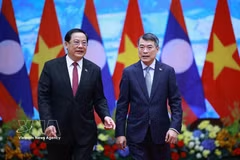
Politburo Member, Secretary of the Communist Party of Vietnam (CPV) Central Committee and President of the Vietnam Fatherland Front (VFF) Central Committee Bui Thi Minh Hoai (L) and Lao National Assembly President Sonexay Siphandone in Hanoi on November 3. (Photo: VNA)

Lao, Vietnamese front organisations urged to strengthen cooperation

Hoai stressed the need for the leaders of both Parties and countries, including the Lao NA President, to continue providing guidance and favourable conditions for the Vietnam Fatherland Front and the Lao Front for National Construction to enhance cooperation and exchange experience in mobilising and uniting people from all walks of life to participate in national construction and development.

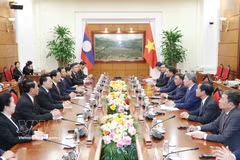
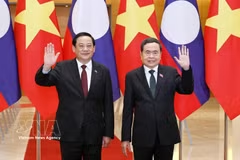
National Assembly President Tran Thanh Man (R) and his Lao counterpart Sonexay Siphandone. (Photo: VNA)

National Assembly President holds talks with Lao counterpart

Parliamentary cooperation is an important pillar of overall Vietnam-Laos relations, helping strengthen the legal foundation, oversee the implementation of high-level agreements, translate the policies and agreements of the high-ranking leaders of the two Parties and countries into concrete action, and support each other's development.

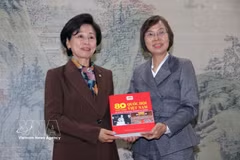
VNA General Director Vu Viet Trang (R) presents a book entitled "80 Years of the National Assembly of Vietnam" to Deputy Speaker of the RoK’s National Assembly Nam In-soon. (Photo: VNA)

RoK NA Deputy Speaker lauds VNA, Yonhap’s role in bilateral ties

The Vietnam News Agency and Yonhap agreed to coordinate closely on information and communications for the 35th anniversary of Vietnam-RoK diplomatic ties next year, and continue information and delegation exchanges, support for resident correspondents, anti-fake news work and technology cooperation.

Politburo Member and Standing Member of the CPV Central Committee’s Secretariat Tran Cam Tu welcomes the LPRP delegation. (Photo: VNA)

Key Vietnamese Party leader welcomes LPRP delegation

Tu cast Vietnam–Laos ties as a special solidarity asset cultivated by generations of leaders and people, strategically vital to the construction and defence cause of both countries. With global and regional conditions shifting rapidly, he said the “great friendship, special solidarity, comprehensive cooperation, strategic cohesion” motto requires shared resolve and responsibility from all sectors and levels, especially the two Parties and States’ leaders.

Congratulations extended to Commonwealth of Dominica, Panama on National Days

Congratulations extended to Commonwealth of Dominica, Panama on National Days

General Secretary of the Communist Party of Vietnam (CPV) Central Committee and President To Lam on November 3 sent a congratulatory message to President of the Commonwealth of Dominica Sylvanie Burton on the occasion of the 48th anniversary of the Caribbean country's Independence Day (November 3, 1978 – 2026).

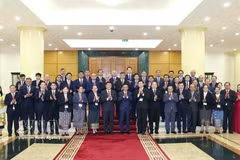
An overview of the meeting (Photo: VNA)

Vietnam, Czech Republic step up parliamentary cooperation, people-to-people exchanges

Ha Thi Nga, member of the Party Central Committee and Vice President and Secretary-General of the VFF Central Committee, expressed her wish for the VFF and its counterpart bodies under the Czech Chamber of Deputies to step up exchanges of experience in legislative work, receiving and addressing voters’ petitions, supervision and social governance.

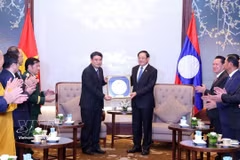
President of the Lao NA Sonexay Siphandone (right) presents a souvenir to the Vietnam-Laos Friendship Association (VLFA) at the meeting in Hanoi on November 2, 2026. (Photo: VNA)

Top Lao legislator backs friendship activities ahead of 2027 milestones

Lao NA Sonexay Siphandone, who is on official Vietnam visit, urged the Vietnam-Laos and Laos-Vietnam friendship associations to keep coordinating closely and step up messaging on the two countries’ great friendship, special solidarity, comprehensive cooperation and strategic cohesion, especially around the treaty’s 50th anniversary.

President of the National Assembly Tran Thanh Man speaks at the eighth session of the NA Standing Committee on November 2, 2026. (Photo: VNA)

Top legislator asks for harnessing people’s power to curb crime

The top legislator stressed that to curb drug-related offences and other crimes, it is vital to leverage the collective strength of the entire people, describing every citizen as a soldier, every family as a battleground, and every locality as a fortress.

At the meeting between Nguyen Thanh Nghi, member of the Political Bureau, Secretary of the CPV Central Committee, and head of the committee’s Commission for Policy and Strategy and Wang Huning, member of the Standing Committee of the Political Bureau of the Communist Party of China (CPC) Central Committee and Chairman of the National Committee of the Chinese People's Political Consultative Conference, in Beijing on November 2. (Photo: VNA)

CPV delegation pays working visit to China

The two sides discussed measures to further enhance the effectiveness of cooperation, focusing on increasing delegation exchanges, strengthening training and capacity-building for officials, establishing regular research coordination channels, and organising thematic seminars and online discussions.

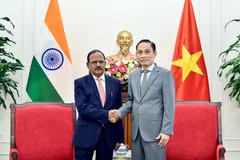
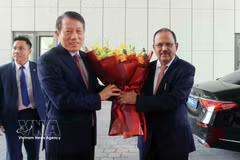
Vietnamese Minister of Public Security General Luong Tam Quang welcomes Indian National Security Adviser Ajit Doval. (Photo: VNA)

Vietnam, India promote law enforcement cooperation

The Vietnamese Ministry of Public Security called on India’s National Security Council to continue urging Indian law enforcement agencies to negotiate and sign cooperation documents with the ministry, including a draft memorandum of understanding on cooperation in personnel training and capacity building and a draft agreement on cooperation in combating transnational crime between the Vietnamese ministry and the Indian Ministry of Home Affairs.

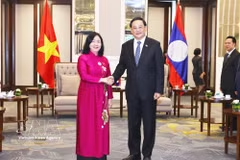
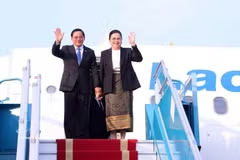
President of the Lao National Assembly Sonexay Siphandone and his spouse, Vandara Siphandone, arrive at Noi Bai International Airport on November 2, 2026. (Photo: VNA)

Lao NA President begins official visit to Vietnam

In an interview on the visit and bilateral cooperation, Vietnamese Ambassador to Laos Nguyen Minh Tam said that, from a strategic perspective, the visit is important in further translating the concept of “strategic cohesion” into concrete action and making it a guiding principle underpinning Vietnam-Laos relations.