Hanoi (VNA) - The Civil Aviation Authority of Vietnam (CAAV) is coordinating with foreign airlines operating flights to and from Vietnam to increase flight frequencies and to support passengers affected by the Middle East conflict.
The armed conflict in the Middle East has disrupted global air connectivity chains, affecting passenger travel plans and cargo transport. It has also forced airlines to adjust operations, potentially leading to longer flight times and higher operating costs.
Tens of thousands of passengers affected
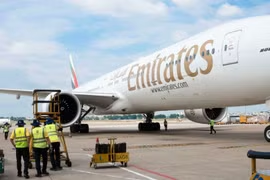
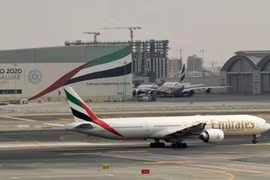
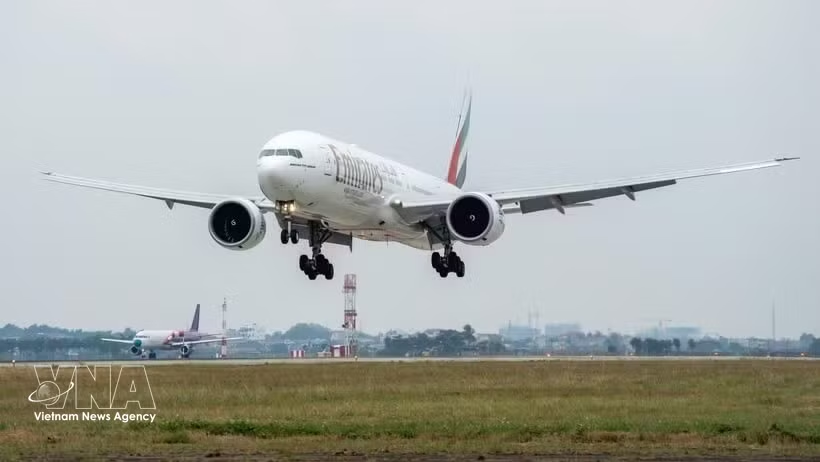
According to a report from the Ministry of Construction on measures to ensure safe transport of goods and passengers and to avoid supply chain disruptions caused by the Middle East conflict, the CAAV noted that three Middle Eastern airlines are currently operating regular flights to Vietnam, namely Qatar Airways, Emirates, and Etihad Airways. They operate routes connecting Doha (Qatar), Dubai, and Abu Dhabi (UAE) with Hanoi, Ho Chi Minh City, and Da Nang, with a total average frequency of around 12 flights per day (equivalent to 84 flights per week).
These hubs are key transit points in the international networks of Middle Eastern carriers, particularly for journeys between Vietnam and Europe, North America, and Africa.
Before the conflict, these airlines had operated more than 7,000 flights to and from Vietnam in 2025, carrying nearly 1.4 million passengers and over 151,000 tonnes of cargo. This contributed significantly to maintaining international air connectivity and promoting trade between Vietnam and global markets.
Between February 28 and March 6, 2026, the CAAV recorded 98 flights including 80 passenger flights and 18 cargo flights operated by Qatar Airways, Emirates, and Etihad Airways that were either cancelled or rescheduled, affecting an estimated 20,000 passengers.
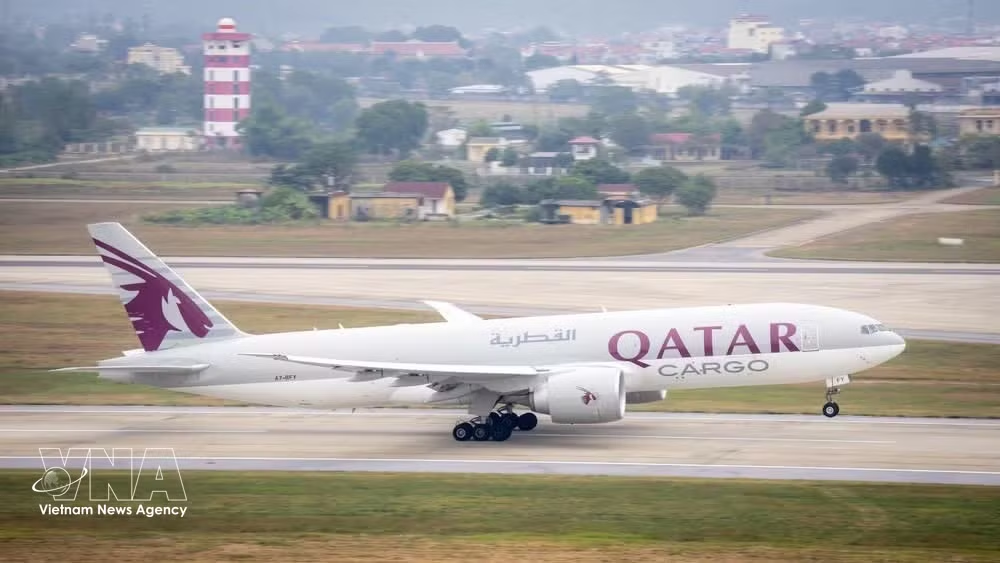
For example, from March 5 to 9, Qatar Airways cancelled a total of 31 flights including 22 passenger and nine cargo services, affecting around 4,800 passengers, mainly on the Ho Chi Minh City-Doha and Hanoi-Doha routes.
From March 5 to 7, Etihad Airways cancelled six passenger flights between Vietnam and Abu Dhabi, affecting 1,468 passengers. Emirates cancelled six flights on the Dubai-Ho Chi Minh City route in both directions, impacting nearly 1,000 passengers. However, it still operated 14 other flights between Dubai and Vietnam’s destinations, namely Ho Chi Minh City, Hanoi, and Da Nang, carrying more than 3,500 passengers during the same period.
At present, Vietnam has limited direct routes to Europe, North America, and Africa, and airports in the Middle East serve as major transit hubs connecting these regions.
“As a result, the conflict in the Middle East, leading to airspace closures in several countries in the region, has disrupted international aviation connectivity, affected passenger travel plans and cargo transport, and may require airlines to adjust operations, extend flight times, and incur additional operating costs,” a CAAV leader said.
Increasing capacity and flight frequencies
Considering that the Middle East Flight Information Region (FIR) remains highly unpredictable, the authority noted that some countries in the region have shifted from strict restrictions to partial airspace reopening. This is seen as a positive signal, allowing airlines to gradually resume operations to and from the Middle East, reducing disruption to international air transport.
In the immediate term, the CAAV will continue working with Qatar Airways, Emirates, and Etihad Airways to update developments on airspace changes in Gulf countries including Iran, Iraq, Israel, Qatar, Kuwait, Bahrain, Syria, the UAE, and Jordan, passenger service conditions, and compliance with carrier responsibilities. It will also coordinate with airports and aviation service providers in Vietnam to arrange overnight aircraft parking, confirm slots, and approve flights carrying stranded passengers, as well as prepare response plans for potential sudden increases in aviation fuel prices.
In addition, the authority advises passengers to consider alternative airlines and routes via other transit hubs in Northeast Asia including the Republic of Korea, Japan, China, Taiwan and Hong Kong (China); Southeast Asia including Singapore, Thailand, and Malaysia; Türkiye and North Africa including Ethiopia.
Given the risk that the conflict may persist and affect global networks, and to ensure aviation safety, maintain supply chains, and international connectivity, particularly between Vietnam and Europe, the CAAV will work with domestic airlines to increase capacity on routes to and from Europe and Central Asia.
It will also encourage foreign carriers operating routes to Europe, North America, and Africa to increase flight frequencies to support affected passengers and facilitate cargo operations, especially for key import and export goods./.