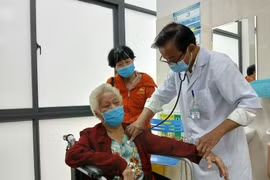
Hanoi (VNA) - New health insurance regulations taking effect nationwide from July 1, 2026 expand benefits for policyholders, facilitate access to medical services, and reduce out-of-pocket costs, particularly for patients with serious or rare diseases.
July 1 also marked the nationwide implementation of several new health insurance provisions, including adjustments to contribution and benefit levels following the increase in the statutory base salary, as part of efforts to further improve social security policies and make healthcare more accessible.
Patient-centred approach
July 1 has been designated by the Prime Minister as Vietnam Health Insurance Day to raise public awareness of the role and significance of health insurance in protecting, caring for and improving people’s health.
According to Tran Thi Trang, Director of the Ministry of Health’s Department of Health Insurance, Vietnam currently has more than 97.65 million people covered by health insurance, equivalent to 95.16% of the population. In 2025, health insurance-covered medical facilities recorded 195.1 million patient visits, up 11.5 million, or 6.5%, from 2024.
The health insurance fund paid out 166.4 trillion VND (6.38 billion USD) in 2025, up 23.5 trillion VND from 2024, with medicines accounting for more than 30% of the total.
The Law amending and supplementing several articles of the Law on Health Insurance, effective July 1, 2026, further improves the policy with a patient-centred approach, expanding benefits and facilitating access to healthcare services.

Under the new provisions, regulations on benefit coverage, medical examination and treatment conditions, and payment of health insurance-covered expenses have been revised to make procedures more flexible.
Patients with serious or rare diseases or those requiring specialised treatment will have greater access to appropriate medical facilities while retaining their health insurance benefits. Regulations on transfers between medical facilities have also been improved to reduce administrative procedures during treatment.
Notably, under the Health Ministry’s Circular No. 01/2026/TT-BYT dated January 9, 2026, patients diagnosed with 62 diseases at eligible medical facilities can, from July 1, go directly to specialised medical facilities without a referral while still receiving health insurance benefits as prescribed.
The list covers serious and rare diseases and conditions requiring specialised treatment, including certain cancers, blood, cardiovascular, neurological and metabolic diseases, as well as organ transplants. The measure is expected to shorten referral procedures, helping patients receive timely treatment while reducing travel time and costs.
Meanwhile, healthcare facilities are accelerating digital transformation and data connectivity, allowing people to use chip-based citizen ID cards, VssID or VNeID instead of paper health insurance cards when seeking treatment. This helps simplify procedures, reduce waiting times, and improve service quality.
This is also part of efforts to concretise the Political Bureau’s Resolution No. 57-NQ/TW, dated December 22, 2024, on breakthroughs in science and technology development, innovation and national digital transformation, which plays a crucial role across all sectors, including healthcare.
The implementation of Resolution No. 57 in the healthcare sector will help improve the quality of healthcare services, accelerate the development of a national healthcare database, and build a modern, efficient, and people-centred healthcare system.
Lower out-of-pocket costs
Under the Government’s Decree No. 161/2026/ND-CP dated May 15, 2026, the statutory base salary rose to 2.53 million VND per month from July 1. As a result, several health insurance-related contribution and benefit levels calculated based on the base salary have also changed.
Patients continue to have 100% of their health insurance medical costs paid when the total cost of a single visit is below 15% of the base salary. With the new salary level, this threshold has risen to 379,500 VND per visit, helping reduce co-payments, particularly for routine examinations and treatment.
For people seeking outpatient care on their own at certain medical facilities, benefits have also been expanded. Diseases and disease groups covered by Circular No. 01/2025/TT-BYT continue to receive payment at 100% of the prescribed benefit level. For other diseases and disease groups, the health insurance fund will now cover 50% of the benefit level within the prescribed scope, instead of providing no coverage as previously.
The new policies enhance benefits for health insurance participants, encourage broader coverage and, together with digital transformation and streamlined administrative procedures, make it easier for people to access and benefit from health insurance./.