Nguyen Dynasty imperial throne to be restored

The project aims to return the artefact to its original condition, preserving its form, structure, colours, and historical integrity. The restoration supports long-term preservation and highlights the value of this iconic piece.

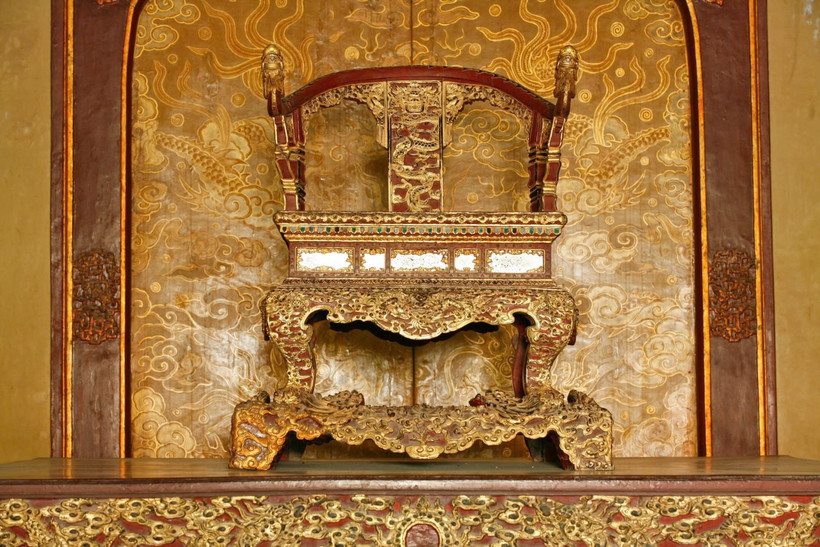
The Nguyen Dynasty (1802-1945) imperial throne is a nationally recognised treasure. (Photo: VNA)

Hue (VNA) - The People’s Committee of central Hue city on August 11 issued a plan to restore the Nguyen Dynasty (1802-1945) imperial throne, a nationally recognised treasure.

The project aims to return the artefact to its original condition, preserving its form, structure, colours, and historical integrity. The restoration supports long-term preservation and highlights the value of this iconic piece.

The initiative follows a vandalism incident on May 24, which left the throne’s left armrest shattered into 14 pieces. The rest of the structure remained intact. Assigned to the Hue Monuments Conservation Centre and the Museum of Royal Antiquities, the urgent restoration seeks to uphold the throne’s authenticity and safeguard its heritage status.

Work will begin with preparing the site and retrieving the throne and broken fragments from storage. Specialists will clean the components, reassemble and stabilise the structure, and restore the lacquer and gilding. A thin, removable protective coating will be applied, followed by anti-mould and dust measures. Upon completion, the throne will return to its original location in Thai Hoa Palace, with preservation carried out in line with national standards.

The throne consists of two parts - the seat and base, both made of lacquered and gilded wood. Four vertical posts connect the base to curved armrests and a backrest carved with the “dragon embracing longevity” motif. The armrests feature bat-leaf patterns and dragon head finials. The rectangular base (87 x 72 cm) is decorated with mirrored glass and ornate carvings, supported by four legs in a traditional kneeling form.

This seat rests on a three-tiered pedestal, also gilded and lacquered. The top tier is adorned with the “two dragons flanking the sun” motif, while the lower tiers show dragons facing a medallion inscribed with the character for longevity. The corners feature dragon-horse figures with trigrams and scroll chests. Iron rings and locking pins on the bottom tier serve as transport handles.

At the time of its national recognition in 2015, the throne was already deteriorating. The right armrest had broken and was wired in place, while the left armrest was cracked with peeling lacquer. Several joints had split, glass inlays were damaged, and some carvings had decayed. Wood rot was also visible.

In 2017, the Museum of Royal Antiquities conducted minor repairs, removing the wire and nails from the damaged armrest, reinforcing joints with bamboo pegs and adhesive, repairing cracks, and restoring missing decorations. Since then, the throne has been displayed in the central chamber of Thai Hoa Palace, its original site within the imperial city./.
VNA

See more

Brocade weaving is a cultural lifeblood for the Khmer community in the Bay Nui (seven-mountain) area of An Giang. (Photo: VNA)

Khmer brocade weaving helps drive heritage-based economic development

Nestled at the foot of the majestic That Son mountain range, Van Giao - the brocade weaving village of Khmer people in An Cu commune, An Giang province - is not only a repository of centuries-old cultural heritage but is also emerging as a model for heritage-based economic development.

People and vehicles travel across the Lo river pontoon bridge on the morning of February 16. (Photo: VNA)

PM commends units for constructing pontoon bridge to serve Tet travel demand

Prime Minister Pham Minh Chinh on February 16 sent a letter commending the determination and strong sense of responsibility of agencies and units in urgently building a pontoon bridge across the Lo river in Phu Tho province to promptly serve people’s travel demand during the Lunar New Year (Tet) 2026.

Prime Minister Pham Minh Chinh visits and extends Lunar New Year greetings to a patient undergoing treatment at Bach Mai Hospital. (Photo: VNA)

PM extends best wishes to doctors, patients on Tet occasion

Prime Minister Pham Minh Chinh visited and extended Tet greetings to medical staff and patients at Bach Mai Hospital and Viet Duc University Hospital in Hanoi while inspecting healthcare services during the holiday at these two leading central hospitals on February 16, or the last day of the Year of the Snake.

The Van Mieu-Quoc Tu Giam heritage site in Hanoi remains a major attraction for large numbers of visitors during the early days of spring. (Photo: VNA)

Hanoi offers free parking, public transport during Lunar New Year

During Tet, Hanoi offers free parking at selected schools and locations surrounding central heritage sites. In addition, single-journey fares are waived on the Cat Linh–Ha Dong and Nhon–Hanoi Station metro lines, while subsidised public bus services across the city are operating free of charge during the holiday period.

President Luong Cuong, his spouse, delegates and artists at the special Spring Homeland Art Programme 2026. (Photo: VNA)

Five major shifts chart overseas Vietnamese affairs in 2026 and beyond

In a world marked by intensifying strategic competition, emerging conflicts and intertwined economic, security and social challenges, nearly 6.5 million Vietnamese living in over 130 countries and territories have continued to look to the homeland as a firm spiritual anchor. The homeland remains a source of confidence, connection and aspiration for Vietnamese abroad.

Vietnamese Ambassador to Cuba Le Quang Long (right) symbolically hands over 250 tonnes of rice to Cuban Deputy Minister of Agriculture Telce Abdel González (Photo: VNA)

Vietnam supports Cuba in ensuring food security

Cuban Deputy Minister of Agriculture Telce Abdel González affirmed that Cuba will create all favourable conditions for AgriVMA’s rice production project in Los Palacios district, Pinar del Río province, with a view to expanding the model to other localities across the country.

The Binh Phuoc provincial Intelligent Operations Center (IOC), operational since September 2020, has played an important role in supporting the development of digital government. (Photo: VNA)

Breakthroughs under Resolution 57 drive local development

Following the Politburo’s Resolution No. 57-NQ/TW on advancing science, technology, innovation and national digital transformation, many localities across Vietnam are translating strategic guidelines into concrete action, laying the foundation for a new development model based on knowledge, technology and modern governance.