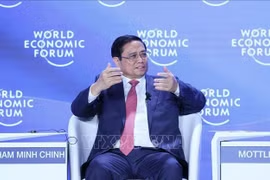
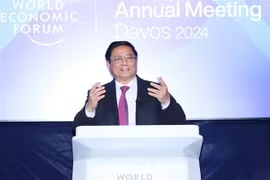
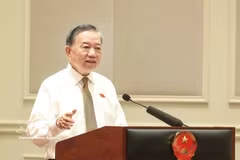
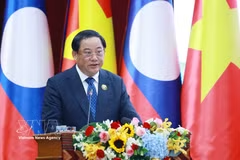
PM Pham Minh Chinh speaks at the policy dialogue (Photo: VNA)
Davos (VNA) – Prime Minister Pham Minh Chinh attended and delivered akeynote speech at the policy dialogue on Vietnam’s global vision during the 54th annual meeting of the World Economic Forum(WEF) in Davos, Switzerland on January 16 (local time).
It was one of the eight policy dialogues featuring heads of Statesand Governments organised by the WEF, reflecting the organisation’s positiveevaluation of Vietnam's international role, position, achievements, vision anddevelopment prospects.
As a highlight of the WEF Davos 2024, the event saw thedistinguished presence of Prof. Klaus Schwab, WEF Founder and ExecutiveChairman, along with 100 leaders and representatives from various countries,international organisations, corporations and businesses that are members ofthe WEF. Renowned international relations commentator Thomas Friedman from TheNew York Times and author of the book "The World is Flat" assumed therole of event coordinator.
Schwab expressed his delight at welcoming PM Chinh for the firsttime to the WEF Davos meeting, hailing Vietnam not only as a star in the EastAsia but also a nation in the process of ascending as an economically influentialplayer on the global stage. He also highly praised Vietnam's role as oneof the trailblazers in the development of a green and smart economy.
Sharing a similar view with Schwab, Friedman described Vietnamas an exemplary model of reform and development, internationally recognised forits rapid and sustainable economic progress. In his coordinating role, heexpressed a keen interest in understanding Vietnam's experiences,development directions and contributions to the global problem-solving process.
In his speech, PM Chinh highlighted Vietnam’s key directions and stance throughout itsnation-building and development process, and great achievements of historicalsignificance during the nearly 40 years of reform.
Drawing on these successes, he outlined five major lessons,including steadfastly pursuing the path of socialism, maintaining a consistentstance on the foreign policy of independence, self-reliance, multilateralismand diversification of external ties, being a trusted friend, reliable partnerand responsible member of the international community; considering the peoplethe architects of history; upholding the strength of great national unity;combining the power of the nation with contemporary forces; and upholdingthe leadership role of the Communist Party of Vietnam (CPV).
Buildingupon these lessons, PM offered two suggestions to other nations. He proposedthat they identify resources starting from mindset, motivation rooted ininnovation, and strength derived from the people. He also underscored the roleof international solidarity and multilateralism in addressing globalchallenges.
The second suggestion was placing people at the centre as themain subject, the most crucial resource, the driving force, and the ultimategoal of development. Accordingly, people should be directly involved in andbenefit from policies.
In response to Friedman's query regarding Vietnam's stance in balancing relations with major powers, Chinh underscored the nation’s status as one of the most adversely affected since the Second World War, enduring persistent impacts from wars, blockades, and sanctions. Nevertheless, Vietnam has put the past aside, overcome differences, promoted similarities, and aimed towards the future to turn adversaries into friends.
He asserted that the recent visits to Vietnam by Chinese Party General Secretary and President Xi Jinping and US President Joe Biden demonstrate unwavering political trust between the nation and its two partners, as well as its foreign policy of independence and self-reliance for peace, cooperation, development, prosperity, multilateralism, and diversification.
Highlighting several priority areas for Vietnam in the near future, including digital transformation, science and technology, artificial intelligence (AI), and green transition, the PM considered these as both objective requirements and strategic choices.
Regarding the semiconductor field, he shared Vietnam's endeavors in developing strategic infrastructure, particularly in information technology, and disclosed plans to train 50,000 - 100,000 engineers in the time to come.
Addressing artificial intelligence (AI), Chinh affirmed Vietnam's proactive approach in leveraging its advantages and mitigating its negative aspects, starting with building a national database, refining investment attraction policies, and boosting the effectiveness of manpower training.
He stressed the Vietnamese Government's commitment to further developing three strategic breakthroughs in institutions, infrastructure, and human resources, creating the most favorable conditions for foreign companies to engage in cooperative endeavors, based on maximising mutual trust, hope, and determination. He said he wishes businesses will integrate production, consumption, research, and training.
The PM said Vietnam stands among the nations most severely impacted by climate change, underscoring its commitment to achieving net-zero emissions by 2050 at the 26th United Nations Climate Change Conference of the Parties (COP26). Vietnam has worked to adapt to landslides, droughts, and natural disasters, implementing an innovative initiative for cultivating one million hectares of high-quality and low-emission rice, which aligns with global sustainability trends and promotes Vietnam's crucial role in ensuring global food security.
His remarks received high praise from delegates participating in the session, whose open and interactive format as well as diverse media coverage effectively disseminated the message of a Vietnam with a new great plan, potential, position, and credibility./.