Top leader urges stronger planning, governance reforms to build modern infrastructure

In his concluding remarks, the leader stressed that infrastructure is no longer merely a foundation for production and daily life, but has become a decisive factor in enhancing national competitiveness.

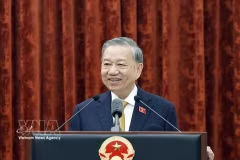
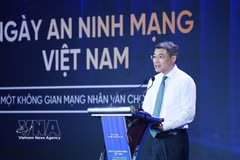
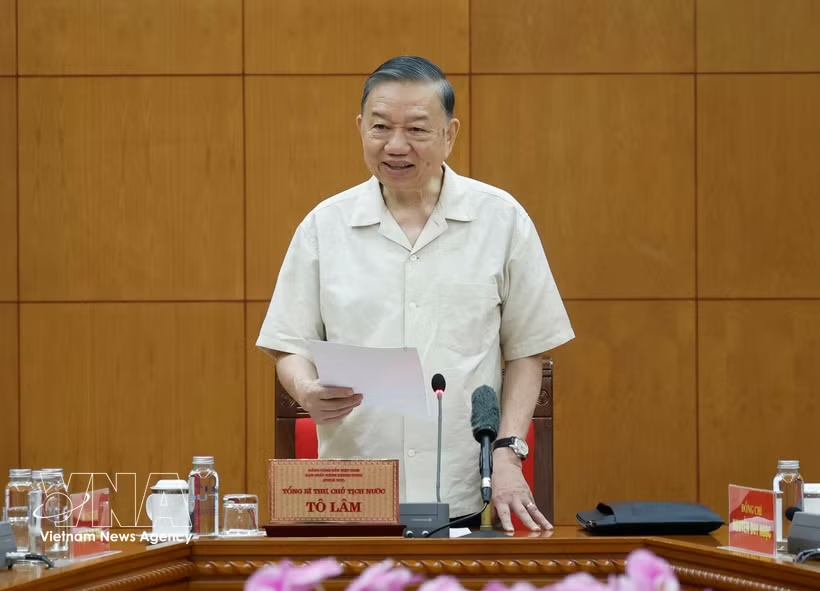
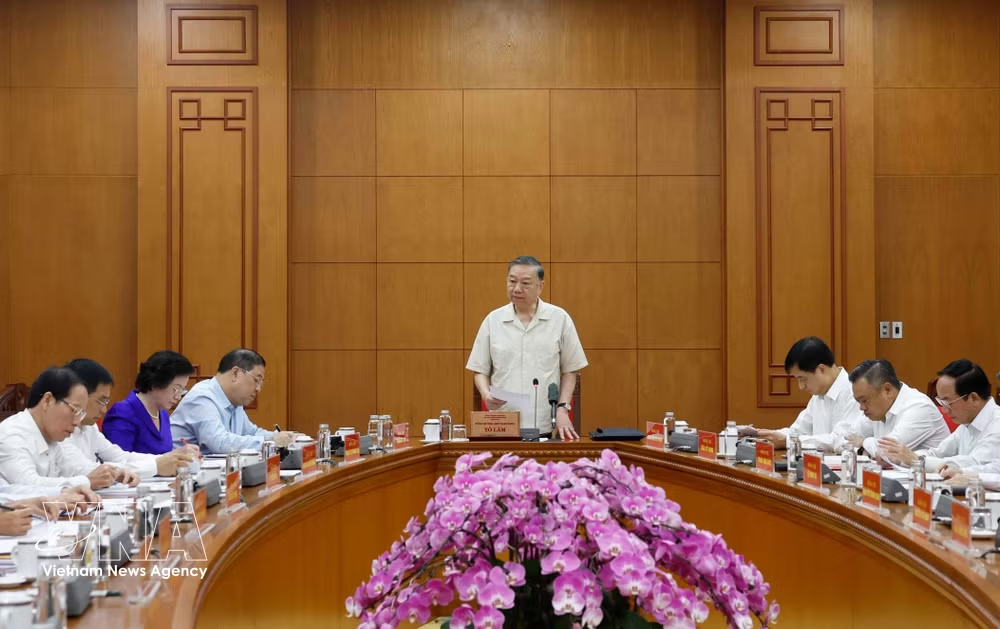
Party General Secretary and State President To Lam speaks at the working session with the Government Party Committee and relevant agencies in Hanoi on August 6. (Photo: VNA)

Hanoi (VNA) – Party General Secretary and State President To Lam on August 6 called for strong reforms of infrastructure planning and development, stressing that infrastructure has become a decisive factor in enhancing national competitiveness and must be planned and managed with a long-term strategic vision.

Chairing a working session with the Government Party Committee and relevant agencies in Hanoi, the top leader reviewed the implementation of Resolution No. 13-NQ/TW, issued by the 11th Party Central Committee in 2012, and Conclusion No. 72-KL/TW of the 13th Politburo on developing a synchronised infrastructure system to help Vietnam become a modern industrialised country.

In his concluding remarks, the leader stressed that infrastructure is no longer merely a foundation for production and daily life, but has become a decisive factor in enhancing national competitiveness. Infrastructure should be assessed by the tangible benefits it delivers to people, businesses, and the economy.

Pointing out shortcomings in infrastructure development, General Secretary and President Lam called for greater synchronisation between planning and investment, with infrastructure projects designed to maximise service quality and economic efficiency while ensuring balanced development of physical, digital and natural infrastructure.

He emphasised that infrastructure should be seen as a key economic sector, capable of fostering a large domestic market for production and innovation, with the State taking the lead in mobilising resources and directing public investment toward essential, inter-regional, and high-impact projects.

Highlighting key tasks for the coming period, he requested the Government Party Committee to prioritise reforming planning and infrastructure development.

He said infrastructure planning must be aligned with the country's long-term development strategy, economic spatial planning, and efforts to enhance national competitiveness. It should take into account technological advances, market trends, demographic changes, and climate change while ensuring stronger links among sectors, regions, and economic zones.

He also called for synchronised development of economic, social and digital infrastructure alongside scientific, technological and innovation infrastructure, while strengthening connectivity between transport, energy, logistics, urban development and other socio-economic infrastructure systems.
vnanet-potal-tong-bi-thu-chu-tich-nuoc-to-lam-chu-tri-lam-viec-voi-dang-uy-chinh-phu-8936699.jpg
Party General Secretary and State President To Lam chairs the working session with the Government Party Committee and relevant agencies in Hanoi on August 6. (Photo: VNA)

Infrastructure planning must improve connectivity between regions, urban and rural areas, and domestic and international markets, while integrating national defence, security, environmental protection, digital transformation, and green transition goals.

He emphasised improving improve regional financial coordination mechanisms so that localities can jointly finance, manage and benefit from inter-regional infrastructure projects.

General Secretary and President Lam also called for a fundamental overhaul of investment management and infrastructure asset governance, with greater accountability for agency heads.

Project preparation and implementation should be improved through lifecycle management, he said, stressing that investment decisions should only be made after land, capital, construction materials, technology, human resources, and connecting infrastructure are fully prepared.

Responsibilities must be clearly defined for projects suffering delays, repeated cost overruns or poor operational performance, he said, calling for the rapid establishment of a unified national database on infrastructure planning, projects and assets, alongside wider application of digital technologies and artificial intelligence in investment, management and operation. Project effectiveness, he stressed, should be measured not only by disbursement rates but also by construction progress, quality, connectivity and operational efficiency.

He also called for prioritising resources for strategic infrastructure systems, including transport and logistics corridors, inland waterways, national and urban railways linked with technology transfer and domestic industrial development, as well as electricity generation, transmission, energy storage, digital infrastructure and national computing capacity.

Attention should also be given to resolving urban infrastructure bottlenecks, strengthening climate resilience, ensuring water security and dam safety, particularly in industrial centres, seaports, coastal cities and the Mekong Delta, he said.

On resources mobilisation, he said public investment should play a leading role by focusing on essential inter-regional infrastructure, nationally important projects, public service facilities, social infrastructure, and national defence and security projects in disadvantaged areas.

He also called for ongoing improvements to the public-private partnership (PPP) framework, encouraging greater private sector involvement through fair risk-sharing, the growth of medium- and long-term capital markets, smarter use of land value gains from infrastructure projects, and diversification of international funding sources.

The leader stressed the need to further decentralise authority in line with resources, implementation capacity, and accountability, allowing localities to take greater responsibility where they have sufficient capability.

At the same time, nationally significant inter-sectoral and inter-regional projects should remain under unified coordination, with clear responsibility assigned to lead agencies, he said, calling for stricter management of national infrastructure assets, stronger anti-corruption and anti-waste measures, and uncompromising adherence to investment discipline.

Looking ahead to 2045, the leader said Vietnam should build a synchronised, smart, green, safe, and climate-resilient infrastructure system capable of seamlessly connecting the country, linking the economy with global markets, and ensuring all people have access to essential services.

He urged the Standing Board of the Government Party Committee, ministries, sectors, and localities to adopt innovative approaches to implementation, use resources effectively, and ensure the quality of every project so that today's infrastructure investments become a lasting foundation for future generations and support Vietnam's sustainable, independent, and prosperous development./.
VNA

See more

Vietnamese Ambassador to Australia Pham Hung Tam (Photo: VNA)

Vietnam-Australia ties poised for new development breakthroughs

After more than half a century of diplomatic relations and comprehensive cooperation, the two countries have increasingly shared strategic interests and have a growing need to strengthen coordination in responding to profound changes in the international environment.

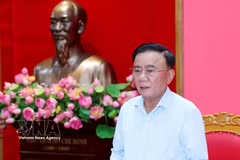
Politburo member, Permanent member of the Communist Party of Vietnam (CPV) Central Committee's Secretariat Tran Cam Tu speaks at the meeting. (Photo: VNA)

Digital management, outcome-based evaluation key to improving Party governance: official

The work management software must enable Party committees and agency heads to quickly identify what tasks are being carried out, who is responsible, deadlines, implementation progress, whether outputs meet required standards, which tasks are behind schedule, the reasons for delays, who should be held accountable, and what decisions leaders need to make to remove bottlenecks, said Politburo member, Permanent member of the Communist Party of Vietnam (CPV) Central Committee's Secretariat Tran Cam Tu.

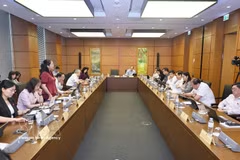
National Assembly deputies from Bac Ninh and Ca Mau provinces hold group discussions on August 6. (Photo: VNA)

NA reviews proposals to establish Quang Ninh, Bac Ninh as centrally-run cities

Minister of Home Affairs Nguyen Tien Hai said Quang Ninh and Bac Ninh have become among Vietnam’s leading economic localities by capitalising on their geographical advantages and development potential, playing an increasingly important role in the Red River Delta, the northern region and the national economy.

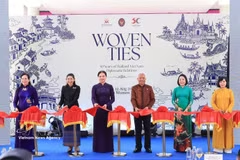
From right: Vietnamese National Assembly Vice Chairwoman Nguyen Thi Thanh (2nd), President of the National Assembly and Speaker of the House of Representatives of Thailand Sophon Zaram (3rd), and other delegates jointly cut the ribbon to officially open the exhibition entitled "Woven Ties – 50 Years of Thailand–Vietnam Diplomatic Relations" at the Vietnamese Women's Museum in Hanoi on August 6, 2026. (Photo: VNA)

Thailand's top legislator attends exhibition marking 50 years of bilateral diplomatic ties

An exhibition entitled "Woven Ties – 50 Years of Thailand–Vietnam Diplomatic Relations" opened in Hanoi on August 6 as part of the official visit to Vietnam by Sophon Zaram, President of the National Assembly and Speaker of the House of Representatives of Thailand. It showcases the rich cultural heritage, unique identity and artistic excellence of Vietnam and Thailand.

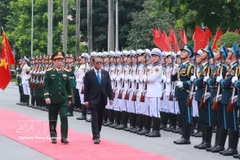
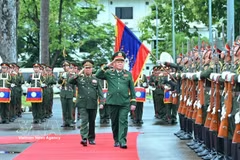
Deputy Prime Minister and Minister of National Defence General Phan Van Giang (L) and Malaysian Minister of Defence Dato’ Seri Mohamed Khaled bin Nordin inspect the guard of honour. (Photo: VNA)

Vietnamese, Malaysian Defence Ministers hold talks in Hanoi, seek to enhance bilateral ties

Deputy Prime Minister and Minister of National Defence General Phan Van Giang noted with satisfaction the strong development of Vietnam-Malaysia relations, highlighted by the historic elevation of bilateral ties to a comprehensive strategic partnership in November 2024. He congratulated Malaysia’s Ministry of Defence on successfully hosting ASEAN military and defence meetings during its 2025 ASEAN Chairmanship, contributing to strengthening ASEAN centrality and promoting the bloc’s goals of peace, cooperation and sustainable development in the region and the world.

Vietnamese Ambassador to Thailand Pham Viet Hung (Photo: VNA)

Vietnam, Thailand well placed to deepen Comprehensive Strategic Partnership: ambassador

Talking to the Vietnam News Agency (VNA)’s correspondents in Thailand on the occasion of the 50th founding anniversary of Vietnam-Thailand diplomatic ties (August 6, 1976–2026), Ambassador Hung said the bilateral relationship has evolved from its early stages into one of ASEAN's most dynamic partnerships, underpinned by sustained political commitment and growing public support.

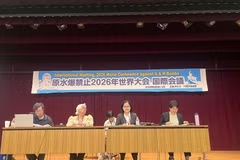
Duong Thi Nga (2nd from right), Deputy Secretary-General of the Vietnam Peace Committee, at 2026 World Conference against Atomic and Hydrogen Bombs, held in Hiroshima, Japan, from August 2–8. (Photo: qdnd.vn)

Vietnam reaffirms commitment to global peace, nuclear disarmament

At the conference's official opening session, Duong Thi Nga, VPC Deputy Secretary-General, presented a message from General Secretary of the Communist Party of Vietnam’s Central Committee and State President To Lam to the organisers. The message was formally read before delegates at the international plenary session, while Japanese and English translations were distributed throughout the conference.

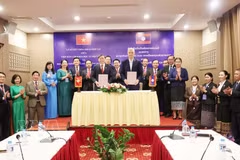
President of the Vietnam Academy of Social Sciences Le Van Loi (L) and President of the Lao National Academy of Politics and Public Administration Anouphap Tounalom exchange the MoU on scientific cooperation for the 2026-2030 period. (Photo: VNA)

Vietnam, Laos step up cooperation in social sciences

Against the backdrop of complex and rapidly evolving regional and international developments, cooperation in social sciences and political theory between the Vietnam Academy of Social Sciences and the Lao National Academy of Politics and Public Administration is expected to provide solid scientific evidence and databases to support the formulation of orientations, policies and strategies for socio-economic development.

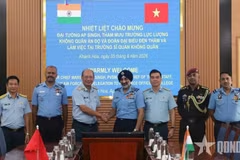
Leaders of the Air Force Officers College poses for a group photo with the Indian Air Force delegation. (Photo: qdnd.vn)

Indian Air Force delegation visits Air Force Officers College

During the meeting, both sides affirmed that training cooperation remains a key pillar of the Vietnam–India defence relationship. The Air Force Officers College introduced its training programmes for military pilots, parachute and search-and-rescue officers, and aviation technical personnel. College leaders also highlighted ongoing efforts to modernise training curricula through the application of simulation technology, digital transformation, and enhanced training quality.

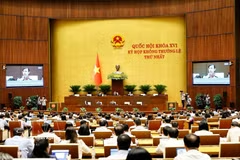
An overview of the 16th National Assembly's first extraordinary session. (Photo: VNA)

National Assembly considers special mechanisms for Ring Road No. 5 project

The draft resolution is designed to provide a legal foundation for implementing the nationally important project, which is expected to play a strategic role in strengthening regional connectivity, easing traffic pressure on downtown Hanoi, expanding space for socio-economic development, and completing the regional expressway network.

General Nguyen Trong Nghia, Politburo member, Secretary of the Communist Party of Vietnam (CPV) Central Committee, Member of the Central Military Commission's Standing Board, and Chairman of the General Department of Politics of the Vietnam People’s Army (VPA) (right) reviews the guard of honour of the Lao People's Army during the official welcome ceremony in Laos. (Photo: VNA)

Vietnam, Laos look to step up comprehensive defence cooperation

Nghia stressed that Vietnam always treasures and continuously promotes its special, loyal and enduring relations with Laos, adding that the recent elevation of bilateral ties to great friendship, special solidarity, comprehensive cooperation and strategic cohesion opened a new chapter in the special Vietnam – Laos relationship.