Vietnam promotes multilingual Internet adoption in APAC

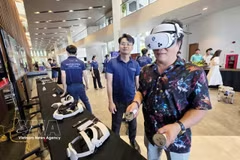
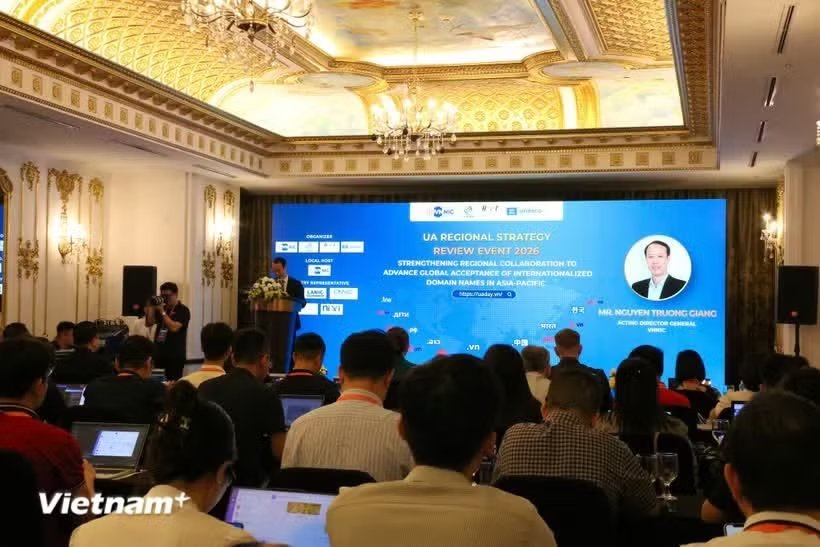
An overview of the event. (Photo: VietnamPlus)

Hanoi (VNA) – The Vietnam Internet Network Information Centre (VNNIC) under the Ministry of Science and Technology hosted UA Day 2026 in Hanoi on April 17 under the theme “Strengthening regional collaboration for universal acceptance implementation in Asia-Pacific.”

UA Day was initiated in 2023 by the Internet Corporation for Assigned Names and Numbers (ICANN) in collaboration with UNESCO to promote Universal Acceptance (UA) of Internationalised Domain Names (IDNs) and multilingual email addresses across Internet systems, software, and digital services.

The initiative was introduced as many technical platforms still do not fully support all valid domain names and email addresses, limiting access to digital services, particularly in countries that use languages and scripts other than the Latin alphabet.

Since 2023, UA Day has been held annually in linguistically diverse regions, including Asia-Pacific, Africa, and Latin America, reflecting growing efforts by countries to address and promote technical issues related to Universal Acceptance.
vnnic13.jpg
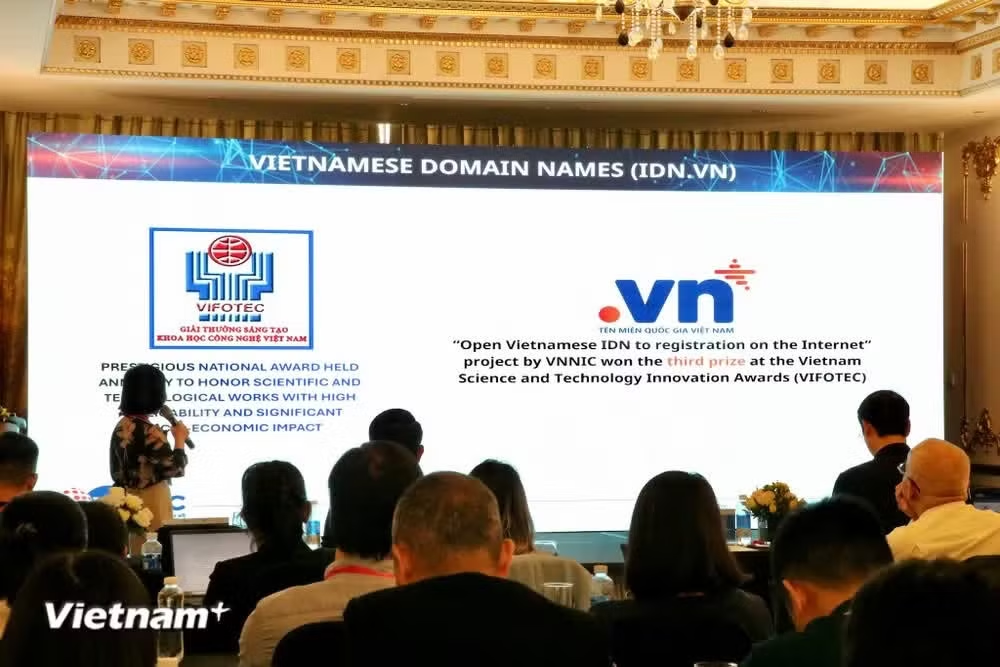
(Photo: VietnamPlus)

In Vietnam, multilingual domain names, including Vietnamese-language domain names with diacritics, were introduced in 2011. The number of registrations peaked at nearly one million in 2014, and the system has since been fully integrated into the national .vn domain name management framework.

However, actual usage remains below its potential. As Vietnam accelerates the development of its digital government, digital economy and digital society, promoting Universal Acceptance has become increasingly important to ensure that individuals and businesses can use Vietnamese-language domain names and email addresses safely and on an equal footing. It is also seen as a way to strengthen digital sovereignty and maximise the value of national Internet resources.

Speaking at the event, Nguyen Truong Giang, Acting Director of VNNIC, said ensuring Universal Acceptance is not merely a technical requirement but a strategic priority with direct implications for digital transformation, innovation and the ability of communities to participate in the global digital economy.

For Vietnam, this is an opportunity to strengthen national capabilities in Internet infrastructure and digital services, promote the adoption of multilingual Internet technologies, and deepen cooperation with regional and international partners. For the region, this conference provides a platform to align priorities, share national experiences and jointly address common challenges in implementing Universal Acceptance, Giang said.
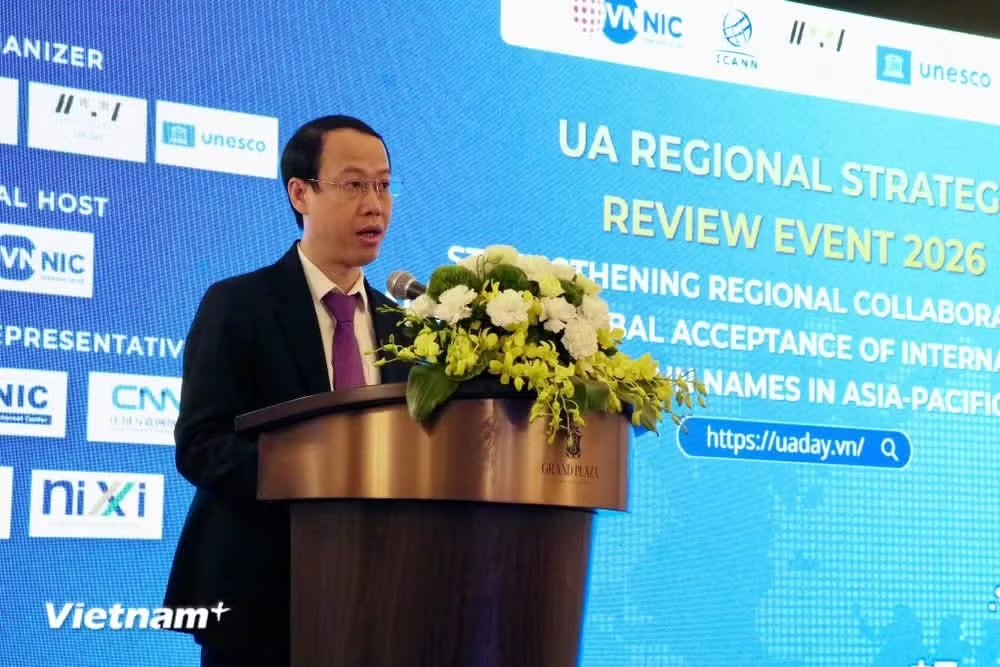
vnnic5.jpg
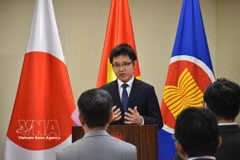
Nguyen Truong Giang, Acting Director of VNNIC, speaks at the event. (Photo: VietnamPlus)

UA Day 2026 aims to advance the global adoption of multilingual domain names while fostering dialogue, knowledge-sharing, and cooperation among regulators, organisations, and businesses. The event also seeks to strengthen Vietnam’s technology community and enhance the country’s role and standing in regional and international cooperation on Internet governance and Internet resource development.

As Vietnam implements Resolution 57 on science, technology, innovation, and digital transformation, the development of the Internet, and Internet domain name resources, it has been described as critical “soft infrastructure” underpinning the country’s digital transformation journey.

Efforts to promote Universal Acceptance and expand the use of multilingual domain names, particularly Vietnamese-language domain names, are expected to improve access to digital services and help narrow the digital divide among different population groups.

With Internet infrastructure becoming more inclusive, secure, and multilingual, the goals set out in Resolution 57 will strengthen Vietnam’s digital sovereignty and enhance its competitiveness on the global digital landscape./.


VNA

See more

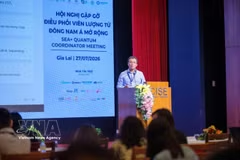
A speaker addresses the SEA+ Quantum Coordinator Meeting held in Gia Lai province on July 27. (Photo: VNA)

Regional conference strengthens Southeast Asia’s quantum technology ecosystem

Stronger networks linking government agencies, research institutes, universities, businesses and scientific organisations will provide a solid foundation for faster and more effective development of quantum technology, contributing to the sustainable development of each country and the region as a whole, said a Gia Lai official.

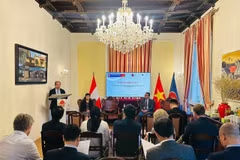
VAST Vice President Prof. Dr. Tran Tuan Anh speaks at an event in Vienna. (Photo published by VNA)

VAST expands global partnerships through science and people-to-people diplomacy

During a working visit to Austria from July 19-23, a VAST delegation led by Vice President Prof. Dr. Tran Tuan Anh held a series of meetings with leading research institutions and international organisations, including the International Institute for Applied Systems Analysis (IIASA), the Austrian Academy of Sciences, the Vienna University of Technology (TU Wien), and the International Atomic Energy Agency.

The Quantum Hackathon for Social Good 2026 (QC4SG 2026) kicks off in Quy Nhon, Gia Lai province, on July 24. (Photo: VNA)

Int’l quantum computing hackathon kicks off in Gia Lai

As a key activity within the technology component of the Gia Lai Quantum Year 2026, the event brings together nearly 100 contestants across 26 teams, including students, PhD candidates, young researchers, startups, and tech talents, alongside 50 domestic and international experts, mentors, and judges.

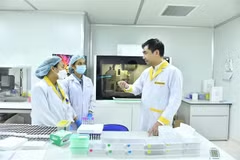
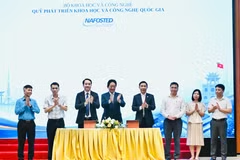
The National Foundation for Science and Technology Development under the Ministry of Science and Technology signs funding agreements for five Vietnam-Japan joint research projects in semiconductors for 2026 at a ceremony on July 22 (Photo: https://baochinhphu.vn/)

Vietnam, Japan launch five joint semiconductor research projects

The signing and implementation of the five projects mark a concrete step toward realising the Party and State’s policies on science – technology development, innovation and digital transformation, with the semiconductor industry identified as one of strategic technologies fundamental to national competitiveness and technological autonomy.

Speakers at the workshop held in Ho Chi Minh City on July 22 (Photo: VNA)

Vietnam urged to develop sovereign AI in digital era

Data has become a strategic asset and a key resource for socio-economic development, as well as a foundation of national competitiveness. As a result, effective data governance, utilisation and protection have become increasingly urgent for organisations and businesses.

(Illustrative photo; VietnamPlus)

Expert calls for secure national digital archives system

Building a national electronic archives system is not merely a matter of investing in technological infrastructure. It must be designed in an integrated manner from the outset, encompassing system architecture, governance procedures, and data protection mechanisms, to ensure long-term security, integrity, and data sovereignty.

Dr. Vo Duc Thang, Assistant Professor at the National Taiwan University of Science and Technology and President of the Vietnam Innovative and Intellectual Network in Taiwan (China), speaks at a seminar on the semiconductor industry. (Photo: VNA)

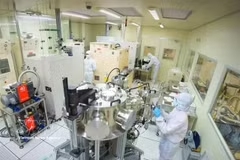
Vietnam can deepen role in global semiconductor supply chain: Taiwan-based expert

Vietnam’s biggest takeaway from Taiwan isn’t just cutting-edge technology alone, but how to build an entire semiconductor ecosystem from the ground up, said Dr. Vo Duc Thang, Assistant Professor at the National Taiwan University of Science and Technology (Taiwan Tech) and President of the Vietnam Innovative and Intellectual Network in Taiwan (China) (VIN Taiwan) told the Vietnam News Agency.

The need to develop human resources for the atomic energy and nuclear power sectors is becoming increasingly urgent. (Illustrative photo from the Vietnam Government Portal)

Vietnam needs tens of thousands of nuclear power workers by 2035

According to the Agency for Radiation and Nuclear Safety under the Ministry of Science and Technology, human resources will be among the decisive factors determining whether the country can successfully implement its nuclear power programme on schedule.

Technologies for developing digital government infrastructure and cashless payment solutions are showcased at an exhibition. (Photo: VNA)

Vietnam approves national digital transformation strategy for 2026 - 2030

Vietnam aims to become a developed digital nation where digital transformation is implemented comprehensively across all sectors and serves as the country's principal development model. The strategy envisions a modern system of national governance powered by data and AI, strong domestic capabilities in strategic digital technologies, platforms and products, and firm protection of national digital sovereignty.

Vice Chairman of the Gia Lai provincial People’s Committee Lam Hai Giang speaks at the event. (Photo: VNA)

Int’l scientists gather at 2nd advanced school on topological quantum matters in Gia Lai

Jointly organised by the Rencontres du Vietnam (Meeting Vietnam) association and the International Centre for Interdisciplinary Science and Education (ICISE), the five-day event features lectures by leading professors and scientists in quantum physics and materials science, providing participants with a solid theoretical foundation. They are also updated on the latest research advances in quantum topological materials.