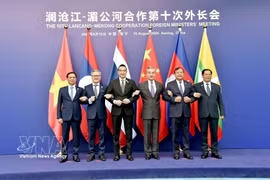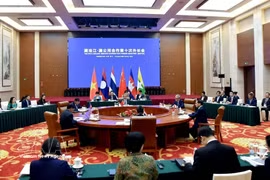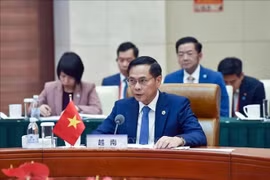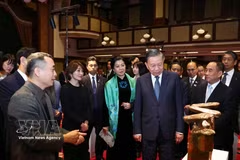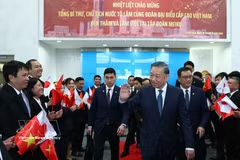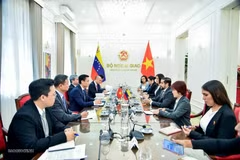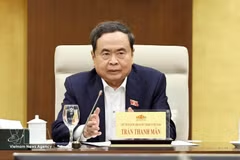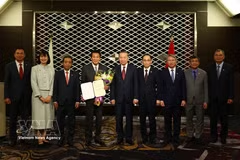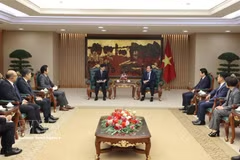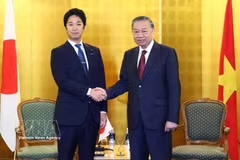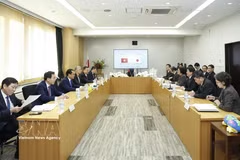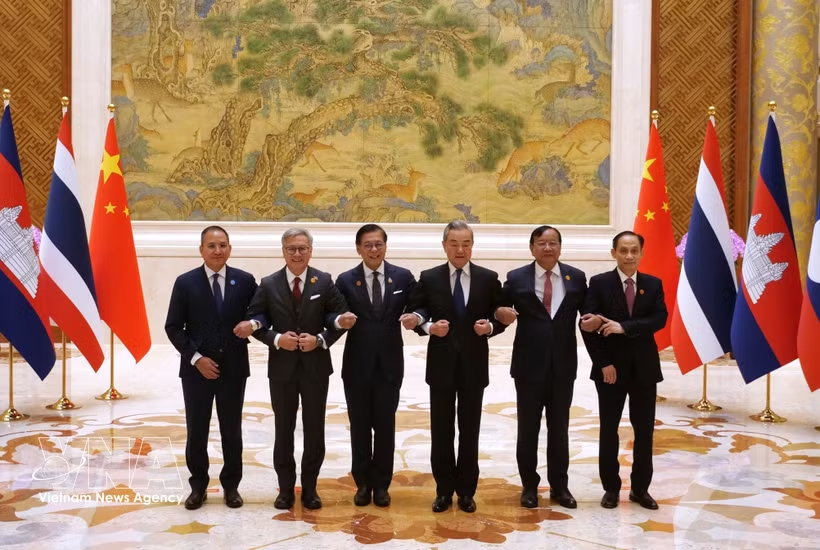
Beijing (VNA) – Minister of Foreign Affairs Le Hoai Trung has proposed building a resilient and innovative Mekong–Lancang region while strengthening regional connectivity and cooperation in addressing non-traditional security challenges at the 11th Lancang–Mekong Cooperation Foreign Ministers’ Meeting in Beijing on November 4.
The event saw the presence of officials from host China, Cambodia, Laos, Myanmar, Thailand, and Vietnam.
In his remarks, Trung noted that despite numerous challenges facing the world and the region, the Mekong–Lancang region is presented with many development opportunities. He said rapid advances in science – technology, innovation, digital transformation, green transition and the restructuring of regional and global supply chains are opening up a new development space, enabling countries to enhance their adaptability, leverage complementary strengths and strengthen connectivity and integration.
He acknowledged the positive outcomes of the implementation of the Mekong–Lancang Cooperation (MLC) Action Plan for 2023–2027, stressing the need to translate cooperation potential, advantages and achievements into practical, far-reaching development drivers that deliver tangible benefits to member countries.
He suggested a resilient and innovative Mekong–Lancang region be built, regional connectivity strengthened, coordination between the MLC and other regional and Mekong cooperation mechanisms boosted, cooperation in addressing non-traditional security challenges fostered, and people placed at the centre of the MLC.
At the meeting, the ministers welcomed progress in the MLC cooperation since the 10th meeting in August 2025, particularly the implementation of the MLC Action Plan for 2023–2027, reflected in trade growth and specific projects financed by the MLC Special Fund.
They also noted advances in hydrological information sharing, flood and drought response, environmental protection, law enforcement, transnational crime combat, culture, education and people-to-people exchanges. They agreed on some future cooperation priorities to ensure security, boost economic development and improve the life quality for regional residents.
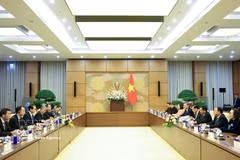
The same day, Trung held talks with Wang Yi, Politburo member, Director of the Office of the Commission for Foreign Affairs of the Communist Party of China (CPC) Central Committee and Minister of Foreign Affairs of China.
The two sides welcomed the positive, comprehensive and substantive progress in relations between the two Parties and countries, particularly high-level exchanges, noting that their top leaders have made three reciprocal visits over the past two years, most recently General Secretary of the Communist Party of Vietnam (CPV) Central Committee and President To Lam’s state visit to China in April 2026.
The two sides agreed to effectively implement the top leaders' agreements and common perceptions in line with the "six major orientations” and work together to prepare for high-level exchanges, including the 2026 APEC Economic Leaders’ Meeting in China and the APEC Year 2027 in Vietnam.
Trung congratulated China on the successful organisation of the fifth plenary session of the 20th CPC Central Committee, and briefed Wang on Vietnam’s major development policies and socio-economic achievements.
He proposed the two sides continue to promote substantive cooperation and strategic connectivity in the coming time, particularly speeding up the implementation of three railway cooperation projects, developing smart border gates, expanding the import of Vietnamese agricultural and aquatic products, and promoting balanced and sustainable trade.
The Vietnamese minister also called for stronger cooperation in energy, education, high-quality human resources training and people-to-people exchanges, as well as the effective implementation of the Vietnam–China Tourism Cooperation Year 2026–2027.
Wang, for his part, congratulated Vietnam on the successful fourth plenum of the 14th CPV Central Committee and reaffirmed China’s support for Vietnam in achieving development goals in the new era.
He stated that China stands ready to work with Vietnam to increase strategic exchanges, enhance cooperation effectiveness and reinforce people-to-people links.
The two sides agreed to properly manage their land border, build border areas of peace, cooperation and development, manage differences and peacefully settle sea-related issues in accordance with international law, particularly the 1982 United Nations Convention on the Law of the Sea (UNCLOS), thereby making responsible contributions to peace, cooperation and development in the region and the world.
During his stay, Trung also met with Lao Deputy Prime Minister and Foreign Minister Thongsavanh Phomvihane and Cambodian Deputy Prime Minister and Foreign Minister Prak Sokhonn./.