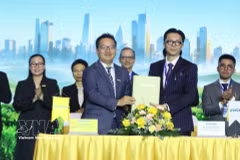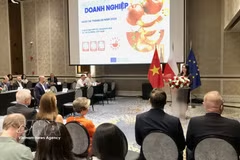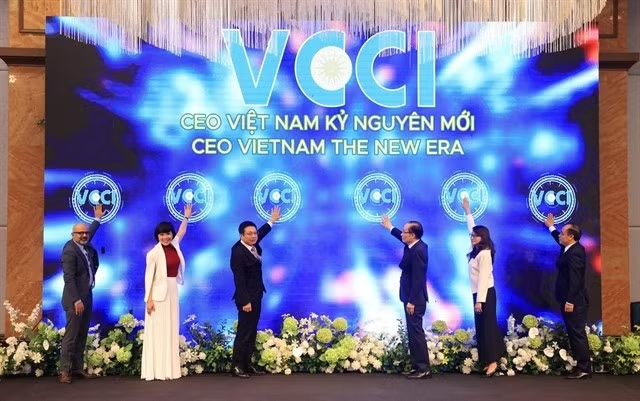
Hanoi (VNS/VNA) - The Vietnam Chamber of Commerce and Industry (VCCI) on July 25 launched a Vietnam business leadership development programme 2026-2030 (CEO Vietnam The New Era), to build a new generation of internationally competitive chief executive officers (CEOs) in Vietnam.
This programme is designed to equip business leaders with internationally recognised management skills and prepare them for digital transformation, green transition and deeper integration into global value chains.
The initiative comes as Vietnam pursues faster, higher-quality economic growth and steps up efforts to develop high-quality business leadership in line with government priorities to expand the role of the private sector under the Politburo’s Resolution 68, and enhance innovation under the Politburo’s Resolution 57.
Speaking at the launch ceremony, attended by Politburo member and Minister of Foreign Affairs Le Hoai Trung, VCCI Chairman Ho Sy Hung said Vietnamese businesses would need leaders with long-term vision, modern management capabilities and the ability to adapt to rapid technological and geopolitical change.
The programme is one of the organisation's flagship initiatives, closely aligned with VCCI's mission, the Party and State's development agenda, and the needs of Vietnam's more than one million active enterprises.
VCCI said it would mobilise support from its nationwide network, business associations, training partners, experts, international organisations, and the broader business community to implement the programme.
The chamber also called on entrepreneurs to participate not only as learners but also as mentors and contributors who can share experience and foster a culture of lifelong learning and innovation.
Representing the Ministry of Finance, Bui Anh Tuan, Director of the Department for the Development of Private Enterprises, described the programme as a practical step toward implementing the Politburo’s Resolution 68-NQ/TW and the Prime Minister's Decision 525/QD-TTg.
Tuan noted that amid intensifying global competition, corporate governance and leadership quality had become decisive factors in business competitiveness.
Developing CEOs with modern management thinking, international capabilities, and strong business ethics would be necessary.
According to Prof. Dr. Nguyen Thi Thanh Mai, President of Vietnam National University–Ho Chi Minh City (VNU-HCM), the programme aims to cultivate a new generation of CEOs with strategic vision, innovative thinking, and social responsibility. It also seeks to strengthen the cooperation among government, universities, and businesses in education, research, and knowledge transfer.
The curriculum has been designed for a wide range of participants, from leaders of large corporations to executives of small and medium-sized enterprises, family businesses, and startups, with the goal of building a nationally connected network of Vietnamese CEOs capable of competing at both regional and international levels.
VNU-HCM expects the programme to make a meaningful contribution to developing business leaders who possess strategic thinking, innovation capabilities, and a strong sense of social responsibility, supporting Vietnam's ambitions for rapid and sustainable development.
The university partnered with A11 Management Consulting Vietnam Co, Ltd, INSEAD Business School, and other partners to develop the curriculum. Faculty members from VNU-HCM will work alongside INSEAD experts to deliver executive education programmes both in Vietnam and internationally.
Speaking at the launch, A11 Chief Executive Officer Vo Thi Minh An said: "Through the programme, we aim to transform global best practices into 'glocal' value – combining world-class knowledge with a deep understanding of Vietnam's business environment – to support a new generation of leaders shaping the future. We firmly believe the programme will create lasting value for Vietnam's future business leaders."
Professor Sameer Hasija, Dean of Executive Education and Dean of the Asia Campus at INSEAD, said that as Vietnam continues its remarkable economic development, cultivating future-ready business leaders would be critical to sustaining growth and driving innovation.
"INSEAD is honoured to partner with VCCI, A11, and VNU-HCM to equip Vietnamese executives with world-class management expertise, a global mindset, and the confidence to build competitive, resilient, and sustainable organisations in an increasingly interconnected and rapidly evolving world," Hasija said.
The programme will offer executive education for leaders of large corporations, family businesses, small and medium-sized enterprises and startups, covering subjects including strategic leadership, corporate governance, digital transformation, finance, sustainability, ESG and international business development.
In addition to executive training, the initiative aims to establish a network linking business leaders, academics, international experts and policymakers to promote knowledge sharing, collaboration and innovation, supporting the long-term development and global competitiveness of Vietnam's business community./.
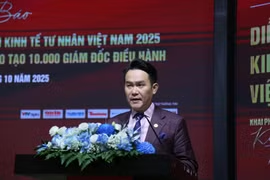
Vietnam to train 10,000 CEOs to strengthen private sector development
The VPSF 2025 summary report highlights critical issues related to institutions, innovation, international integration, and corporate governance, while also putting forward several breakthrough proposals, notably, the training programme for 10,000 CEOs to help build a new generation of Vietnamese business leaders with vision, integrity, and capability for sustainable growth.