Vietnam’s 2024 milestones pave the way for future growth

Vietnam is recognised as one of the world’s bright spots in seizing opportunities from newly formed supply chains, thereby generating new growth momentum for its economy.

xuat-khau.jpg
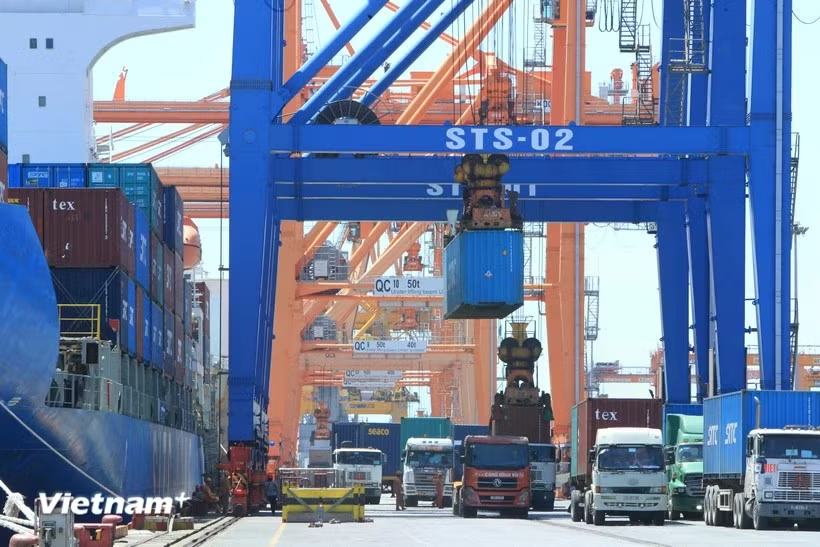
Import and export of Vietnamese goods at Hai Phong port. (Photo: VietnamPlus)

Hanoi (VNA) - Vietnam is recognised as one of the world’s bright spots in seizing opportunities from newly formed supply chains, thereby generating new growth momentum for its economy.

Exports and imports were one of the highlights of the economy in 2024, hitting nearly 800 billion USD.

A key contributor to this achievement is Vietnam’s proactive international economic integration, market expansion, and efforts to connect local businesses with global partners.

One of the most significant milestones was the signing of the Vietnam-UAE Comprehensive Economic Partnership Agreement (CEPA) within a record-breaking negotiation period of just 16 months.

This agreement has opened up major potential markets in the Middle East and Africa while advancing Vietnam’s global trade integration.

Luong Hoang Thai, Director General of the Multilateral Trade Policy Department under the Ministry of Industry and Trade, highlighted Vietnam’s 2024 integration achievements.

Specifically, Vietnam has put the Vietnam-Israel free trade agreement into effect as well as signed the Vietnam-UAE free trade agreement. These deals are in the region where Vietnam previously had no free trade relations.

In addition to exploring new opportunities, an equally crucial task for Vietnam is to continue maintaining and effectively leveraging its traditional markets, which currently account for 80% of the country’s exports.

luong-hoang-thai.jpg
Luong Hoang Thai, Director General of the Multilateral Trade Policy Department under the Ministry of Industry and Trade (Photo: VNA)

For example, the G7 countries have invited Minister of Industry and Trade Nguyen Hong Dien to present to the World Trade Organisation (WTO) on how economies can capitalize on the recent trend of supply chain transformation, with Vietnam being recognised by the WTO as a standout example.

Similarly, Vietnam’s relationship with the US has been strengthened through the Indo-Pacific Economic Framework (IPEF). Alongside key partners like China and ASEAN, Vietnam continues to deepen ties and stabilise these markets.

In 2024, Vietnam signed two new free trade agreements (FTAs) in the Middle East. The first one is with the UAE, which serves as a central hub in the region and has significant potential in capital and logistics services. The UAE also acts as a major transshipment port, not only for the Middle East but also for North Africa, India, and beyond.

“This makes the UAE a strategic gateway that Vietnam is determined to unlock potential to maximize the connectivity opportunities between the two economies,” Thai said.

The second one is with Israel, which was implemented after a long period of negotiations and preparations.

Israel is considered one of the world’s success stories in terms of startups and innovation, offering a wealth of technological expertise that Vietnam can learn from, Thai said.

“Although the UAE is a relatively small export market, it is also a very good market if we can link to this economy.”

ky-ket.jpg
The signining of a Memorandum of Understanding between Vietnamese and Israeli businesses at the “Vietnam-Israel Economic and Business Forum” held in August 2023 in Hanoi. (Photo: Vietnamplus)

Looking ahead to economic and trade integration in 2025, Vietnam is expected to be among the biggest beneficiaries of global integration trends, according to Thai.

The significant shift of the global supply chains in recent years presents an opportunity for Vietnam. “By leveraging trends such as digital transformation and green transition, the country can accelerate its progress to a higher level,” Thai said./.
See more

A view of Vinh Loc 2 Industrial Park in My Yen commune, Tay Ninh province (Photo: VNA)

FDI surge fuels new real estate demand

According to Savills experts, FDI continues to flow into manufacturing, logistics, technology and digital infrastructure, changing property requirements for investors.

Lien Chieu Port is under construction in central Da Nang city. (Photo: VNA)

Energy infrastructure underpins marine economy development

The integrated investment in energy infrastructure will provide a vital infrastructure foundation for effectively harnessing the marine potential, helping realise the goal of making Vietnam a strong maritime nation and achieving sustainable and prosperous development from the sea./.

The Australia-Vietnam Policy Institute Forum in Ho Chi Minh City on August 25, 2026 discusses how Australian expertise, partnerships and capital can support Vietnam's growth, and how to build stronger connections between the two countries' business communities. (Photo: VNA)

Vietnam, Australia seek new space for economic cooperation

The Australia–Vietnam Policy Institute Forum was held in Ho Chi Minh City on August 25, bringing together policymakers, businesses, and organisations for discussing how the business communities of Australia and Vietnam can build stronger connections.

Officers from Thanh Hai Border Guard Station (Phu Thuy ward, Lam Dong province) patrol and monitor fishing vessels entering and leaving the port. (Photo: VNA)

Lam Dong province deploys 10 key measures to combat IUU fishing

The measures target key gaps, including ineligible fishing vessels, port controls, electronic fishing-trip data, seafood traceability and vessel monitoring system (VMS) violations. Authorities will also act against vessels detained by foreign authorities, submit weekly progress reports and draw up specific action plans.

Speakers at the seminar (Photo: VNA)

Legal transparency key to making VIFC more attractive: experts

Dominic Scriven, Chairman and Founder of Dragon Capital, said legal clarity, consistency and predictability are essential to strengthening investor confidence, enabling long-term business planning and encouraging firm capital commitments to Vietnam.

Illustrative photo (Photo: VNA)

Vietnam promotes cooperation to remove barriers to rice trade with Philippines

Vietnam proposed studying a higher-level cooperation framework on rice trade to provide a more stable and long-term foundation for Vietnam-Philippine rice trade while balancing the interests of farmers, businesses and consumers, and providing sustainable livelihoods for rice growers and stable living conditions for Philippine consumers.

An overview of the 11th APEC Food Security Ministerial Meeting in Hangzhou on August 25. (Photo: VNA)

Vietnam proposes four strategic cooperation directions at APEC Food Security Ministerial Meeting

Vietnam’s proposals at the 11th APEC Food Security Ministerial Meeting, which took place in Hangzhou, China received broad support and consensus from participating economies. Several members expressed their desire to work with Vietnam to further build consensus, with a view to ensuring that the APEC Food Security Ministerial Meeting in Vietnam in 2027 will produce a shared vision and a substantive action programme.

Vietnam Post accelerates the adoption of modern technology, elevates logistics capabilities, and boosts the digital economy. (Photo: VNA)

Breakthrough opportunities for businesses in digital economy

Only when businesses view digital transformation as a fundamental change in their business models, while the State provides an enabling framework, data infrastructure and sufficiently broad markets for innovation, can the digital economy become a substantive growth driver.

A lecturer guides students on how to diagnose diseases in aquatic animals. (Photo: VNA)

Vietnam leans on digital workforce to unlock productivity boom

Vietnam needs a cohesive national strategy linking the State, enterprises, and training establishments. The strategy must prioritise standardising training to international norms and investing in technological infrastructure to boost national productivity.

A factory in Bac Ninh province (Photo: VNA)

Vietnam directs more credit to SMEs

With deposit rates still relatively high, banks’ room to cut lending rates sharply is limited. Lenders must stay efficient and cannot fund at high cost while lending at very low rates.