World Water Day frames equality, with Meteorological Day on horizon

This year, the United Nations has launched World Water Day under the theme “Water and Gender,” underscoring the tight nexus among water, sanitation, and gender equality in advancing sustainable development and human rights.

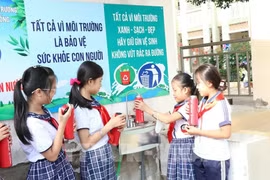
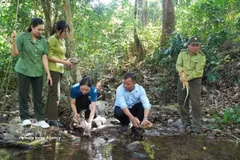
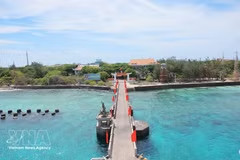
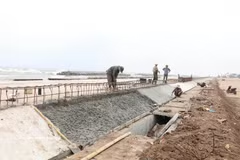
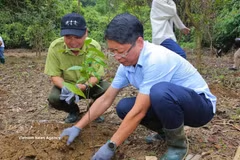
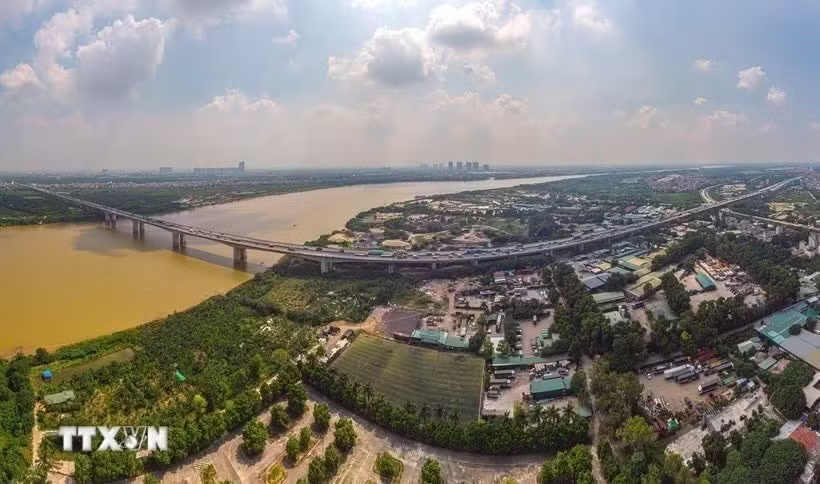
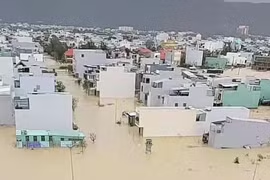
Illustrative image (Photo: VNA)

Hanoi (VNA) – World Water Day (March 22) and World Meteorological Day (March 23) 2026 are putting a spotlight on access to clean water and expanded hydrometeorological data as twin pillars of citizen protection and sustainable development.

Minister of Agriculture and Environment Tran Duc Thang has signed a dispatch directing ministries, agencies, local authorities, embassies, and international organisations in Vietnam to prepare accordingly for the coming events.

This year, the United Nations has launched World Water Day under the theme “Water and Gender,” underscoring the tight nexus among water, sanitation, and gender equality in advancing sustainable development and human rights.

The theme frames access to clean water and sanitation as a fundamental human right and a foundation to close the gender gap. It puts women and girls at the centre of water solutions, champions a rights-based approach, and calls for amplifying women’s voices, leadership, and participation in water governance.

Meanwhile, World Meteorological Day 2026, themed “Observing Today, Protecting Tomorrow,” highlights the critical role of meteorological, hydrological, and environmental observation data in protecting lives, property, and ecosystems from mounting climate risks.

With climate change growing more complex, the Ministry of Agriculture and Environment said the message is designed to tighten the link between science and on-the-ground action, especially among youth, with no one left behind in the global early warning system.

Given this importance, ministries, agencies, and localities are encouraged to display communication materials made from eco-friendly materials in public areas.

They are also urged to accelerate the uptake of information technology and artificial intelligence to harness high-reliability forecasting and early warning data, adapt to climate change, and cut disaster risk, thereby feeding into socio-economic development and national security.

Efforts should also focus on national water security, including upgrading strategies and master plans for water management and use in line with climate change and global integration, and speeding up a unified water resources database. The goal is to balance disaster prevention, water supply for daily life and production, and environmental protection.

The ministry has also planned a modernisation project for the hydrometeorological sector, alongside the national hydrometeorological station network plan for 2021–2030. This includes sharpening rain, flood, and storm forecasts, issuing timely extreme-weather warnings, and embedding AI in early-warning systems.

Authorities were also encouraged to recognise and reward organisations and individuals that excel in adopting innovative, tech-based solutions for efficient natural resource management, environmental protection, and climate adaptation.

Implementation reports are to be submitted to the ministry via the Agriculture and Environment newspaper by April 30, 2026.

A suite of communication messages has been proposed for World Water Day 2026, spotlighting the tight connection between water access and equality. Key messages include “where there is water, there is equality,” “water is life, equality is the future,” ”Gender equality: The key to water security,” “Safe drinking water is the foundation for promoting gender equality,” “Water, Women, and Equality – The basis for sustainable development,” “Clean water for everyone – Equality for all genders,” “Water is an asset – Equality is a right.”

For World Meteorological Day 2026, messaging will centre on the importance of strengthening hydrometeorological observation systems to underpin a sustainable future: The aim is to build monitoring systems that deliver safer, more resilient, and sustainable future for all./.
VNA

See more

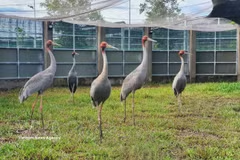
Sarus cranes cranes are being cared for at Nakhon Ratchasima Zoo in Nakhon Ratchasima province, Thailand. (Photo: VNA)

Six sarus cranes from Thailand arrive in Dong Thap

Of the six cranes, two are males and four females, with individual weights ranging from 5.3kg to 6.7kg. The birds were raised at Nakhon Ratchasima Zoo in Thailand and transported to Vietnam by air.

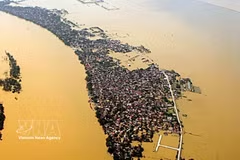
An area in Ha Tinh province under water following Storm Megi in October 2010 (Photo: VNA)

Conference delivers hydro-meteorological outlook for 2026

Deputy Minister of Agriculture and Environment Le Cong Thanh, in his speech, said climate change is making weather more severe and unpredictable, with a powerful El Nino set to hit Vietnam in the second half of 2026 and early 2027. Against such backdrop, enhancing forecasting and early warning capacity, while effectively translating scientific information into management decisions and timely response actions, has become urgent, he said.

Truong Sa Lon (Big Spratly) of Vietnam (Photo: VNA)

Blue sea, strong economy: Vietnam’s vision for sustainable development

The robust growth of the marine economy has created significant opportunities for Vietnam while at the same time posing major challenges to marine environment protection. From coastal aquaculture areas and renowned tourist bays to marine protected areas rich in biodiversity, traces of plastic waste, land-based pollution and unsustainable exploitation remain visible every day.

Sea dike protection works to deal with the risk of erosion and rising sea levels in Hai Thinh commune, Ninh Binh province. (Photo: VNA)

Law amendments needed to strengthen disaster prevention and response: official

According to the Department of Dyke Management and Natural Disaster Prevention and Control under the Ministry of Agriculture and Environment, natural disasters during the 2020–2025 period caused increasingly serious damage nationwide. On average, natural disasters claimed more than 300 lives each year and caused economic losses exceeding 45 trillion VND (1.7 billion USD), up about 167% compared to the 2015–2019 period.

Deputy Prime Minister Ho Quoc Dung chairs a meeting in Hanoi on June 17, 2026 to discuss the draft law amending and supplementing a number of articles of the Law on Environmental Protection. (Photo: baochinhphu.vn)

Deputy PM identifies three major environmental issues requiring special attention

The pressing concerns comprise persistent environmental hotspots in industrial parks and industrial clusters; increasingly complex air and water pollution in major cities directly affecting public health; and shortcomings in waste management and wastewater treatment across river basins and rural areas that have yet to meet practical requirements.

Illustrative photo (Photo: VNA)

Vietnam accelerates adoption of sustainable aviation fuel

In Vietnam, airlines, fuel suppliers and energy companies have begun collaborating to deploy SAF on commercial flights, demonstrating that key links in the fuel value chain—from production and supply to operation—are gradually taking shape.

Vietnam's 12 world biosphere reserves underscore commitment to environmental protection and sustainable development (Photo: VNA)

Vietnam's 12 world biosphere reserves showcase commitment to environmental protection, sustainable development

On June 5, 2026, the 38th session of the International Coordinating Council of UNESCO's Man and the Biosphere Programme (MAB-ICC 38) officially designated Vietnam's Phong Nha–Ke Bang National Park as a member of the World Network of Biosphere Reserves (WNBR). The recognition marks another milestone in the country's conservation efforts, bringing its total number of UNESCO-designated World Biosphere Reserves to 12.

The rare spot-billed pelicans reappear at Tram Chim National Park in Dong Thap province after a six-year absence. (Photo: VNA)

Wildlife protection drive delivers encouraging conservation gains

Implemented under Plan 628, a joint initiative between the Ministry of Public Security and the Ministry of Agriculture and Environment, the campaign marks a shift towards a more coordinated and long-term approach to protecting wildlife and natural resources.

Recognising the maritime economy as one of its strategic pillars, Da Nang city aims to develop into a world-class coastal megacity (Photo: VNA)

Strong maritime nation takes shape through blue future

The vision of a strong maritime nation will be reflected in green ports, offshore wind farms, thriving coastal communities, restored mangrove forests, sustainable coastal cities, resilient island outposts and generations of Vietnamese equipped with ocean knowledge and a deep sense of responsibility for the nation’s maritime future.