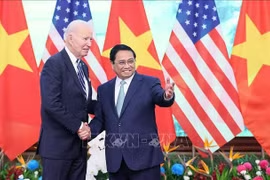
Deputy Minister of Foreign Affairs Ha Kim Ngoc (Photo: VNA)
Question: Could you please evaluate the results of US President Joe Biden's visit to Vietnam?
Answer: The visit took place as planned and was a great success. Initially, President Joe Biden invited Party General Secretary Nguyen Phu Trong to visit the US. However, due to unfavourable conditions, the Party General Secretary could not make that visit and sent a letter inviting President Biden to visit Vietnam. To carry out President Biden’s visit to Vietnam, the US side made unprecedented efforts, adjusting the foreign affairs programmes of both the President and Vice President. The US President sent the Vice President to attend the East Asia Summit in Indonesia on his behalf and he had to shorten the duration of his attendance at the G20 meeting in India to make the trip to Vietnam.
The two sides issued a joint statement upgrading the relationship to a comprehensive strategic partnership and setting out major directions for cooperation in the next ten years and beyond. This is a very important document with ten pillars, covering all areas of cooperation in the two countries' relations. This shows that cooperation between the two countries has not only expanded but also deepened and become more substantive; not only on bilateral cooperation but also on regional and global issues.
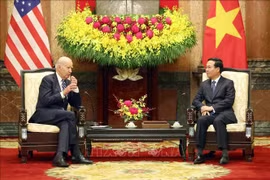
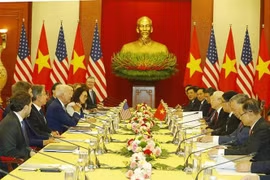
 The talks between Party General Secretary Nguyen Phu Trong and US President Joe Biden (Photo: VNA)
Although his Vietnam visit was short and he had to return home within September 11 for the US anniversary commemoration, Biden held talks and meetings with all the four key leaders of Vietnam.
This was also the first time a US President had visited the National Assembly building to meet the Vietnamese top legislator, and witnessed the handover of war mementos of the two countries’ war veterans. This action demonstrates the respect for Vietnam's political institutions and its leadership, not only in words included in the joint statement but also in practice.
At the same time, it provided an excellent opportunity for President Biden to build and strengthen relations with Vietnam's top leaders.
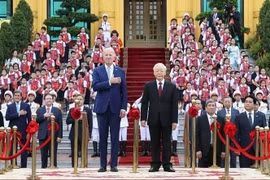
The protocol work, logistics, and security were also successful, with a state-level welcome ceremony hosted by Party General Secretary Nguyen Phu Trong at the Presidential Palace, which took place in Hanoi's gentle autumn sunshine and beautiful scenery.
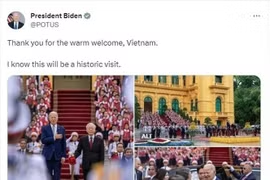
We also ensured absolute security and safety for the delegation. President Biden and the US delegation were deeply impressed, very satisfied, and repeatedly expressed their thanks to the Party General Secretary and other leaders, and people of Vietnam for their warm and hospitable reception.
Question: The establishment of the Vietnam-US Comprehensive Strategic Partnership for peace, cooperation and sustainable development is a historic milestone in the relationship between the two countries. So, what benefits will the establishment of this Comprehensive Strategic Partnership bring to both nations?
Answer: The Comprehensive Strategic Partnership brings both long-term and immediate benefits to both sides.
In general terms, Vietnam has opportunities and conditions to develop its relationship with the US, a partner of strategic importance, in an extensive, efficient and substantive manner, practically serving the development goals, maintaining a peaceful and stable environment, and enhancing the country's reputation and position, as in the spirit of the 13th National Party Congress’s Resolution. Vice versa, the US has conditions to strengthen relations with Vietnam, a partner with an increasingly important role in the region, thereby strengthening relations with ASEAN and regional countries in general, and take advantage of new cooperation opportunities to enhance its position and role in the region.
The new comprehensive strategic partnership framework will create conditions for the two sides to enhance mutual understanding, build and consolidate trust - a very important foundation in the long-term relationship between the two countries in the following years.
The upgrade of relations will have a positive impact, increase consensus in each country, create conditions to mobilise and concentrate resources for important cooperation programmes and plans that benefit both sides. Particularly for the US, the comprehensive strategic partnership framework will strengthen bipartisan support for the two countries' relationship, thereby increasing the stability, sustainability, and predictability in the US policy towards Vietnam regardless of which party is in power in the American country.
One thing that needs to be emphasised is that the comprehensive strategic partnership framework not only brings benefits to the people of the two countries, but also makes an important contribution to peace, cooperation and sustainable development in the region and the world.
 Party General Secretary Nguyen Phu Trong (R) hosts a welcoming ceremony for US President Joe Biden on September 10, 2023 (Photo: VNA)
Question: Could you share more about the process to reach the Joint Leaders' Statement of Vietnam and the US?
Answer: Upgrading relations is an important step forward, opening up a new phase of cooperation, or as President Biden said, it "opens a new era" in Vietnam-US relations. Therefore, the discussion process of the joint statement was very lively and excited because this is a process of reviewing 10 years of cooperation in the comprehensive partnership framework, affirming important principles that are the "guidelines" in the relationship between the two countries such as respecting international law and the United Nations Charter, respecting each other's independence, sovereignty, territorial integrity and political institutions; and at the same time setting out major orientations for cooperation between the two countries in the next 10 years and longer.
The process of negotiation and reaching a consensus on the Joint Leaders' Statement shows that both sides demonstrate goodwill, an attitude of inquiry, respect, willingness to listen, mutual understanding, and the wish to maximise win-win cooperation areas and contribute to peace, cooperation and sustainable development in the region and the world.
Question: Could you elaborate on how will the contents of the Joint Leaders' Statement be realised in the future? And which areas will be given priority?
Answer: With eight pages, the joint statement's wording is concise, tightly-knit, and has a somewhat dry tone, but this document contains many important and meaningful contents for the future cooperation between the two countries, with both sides expressing their hopes, expectations and even emotions, as US Ambassador to Hanoi Marc Knapper stated in response to the press.
With 10 years of experience in the comprehensive partnership, I am confident that both sides will actively and effectively implement the contents of the joint statement on the comprehensive strategic partnership, based on the existing frameworks and mechanisms, as well as those to be established in the future. This process demands significant efforts from each side, including Government agencies, legislatures, organisations, local authorities and businesses. Each year, there should be a specific roadmap and plan to achieve the set objectives, and the implementation should be reviewed every year.
Looking at President Biden's activities during his 24-hour visit to Vietnam and examining the contents of the joint statement, you can clearly see the priorities of the relationship.
(i) First of all, it is the exchange of high-level reciprocal visits and engagements on the sideline of regional and international forums; strengthening cooperation through all channels: Party, State, parliament, and people-to-people exchanges. This is crucial as it contributes to creating a favourable environment and a driving force to promote cooperation in all other areas.
(ii) Economic affairs, trade and investment continue to hold a high priority, with science, technology and innovation as breakthrough areas and capital infrastructure and human resources training as priority fields. The round-table business meeting with the presence of President Biden and Prime Minister Pham Minh Chinh was a highlight of the President's working programme and demonstrated one of the key focal points of bilateral relationship in the coming time.
(iii) Other areas that also receives attention are addressing the consequences of war, education and training, cooperation in handling global issues such as participation in peacekeeping forces, climate change adaptation, including the Mekong Delta region, energy security, food security, water resources security, health care, counter-terrorism, and more.
Question: Vietnam's foreign relations have developed strongly, creating space and room for the development not only in the Vietnam-US relationship but also helping Vietnam's overall foreign ties to be more balanced and steady in correlation with other key partners. Could you tell us how this visit has showcased a bright spot in Vietnam's foreign relations in 2023?
Answer: The establishment of the Comprehensive Strategic Partnership with the US carries significance beyond the bilateral ties, including:
Firstly, the establishment of the Comprehensive Strategic Partnership for Peace, Cooperation and Sustainable Development with the US marks a very important milestone in our overall foreign policy. For the first time, Vietnam has had relations from the level of strategic partnership with all five permanent members of the United Nations Security Council (China, Russia, the US, the UK and France), thereby creating a framework for stable, long-term relations with important partners and helping to consolidate the country’s solid foreign policy.
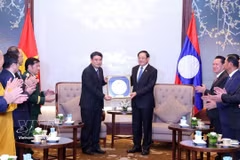
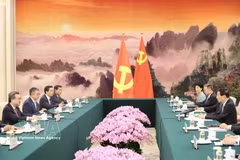
Secondly, in 2023 and in recent years, along with the development of its ties with the US, Vietnam has actively stepped up relations with neighbouring countries, regional nations, major and important partners and traditional friends such as China, Laos, Cambodia, Cuba, ASEAN member states, Russia, and India. This will contribute to creating a broad and favourable complexion of foreign affairs, contributing to the maintenance of a peaceful and stable environment for development, fostering the integration of deep and wide-ranging interests, promoting the realisation of the development goals till 2024 set at the 13th National Party Congress and enhancing Vietnam's position and prestige.
Thirdly, recent foreign affairs, including the establishment of the Comprehensive Strategic Partnership with the US, once again strongly affirmed the soundness as well as the important and prominent outcomes of Vietnam's foreign policy of independence, self-reliance, peace, friendship, diversification, multilateralisation, cooperation and development, and the country's "Four Nos" defence policy./.
VNA