Cairo (VNA) – An Egyptian diplomat has expressed strong admiration for Vietnam’s development achievements during its Doi Moi (Renewal) process, highlighting the country’s transformation into a dynamic and influential economy.
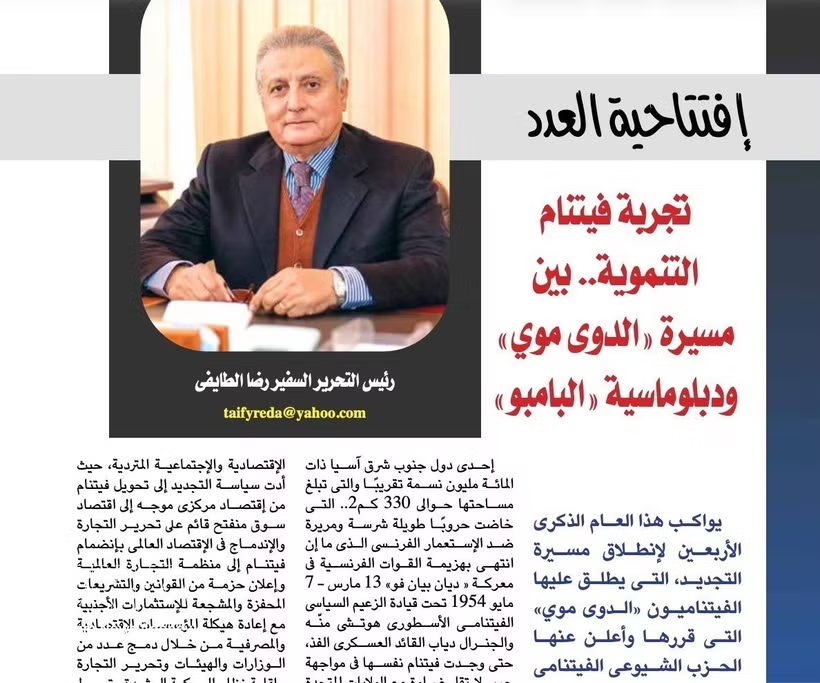
The March 2026 issue of Egypt’s diplomacy magazine carried an article by Ambassador Reda al-Taify, who served as Egypt’s Ambassador to Vietnam from 2010 to 2014. Drawing on his firsthand experience in Hanoi, the diplomat offered a comprehensive analysis of Vietnam’s development journey from the post-war period to the present.
He noted that Vietnam, a Southeast Asian nation of around 100 million people, endured prolonged and devastating wars to secure national independence. In 1986, the 6th National Congress of the Communist Party of Vietnam (CPV) launched the Doi moi (Renewal) policy, marking a historic turning point that helped the country overcome a prolonged socio-economic crisis and embark on a path of comprehensive renewal.
Economically, the transition from a centrally planned system to a market-oriented economy, combined with trade liberalisation and integration into the global economy, has driven remarkable growth. Vietnam’s accession to the World Trade Organisation (WTO) was a major milestone, creating a favourable environment for foreign investment in all fields while leveraging a skilled workforce and maintaining political stability. In 2025, the economy expanded by over 8%, with total foreign trade reaching approximately 930 billion USD and a trade surplus of around 20 billion USD, signalling strong prospects for joining the ranks of trillion-dollar economies.
In agriculture, Vietnam has transformed from a rice importer in the 1980s into one of the world’s leading exporters, ranking second globally in rice and coffee exports and third in natural rubber. The sector has become a key pillar of the economy, ensuring food security and supporting Vietnam’s position among top exporters of agricultural and aquatic products.
Beyond agriculture, the country has emerged as an industrial hub in Southeast Asia, investing in high value-added industries such as automobiles, electronics, software, mobile phones, energy, steel, cement, garments, and sportswear. Cultural industries, heritage, and handicrafts – largely driven by small and medium-sized enterprises – also contribute significantly to economic growth.
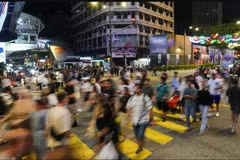
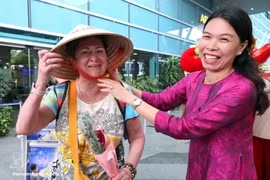
Over the years, tourism has turned into a thriving industry in Vietnam, closely linked to the process of opening up and international integration. This growth is driven by the diversity of tourist destinations in Vietnam such as Sa Pa, Ha Long Bay, Phong Nha-Ke Bang caves, Phu Quoc, and Da Lat. Vietnam welcomed 21.2 million foreign tourists in 2025 and aims to attract 25 million by the end of 2026.
Socially, the diplomat highlighted Vietnam’s success in combining fast economic growth with social equity. The poverty rate has declined sharply while per capita income rose from below 100 USD before Doi moi to over 5,000 USD in 2025. Significant progress has also been made in health care, education, science, and technology, and average life expectancy now exceeds 74 years.
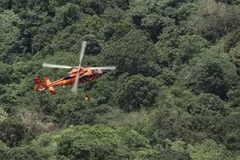
In defence and security, Vietnam has pursued modernisation while maintaining a cautious and independent approach amid complex regional and international dynamics. The country is strengthening its self-defence capabilities, developing modern and flexible armed forces, and staying ready to address latent security challenges such as cybersecurity, food security, energy security, climate change, and disease outbreaks, among others. Vietnam has placed particular emphasis on its defence industry and achieved significant breakthroughs in this field. The Vietnam Defence Expo 2024 showcased many made-in-Vietnam modern weapons and military equipment including unmanned aerial vehicles (UAVs), advanced radar systems, combat vehicles, ships, and surface-to-sea missile systems.
Regarding foreign policy, Ambassador Reda al-Taify noted that diplomacy, which is both a goal and a tool, has been central to Vietnam’s Doi moi process. From the outset, Vietnamese leaders recognised that economic growth must go hand in hand with enhancing the country’s role and standing in regional and global structures, especially amid an evolving international order. They are also aware that strategic self-reliance, is built on the combination of strong internal capacity, political mettle, consistent foreign policy, a clear development roadmap, responsiveness, and proactive international integration.
Accordingly, Vietnam has steadfastly pursued a foreign policy of independence, self-reliance, multilateralisation and diversification of external relations, and active, comprehensive and effective integration into the world. Maintaining traditional ties with China and Russia has not prevented Vietnam from strengthening relations with the US and expanding partnerships with the EU, ASEAN, India, Japan, as well as Arab and African countries.
This flexible, open and pragmatic diplomacy has helped Vietnam break out of isolation and emerge as a dynamic and influential player in regional and international arenas, he noted.
The ambassador emphasised that the leadership of the Communist Party of Vietnam in maintaining political stability and internal security is a decisive factor underpinning the country’s success. This foundation has created a favourable environment for attracting foreign investment and securing fast, comprehensive and sustainable development. He also highlighted national unity and effective investment in education, which have fostered a skilled workforce capable of driving development projects nationwide./.
Vietnam’s Doi Moi success fuels pride among OVs in Malaysia
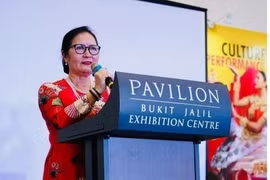
Tran Thi Chang, President of the Malaysia-Vietnam Friendship Association, said she is particularly struck by Vietnam’s ability to sustain rapid growth while safeguarding its cultural identity and traditional values. Numerous tangible and intangible heritages have earned UNESCO World Heritage status, and the distinct cultures of Vietnam’s 54 ethnic groups remain protected and upheld, contributing considerably to national progress.