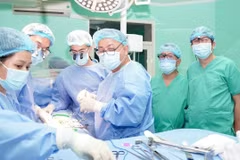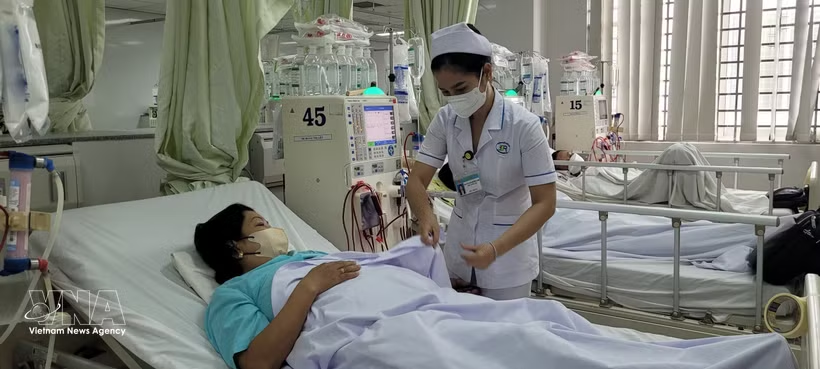
Hanoi (VNA) – Residents and tourists suffering from kidney failure in Con Dao special zone under Ho Chi Minh City can now receive dialysis treatment locally instead of travelling to the mainland, following the launch of the island’s first haemodialysis system at the Con Dao Military-Civilian Medical Centre on May 6.
This milestone was achieved thanks to professional expertise and technical transfer from Thong Nhat Hospital specialists.
Assoc. Prof. Dr. Tang Chi Thuong, Director of the municipal Department of Health, said the successful deployment of haemodialysis services on the island enables patients to receive treatment where they live, easing financial and psychological burdens.
He noted that in the past, chronic kidney disease patients on Con Dao had to travel regularly to the mainland for dialysis treatment. Many were forced to rent accommodation or temporarily relocate to the mainland to stay alive, while their families faced years of separation, immense financial pressure and prolonged stress.
The new service also allows patients from other localities to travel, work or stay on Con Dao without concerns over interrupted treatment, Thuong added.
In early March, upon receiving a request for support from the Con Dao Military-Civilian Medical Centre, Thong Nhat Hospital identified this as a priority task of major significance for islanders and quickly coordinated the installation of a haemodialysis system meeting Ministry of Health safety standards.
On April 16, a team of specialists from the hospital, led by Assoc. Prof. Dr. Nguyen Bach, head of the Department of Nephrology and Dialysis, travelled to Con Dao to assess infrastructure and evaluate the feasibility of deploying the technique.
Between April 20 and 28, the medical centre completed its operational plan and prepared personnel, medicines, supplies and equipment. On April 27, specialists conducted trial operations of the dialysis machines, tested the RO water treatment system and finalised technical procedures.
By May 4, the professional council of Thong Nhat Hospital had completed a comprehensive appraisal before the system officially began serving patients.
According to Bach, the technology transfer is being implemented through a three-stage roadmap. In the first stage, Thong Nhat Hospital directly operates the haemodialysis system on Con Dao. In the second stage, the hospital’s doctors and nurses will supervise and support the special zone’s medical staff. Ultimately, the Con Dao Military-Civilian Medical Centre will independently manage and operate the entire system.
He said establishing a dialysis unit on an island is far more challenging than on the mainland, particularly due to water quality requirements. To ensure patient safety, the centre has installed a modern two-stage RO water treatment system that meets the standards applied at major mainland hospitals.
Regarding human resources, the programme is currently in its initial phase. To prepare for the next stages, two medical teams from Con Dao have undergone intensive training both on-site and at Thong Nhat Hospital, including emergency response procedures for complications arising during dialysis treatment.
Assoc. Prof. Dr. Le Dinh Thanh, Director of Thong Nhat Hospital, affirmed that in the time ahead, the hospital will continue supporting the programme through training, remote consultations and advanced technology transfer to help the special zone’s medical staff gradually master the technique./.