Gold's headline price tells only part of trading story

Gold prices are often quoted as a single figure, making it easy to compare movements across different periods. However, a change in the quoted price does not translate into the same financial outcome for everyone exposed to the market. The result depends on how gold is traded, the size of the position, and the costs and contractual terms attached to the transaction.

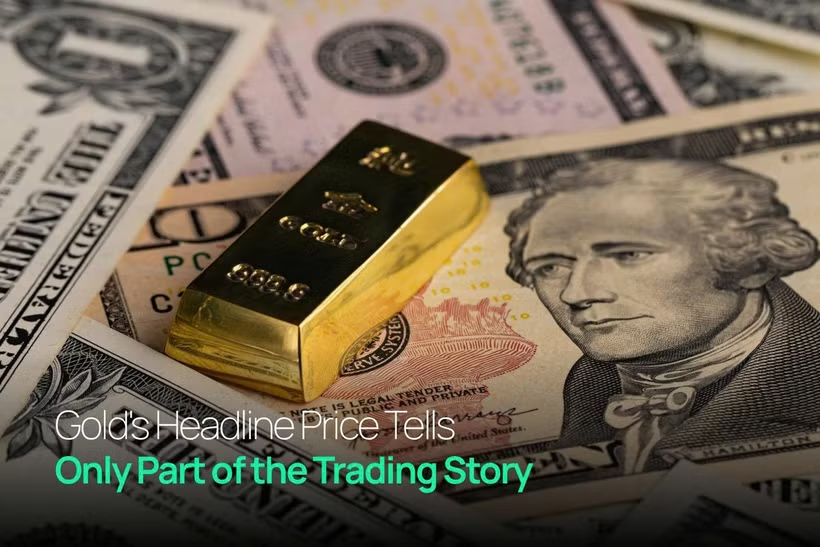
Illustrative image
Illustrative image

Hanoi (VNA) - Gold prices are often quoted as a single figure, making it easy to compare movements across different periods. However, a change in the quoted price does not translate into the same financial outcome for everyone exposed to the market. The result depends on how gold is traded, the size of the position, and the costs and contractual terms attached to the transaction.

This distinction is particularly relevant to XAUUSD trading, where the quoted price represents gold valued in US dollars. Unlike purchasing physical gold, trading a price-linked financial product does not necessarily involve taking ownership of bullion. Understanding that difference helps explain why the same market movement can produce different financial consequences.

XAUUSD prices do not represent physical gold ownership

XAUUSD is a market symbol commonly used to represent the price of gold against the US dollar. XAU refers to gold, while USD identifies the US dollar as the pricing currency. The quotation indicates how much one unit of gold is worth in dollars under the relevant market convention.

However, the symbol alone does not establish what a trader owns or the contractual rights attached to a position. Depending on the product offered, exposure to XAUUSD may come through a contract for difference (CFD) or another financial arrangement. These products can track gold prices without transferring ownership of physical gold.

Physical gold follows a different ownership structure. Someone purchasing bullion generally acquires a tangible asset, although the final cost and resale proceeds depend on dealer premiums, fees, storage arrangements, and the price available when selling.

The distinction between these arrangements is central to understanding XAUUSD trading. Both forms of exposure relate to gold, but they do not necessarily create the same costs, obligations, or financial outcomes.

The same price movement can produce different outcomes

A change in the gold price provides information about the market, but its financial significance depends on the exposure attached to it. For a physical gold owner, the relevant outcome generally involves the difference between the purchase cost and the proceeds received when selling, after accounting for applicable expenses.

For a trader using a price-linked contract, the outcome instead depends on the contract's specifications, position direction, position size, and the difference between the opening and closing prices.

Consider a hypothetical example in which gold rises by $20 per ounce. A person holding one ounce of physical gold would see the market value of that holding increase by approximately $20, assuming the relevant valuation price moves by the same amount. This is an unrealised change in value, not necessarily a realised profit.

A financial position referencing 10 ounces of gold would have a gross price-based gain of $200 if its terms translate the $20 increase into an equivalent gain across the full exposure and the position is held in the appropriate direction. The result would differ if the position were smaller, moved against the price change, or used a contract with different specifications.

These figures exclude transaction costs, financing charges, spreads, and other applicable expenses. They also illustrate gross exposure rather than a guaranteed or typical outcome. The comparison demonstrates that the headline price movement alone cannot establish the financial result of a position.

Contract terms, leverage, and trading costs matter

The relationship between a gold quotation and an individual's financial outcome becomes more complicated when leverage is involved. Leverage allows a trader to control a larger market exposure relative to the capital committed as margin. Although this can reduce the initial capital required for a position, it also increases the effect of price changes on that capital.

For example, a relatively small adverse movement in gold may produce a substantial loss relative to the margin supporting a leveraged position. Depending on the product and account terms, losses may trigger a margin call, forced position closure, or other consequences. The exact outcome depends on the applicable contractual and regulatory arrangements.

Costs also differ across gold products. Physical purchases may include dealer premiums, storage expenses, insurance, and a difference between buying and selling prices. Price-linked trading products may involve spreads, commissions, overnight financing, or other charges, depending on their structure.

Market conditions can affect these costs. During periods of heightened volatility or reduced liquidity, execution prices may differ from the prices observed when an order is submitted. Consequently, even an accurate view of the general direction of gold prices does not guarantee a favourable financial result.

A gold quotation is only one part of financial picture

The quoted XAUUSD price provides a common reference for understanding gold's value against the US dollar, but it does not describe every aspect of a financial position. Ownership rights, contract specifications, exposure, leverage, transaction costs, and execution conditions all influence the eventual outcome.

Physical gold and price-linked trading products can respond to the same underlying price movement while creating different financial experiences. Neither arrangement can be evaluated fully by looking at the gold quotation alone.

The essential distinction is between observing the market price and understanding the financial arrangement built around it. A gold price shows where the market is quoted; the structure of the position determines how that movement translates into a gain, a loss, or a change in asset value./.


See more

A high-level plenary session of the Autumn Economic Forum 2026 in Ho Chi Minh City on October 28. (Photo: VNA)

Autumn Economic Forum 2026: Connecting new growth drivers to unlock potential

Global investment in new digital projects has nearly tripled since 2020, while the digital economy has recorded annual growth of 10–12% for several years, significantly outpacing global GDP growth, she said, adding that industrial digitalisation and cross-border digital services are also expanding rapidly.

Deputy Prime Minister Nguyen Van Thang speaks at the Autumn Economic Forum 2026 on October 28. (Photo: VNA)

Vietnam must strengthen domestic capacity to move up global supply chains: Deputy PM

Thang stressed that Vietnam could not remain a passive recipient or an outside observer. Instead, it must build its own capacity and actively define its role in global production networks. The goal is not simply to join existing or emerging value chains, but to create the conditions, mechanisms and capabilities for Vietnam and its international partners to participate more directly in value creation.

Deputy Prime Minister Nguyen Van Thang speaks at the Autumn Economic Forum 2026 (Photo: thoibaotaichinh,.vn)

AEF 2026 opens in-depth dialogue on cooperation framework in new era

For Vietnam, the urgent requirement now is not only to connect and bring the economy into existing or emerging value chains but, more importantly, to create the environment, mechanisms and capacity so that Vietnam and international partners could plug more deeply and directly into the process of creating and building value in the new value chains, said Deputy Prime Minister Nguyen Van Thang.

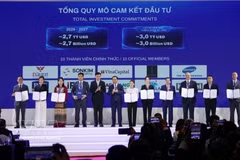
Membership certificates of the Vietnam International Financial Centre in Ho Chi Minh City (VIFC- HCMC) are presented to ten holding companies as its first members. on October 28, 2026 (Photo: VNA)

VIFC-HCMC announces first 10 official members

The 10 first members have a combined registered charter capital and committed capital contribution of 33.63 million USD. They plan to invest in and develop projects across infrastructure, education, energy, technology and financial services.

Innovation is key to helping SMEs enhance competitiveness and participate more deeply in global value chains (Photo: VNA)

Resolution opens new pathways for Vietnamese SMEs

Pham Van Viet, Chairman of the Board of Directors of Viet Thang Jean Co., Ltd. (VitaJean), said continued dependence on low labour costs will drive profit margins towards zero. The company has therefore invested in 3D design and laser-cutting technologies, reducing the time required for certain production stages from weeks to just hours. This has helped cut costs and meet the rapidly changing requirements of international orders.

Delegates attend Phu Tho province's investment promotion conference in Prague. (Photo: VNA)

Phu Tho promotes investment, trade in Czech Republic

Phu Tho, located in Vietnam’s northern midland and mountainous region, has considerable potential in industry, agriculture, services and tourism. Czech businesses’ strengths in manufacturing, engineering, technology, energy and environmental solutions offer promising opportunities for collaboration. Other potential areas include high-tech agriculture, food processing, tourism and human resources training.

Vietnam promotes green hydrogen investment opportunities in Europe

Vietnam promotes green hydrogen investment opportunities in Europe

The trade office introduced four investment priorities of Vietnam. These includes renewable hydrogen production, covering electrolysis, offshore wind-to-hydrogen, green ammonia and liquid hydrogen exports; storage, compression, pipelines, transport networks and port logistics; industrial decarbonisation and fuel switching in heavy transport and shipping; and hydrogen applications in steel, fertilisers, chemicals, cement, power generation and heavy transport.

The application of live-line maintenance technology on a low-voltage power line in Pho Hien ward, Hung Yen province. (Illustrative photo: VNA)

Vietnam considers electricity price cut from November 1, petrol excise tax cut to zero

Deputy Prime Minister Nguyen Van Thang urged the Vietnam Electricity (EVN) Group to review its costs and maximise savings to develop a plan to reduce the average retail electricity price from November 1, 2026, to March 31, 2027, in accordance with relevant regulations. The move aims to support people and businesses and ensure social welfare.

Experts discuss “Sustainable Global Value Chains: Green Logistics” at the event. (Photo: VNA)

Autumn Economic Forum 2026 promotes green logistics and advanced manufacturing

Bui Ba Nghiem, senior expert at the Ministry of Industry and Trade’s Import-Export Department, outlined five priorities, including improving institutions and coordination, promoting multimodal transport, applying digital technologies to emissions management, supporting SMEs in the green transition, and piloting measurable green logistics models.

The EFTA–Vietnam Free Trade Agreement is expected to open up significant business opportunities for Vietnamese enterprises. (Photo: baochinhphu.vn)

EFTA expects trade and investment with Vietnam to grow

Regarding market access and trade benefits, the EFTA countries expect the agreement to gradually eliminate tariffs on almost all goods exported by the four countries to Vietnam, either upon its entry into force or within a maximum period of 16 years.