Autumn Economic Forum 2026: Connecting new growth drivers to unlock potential

Global investment in new digital projects has nearly tripled since 2020, while the digital economy has recorded annual growth of 10–12% for several years, significantly outpacing global GDP growth, she said, adding that industrial digitalisation and cross-border digital services are also expanding rapidly.

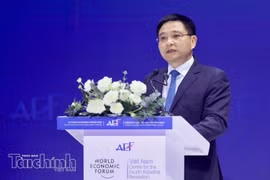
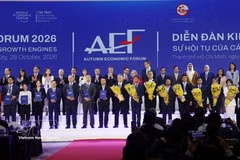
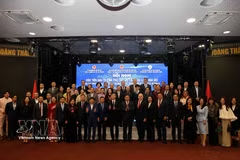
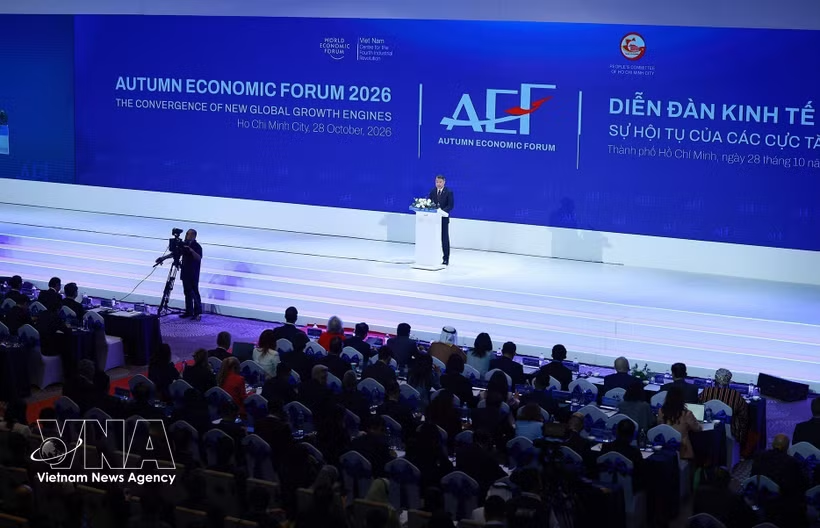
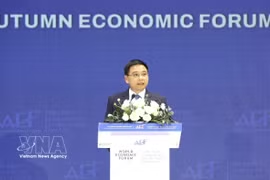
A high-level plenary session of the Autumn Economic Forum 2026 in Ho Chi Minh City on October 28. (Photo: VNA)

Ho Chi Minh City (VNA) – Science and technology, artificial intelligence (AI), digital transformation and green transition are emerging as new drivers of economic growth amid global challenges, speakers told a high-level plenary session of the Autumn Economic Forum 2026 in Ho Chi Minh City on October 28.

They stressed the need for stronger connectivity and broader regional and international cooperation to make the most of these drivers, while improving economies’ ability to adapt to changes and withstand external shocks.

Arsenio M. Balisacan, Philippine Secretary of the Department of Economy, Planning and Development, said global integration has helped raise incomes and promote development for decades. However, excessive dependence on particular industries, suppliers, markets or trade routes has also made economies more vulnerable to shocks. Therefore, the challenge is to maintain openness while strengthening resilience, he said.

Balisacan noted that the next wave of growth would be shaped by AI, advanced manufacturing, digital services and green transition. Bringing these areas together is particularly important because progress in one could improve productivity in others and support long-term prosperity.

For example, AI can improve factory operations and energy management, while clean and reliable energy can support the development of digital industries. Realising these benefits requires stronger links between sectors, alongside investment promotion, greater competition, better transport and logistics infrastructure, and workforce training.

Zhang Qi, Vice President of the Development Research Centre of the State Council of China, also highlighted innovation, science and technology, digitalisation, intelligent transformation and green transition as emerging growth drivers.

Global investment in new digital projects has nearly tripled since 2020, while the digital economy has recorded annual growth of 10–12% for several years, significantly outpacing global GDP growth, she said, adding that industrial digitalisation and cross-border digital services are also expanding rapidly.

Zhang noted that the global economy is undergoing profound changes, with developing countries moving beyond their traditional role as followers of growth to become important contributors to the global economy. They are also playing a growing role in expanding global trade and diversifying supply chains.

From the United Nations’ perspective, Pauline Tamesis, UN Resident Coordinator in Vietnam, said the global prosperity landscape is being reshaped by emerging growth centres driven by AI, digital connectivity, green transition and advanced manufacturing.

She said successful growth centres thrive on connectivity rather than isolation. To transform a manufacturing destination into a sustainable growth centre, countries must move beyond assembly operations to develop local capabilities, advanced skills and homegrown technologies.

Tamesis also stressed that new drivers of progress should not create further development gaps. The transition must be fair and take into account workers whose jobs are changing, communities affected by climate change and developing economies in need of financial resources.

Khuong Sreng, Governor of Phnom Penh, Cambodia, said rapid and complex changes in the global economy require countries to develop strategies suited to the new environment. These should focus on promising sectors, including the digital and AI economies, the green economy, the creative economy and modern manufacturing.

Speakers also highlighted the importance of regional and international cooperation in developing new growth drivers. Stronger partnerships can help economies expand markets, mobilise resources, promote technology transfer and improve resilience amid global uncertainty./.

VNA

See more

Illustrative image

Gold's headline price tells only part of trading story

Gold prices are often quoted as a single figure, making it easy to compare movements across different periods. However, a change in the quoted price does not translate into the same financial outcome for everyone exposed to the market. The result depends on how gold is traded, the size of the position, and the costs and contractual terms attached to the transaction.

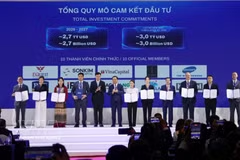
Membership certificates of the Vietnam International Financial Centre in Ho Chi Minh City (VIFC- HCMC) are presented to ten holding companies as its first members. on October 28, 2026 (Photo: VNA)

VIFC-HCMC announces first 10 official members

The 10 first members have a combined registered charter capital and committed capital contribution of 33.63 million USD. They plan to invest in and develop projects across infrastructure, education, energy, technology and financial services.

Innovation is key to helping SMEs enhance competitiveness and participate more deeply in global value chains (Photo: VNA)

Resolution opens new pathways for Vietnamese SMEs

Pham Van Viet, Chairman of the Board of Directors of Viet Thang Jean Co., Ltd. (VitaJean), said continued dependence on low labour costs will drive profit margins towards zero. The company has therefore invested in 3D design and laser-cutting technologies, reducing the time required for certain production stages from weeks to just hours. This has helped cut costs and meet the rapidly changing requirements of international orders.

Delegates attend Phu Tho province's investment promotion conference in Prague. (Photo: VNA)

Phu Tho promotes investment, trade in Czech Republic

Phu Tho, located in Vietnam’s northern midland and mountainous region, has considerable potential in industry, agriculture, services and tourism. Czech businesses’ strengths in manufacturing, engineering, technology, energy and environmental solutions offer promising opportunities for collaboration. Other potential areas include high-tech agriculture, food processing, tourism and human resources training.

Vietnam promotes green hydrogen investment opportunities in Europe

Vietnam promotes green hydrogen investment opportunities in Europe

The trade office introduced four investment priorities of Vietnam. These includes renewable hydrogen production, covering electrolysis, offshore wind-to-hydrogen, green ammonia and liquid hydrogen exports; storage, compression, pipelines, transport networks and port logistics; industrial decarbonisation and fuel switching in heavy transport and shipping; and hydrogen applications in steel, fertilisers, chemicals, cement, power generation and heavy transport.

The application of live-line maintenance technology on a low-voltage power line in Pho Hien ward, Hung Yen province. (Illustrative photo: VNA)

Vietnam considers electricity price cut from November 1, petrol excise tax cut to zero

Deputy Prime Minister Nguyen Van Thang urged the Vietnam Electricity (EVN) Group to review its costs and maximise savings to develop a plan to reduce the average retail electricity price from November 1, 2026, to March 31, 2027, in accordance with relevant regulations. The move aims to support people and businesses and ensure social welfare.

The EFTA–Vietnam Free Trade Agreement is expected to open up significant business opportunities for Vietnamese enterprises. (Photo: baochinhphu.vn)

EFTA expects trade and investment with Vietnam to grow

Regarding market access and trade benefits, the EFTA countries expect the agreement to gradually eliminate tariffs on almost all goods exported by the four countries to Vietnam, either upon its entry into force or within a maximum period of 16 years.

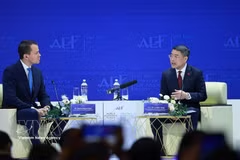
Speakers at the discussion (Photo: VNA)

ASEAN digital pact key to facilitating cross-border business

At a panel discussion on policy frameworks for the digital economy, held as part of the Autumn Economic Forum 2026 on October 27, speakers said ASEAN needed to ensure national systems could work together while protecting data and facilitating business, rather than impose uniform rules across the region.

Vietnam exports nearly 800,000 tonnes of cashew nuts in 2025. (Photo: VNA)

Vietnam cashew sector looks to reshape global supply chains

According to VINACAS Chairman Pham Van Cong, Vietnam exported nearly 800,000 tonnes of cashew nuts in 2025, earning a record 5.4 billion USD. For nearly two decades, the country has led the world in cashew processing and exports, accounting for more than 80% of global exports.