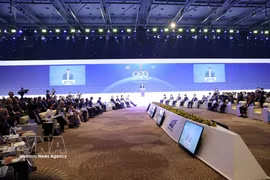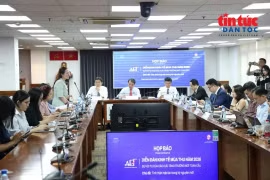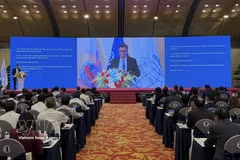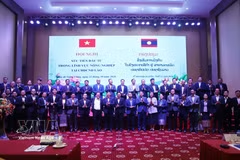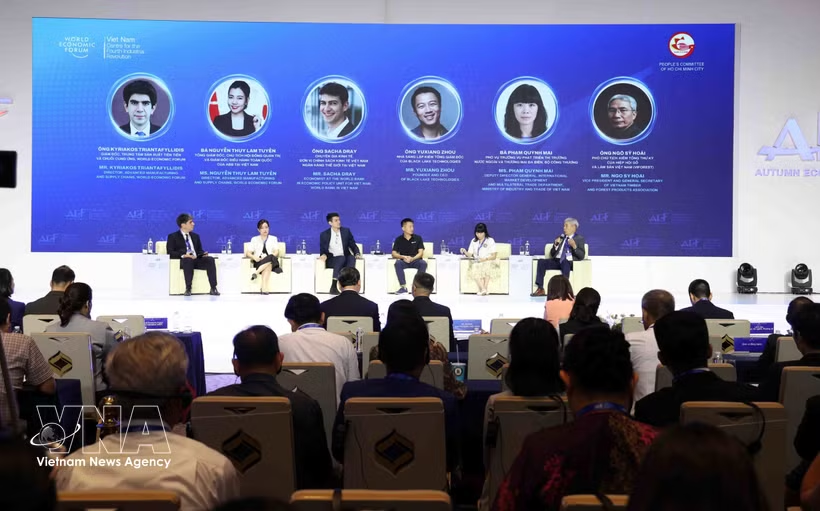
Ho Chi Minh City (VNA) – A thematic session entitled “Repositioning Vietnam and ASEAN in Global Value Chains” was held on October 27 as part of the Autumn Economic Forum 2026, organised by the Ho Chi Minh City People’s Committee in co-branding with the World Economic Forum.
Participants discussed challenges and solutions to strengthen the region and Vietnam’s resilience and future readiness.
ASEAN’s potential and challenges
Nguyen Thuy Lam Tuyen, General Director, Board Chairwoman and Country Holding Officer of ABB Vietnam, said ASEAN is becoming increasingly attractive thanks to its market of more than 680 million people, rapid urbanisation and growing demand for electrification and digital infrastructure.
The region’s manufacturing investment, digital transformation and automation, together with its young workforce and engineering talent, are further strengthening its competitiveness. In addition, ASEAN has one of the world’s most extensive networks of regional economic partnership agreements. ASEAN connectivity goes beyond links among its 11 member states to form an integrated production base. Each country has its own identity and strengths, which together enhance the region’s overall appeal and competitiveness.
Sacha Dray, an economist at the World Bank in Economic Policy Unit for Vietnam, noted that ASEAN has a combined economic value of around 4 trillion USD and is expected to become the world’s fifth-largest economic bloc in 2027. The region attracts more than 15% of global foreign direct investment (FDI) annually, supported by trade openness, a workforce of over 370 million and extensive free trade agreements.
However, intra-regional trade accounts for only 22% of ASEAN’s annual exports of 2 trillion USD, compared with around 60% of goods produced and consumed within the European Union. This leaves ASEAN more exposed to external demand and limits the benefits of deeper regional integration, Dray said. Despite being well integrated into global value chains, the bloc still has considerable room to develop supply chains within the region.
Strengthening regional cooperation
Participants stressed the need to leverage each member’s strengths and build complementary links across global value chains.
Tuyen proposed establishing regional capability corridors based on specialisation, diversification and connectivity, alongside greater sharing of skills and technology. ASEAN should move beyond participating in global supply chains to helping shape them, with engineering and innovation serving as key drivers.
Pham Quynh Mai, Deputy Director of the Ministry of Industry and Trade’s Department of Foreign Market Development and Multilateral Trade Policy, called for cross-border industrial clusters connecting major corporations, small- and medium-sized enterprises (SMEs), universities and research centres, particularly in electronics, semiconductors, automobiles and clean energy. Such clusters could attract investment, facilitate technology transfer, strengthen supply chains and promote balanced, sustainable development.
Dray said ASEAN should focus on helping companies become more capable suppliers and meet evolving environmental, social and governance (ESG) requirements. He cited World Bank support for LG’s 200-million-USD project in Hai Phong to ensure that its third factory in Vietnam uses 100% renewable energy, and help local firms upgrade to become first- and second-tier suppliers.
He also urged greater cross-border investment, trade promotion within ASEAN, support for SMEs and the removal of non-tariff barriers through trade facilitation, single-window mechanisms, and harmonised standards.
Participants agreed that Vietnam and other ASEAN members have the potential to move up global value chains. Achieving this will require deeper regional cooperation, stronger technological capabilities and better use of each member’s comparative advantages./.
See more
EFTA expects trade and investment with Vietnam to grow
Regarding market access and trade benefits, the EFTA countries expect the agreement to gradually eliminate tariffs on almost all goods exported by the four countries to Vietnam, either upon its entry into force or within a maximum period of 16 years.
Vietnam, China explore cooperation potential in AI, digital economy
Discussions focused on three main areas, namely the digital economy, artificial intelligence (AI) and finance, investment in industrial parks and smart technology applications, and investment connectivity, digital infrastructure and services.
Vietnam seeks to modernise state audit amid emerging challenges
As public decisions grow more complex and risks become increasingly interconnected, SAIs must move beyond detecting irregularities to identify root causes, analyse emerging trends and issue early warnings to protect public resources and improve policy implementation, said INTOSAI Chair Mohamed el-Faisal Youssef.
Vietnam steps up sci-tech application in agriculture
The northern region has advantages in research institutes, universities, scientific expertise and technology businesses. However, links between research and production, as well as technology transfer and practical application, remain limited, an official has said.
Ho Chi Minh City seeks private investment to develop transport infrastructure
The municipal People’s Committee is collecting feedback on a draft resolution proposing incentives and mechanisms to mobilise resources for the construction, development and maintenance of infrastructure. The move aims to implement Article 14 of the Urban Development Law No. 18/2026/QH16.
Vietnam–EFTA deal opens access to advanced European manufacturing technologies
While Vietnam’s free trade agreements often draw attention for their benefits to traditional exports such as agricultural products, seafood and textiles, electronics and mechanical components hold significant strategic potential in trade with EFTA, comprising Switzerland, Norway, Iceland and Liechtenstein.
Panama’s export processing zones offer opportunities for Vietnamese firms
After more than 15 years of operation, Panama’s system comprises 27 export processing zones, including 20 operational and seven under development. They host 201 companies conducting 282 business activities, nearly half of which involve logistics, services, and the processing of finished or semi-finished products.
Vietnam seeks to unlock growth potential of low-altitude economy
Vietnam had significant opportunities to develop the low-altitude economy, given strong market demand and its potential applications across various sectors.
Measures sought to remove bottlenecks to reduce logistics costs
Experts emphasise that reducing logistics costs requires integrated planning, investment, operations and data sharing. Developing infrastructure projects separately, without considering regional demand and stable cargo flows, risks duplication and wasted resources.
Ho Chi Minh City opens GRECO 2026 to push green growth
GRECO 2026 is meant to turn those goals into deals covering technology connectivity, trade and investment promotion and international cooperation. The show gives firms access to advanced technology and sustainable production models, helping build a green consumer market.
Reference exchange rate up 6 VND on October 27
With the current trading band of ±5%, the ceiling rate applicable to commercial banks stood at 26,915 VND/USD, while the floor rate was 24,351 VND/USD.
Mozambique considers Vietnam a leading strategic partner in agricultural cooperation
A highlight of bilateral agricultural cooperation was the project on rice, soybean and vegetable production in central Mozambique during the 2013-2017 period. The project delivered tangible results, particularly by helping local farmers gain access to advanced farming techniques and high-quality crop varieties, thereby contributing to higher yields of key crops in the region.
Hanoi affirms role as core, growth pole of Capital region
Hanoi is facing a growing imperative to shift from development mindset limited by administrative boundaries toward one focused on regional spatial growth. Politburo’s Resolution No. 27-NQ/TW, issued on August 28, 2026, on regional development and the organisation of national development space for the new period, identifies the Hanoi metropolitan area as one of the country’s two major growth poles and urges stronger connections in infrastructure, economy, science and technology, and resources between the capital and localities.
Vietnam eyes APEC 2027 to push green farming, food security agenda
Hosting APEC 2027, Vietnam plans to work with the APEC Secretariat on a policy dialogue on rice-sector innovation, and a workshop on public-private partnerships for regenerative agriculture on the sidelines of the first APEC Senior Officials Meeting (SOM1). The events will give economies a platform to share lessons and practical experience in green, low-emission farming.
Ca Mau connects businesses to expand markets
The southernmost province of Ca Mau is stepping up trade promotion and business networking to expand markets for local products, turning its natural, economic and ecological advantages into drivers of rapid and sustainable growth in the Mekong Delta.
Domestic airlines urged to resume, expand domestic air routes by year-end
Director of the Civil Aviation Authority of Vietnam (CAAV) suggested that airlines should identify routes to be resumed or newly launched, as well as existing routes on which flight frequencies could be increased. They should also outline implementation plans and timelines for the final months of 2026 and 2027, assess market demand, and evaluate fleet deployment options and operational sustainability.
Vietnam, Laos drive agricultural collaboration
Some 208 Vietnamese companies are investing in crops, forestry and livestock in Laos, with registered capital of about 1.4 billion USD. Authorities in both countries are also upgrading transport and energy infrastructure as they aim to lift bilateral trade to 10 billion USD by 2030, while pressing ahead with efforts to draw more investment.
Vietnam promotes adoption of GS1 standards
Vietnam is stepping up cooperation with GS1, the global organisation that develops and manages standards for product identification, barcodes and supply chain data, to help businesses improve efficiency and competitiveness in digital supply chains.
Tay Ninh targets at least three logistics centres by 2030
The southern province of Tay Ninh aims to attract investment in at least three logistics centres, two wholesale markets and three to five shopping malls and supermarkets by 2030 as part of efforts to develop modern commercial infrastructure, improve goods circulation and capitalise on regional connectivity and international trade.
Ho Chi Minh City pitches infrastructure, finance, energy, tech to global investors
Competing for global capital, Ho Chi Minh City is targeting quality FDI in finance, technology, digital transformation, green economy, sustainable development and innovation. It aims to draw 19 billion USD in FDI in 2026