Experts advise Vietnamese businesses on how to enter low-altitude economy value chain

Dr Nguyen Thi Hai Hang, Vice Chairwoman of the Vietnam Low Earth Economic Alliance (LAEP), said a network of businesses with different approaches to the low-altitude economy ecosystem has taken shape in Vietnam. Some focus on manufacturing components and parts for UAV production, aiming to participate more deeply in supply chains.

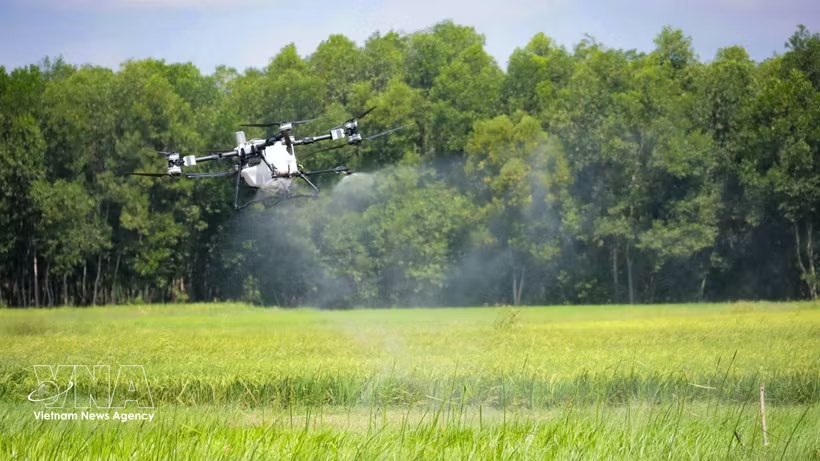
An unmanned aerial vehicle (UAV) sprays plant protection products over a field in Hoa Hoi commune, Tay Ninh province. (Photo: VNA)

Ho Chi Minh City (VNA) – To tap the potential of Vietnam’s low-altitude economy market, which is forecast to reach around 10 billion USD by 2035, domestic businesses do not necessarily need to master the full range of unmanned aerial vehicle (UAV) technologies, but can focus on areas that suit their capabilities, from component manufacturing and software development to artificial intelligence (AI) integration and application services.

This was the view shared by experts at a discussion on unlocking the potential of the low-altitude economy, held on October 27 in Ho Chi Minh City as part of the Autumn Economic Forum 2026.

Dr Nguyen Thi Hai Hang, Vice Chairwoman of the Vietnam Low Earth Economic Alliance (LAEP), said a network of businesses with different approaches to the low-altitude economy ecosystem has taken shape in Vietnam.

Some focus on manufacturing components and parts for UAV production, aiming to participate more deeply in supply chains. Others, particularly technology start-ups, are developing software, integrating AI and building applications on existing UAV platforms.

This is a promising approach, as a wide range of aircraft and components is already available for businesses to develop specialised applications. Rather than having to research and manufacture an entire aircraft themselves, companies can focus on technology solutions that match their capabilities and practical needs.

The LAEP representative noted that Vietnam often sets the goal of mastering core technologies, but this presents a major challenge when compared with countries that have already developed strong technological capabilities.

A more appropriate approach will be to align investment with domestic capacity and conditions rather than spread resources too thinly. The immediate priority is to deploy applications safely and efficiently, generating economic value and added value for the economy. Building on this foundation, businesses can gradually move towards mastering technologies that Vietnam is capable of developing.

On applications, Bui Minh Phuong, Deputy Director of the Institute for Low-Altitude Space Development (ILASD), said Vietnam did not necessarily need to create an entirely new market, but could start with sectors where there was already clear demand. Precision agriculture, infrastructure monitoring, logistics, healthcare and digital mapping are all viable fields for deployment in the near future.

In the Mekong Delta, for example, UAVs have been used in agriculture for more than a decade for seed sowing, pesticide spraying and pest control. By 2025, more than 3,000 agricultural drones were operating across approximately 1.5 million ha in the region.

UAV applications are also expanding to monitoring electricity and energy infrastructure, as well as other structures, particularly in areas that are difficult for people to access. These examples show that businesses can participate not only by supplying equipment but also by developing solutions tailored to the needs of individual economic sectors.

According to Phuong, economic value generated in low-altitude airspace comes not only from aircraft manufacturing, but also from software development, data processing and analysis, system integration, maintenance and operational services.

The long-term goal is to enable businesses to move beyond supplying individual pieces of equipment and towards offering end-to-end services, including flight planning, operations, data processing and reporting.

The ILASD representative said this transition required stronger links between research, manufacturing, services and practical applications. Industry clusters should also be developed with the participation of research institutes, training institutions, technology companies, manufacturers, state management agencies and industrial customers. Such connections would help align research and technological development capabilities with actual user needs.

Nguyen Van Thuat, Deputy Director of the Department of Digital Economy and Digital Society under the Ministry of Science and Technology, cautioned that successful testing should not be confused with successful commercialisation. An application may complete a test flight successfully without necessarily developing into a sustainable business model.

To determine whether a model can be scaled up, businesses must first establish that a genuine market exists, that the application addresses a real-world problem, and that customers are willing to pay for the service, he said. The application must also deliver better results than conventional methods.

The other two key requirements are safety and scalability. A model must operate safely not only in a controlled testing environment but also under real-world conditions. Once proven at one location, an application should be deployable elsewhere without requiring the entire technology, infrastructure and regulatory framework to be redesigned.

Experts said businesses also needed to assess economic viability over the entire lifecycle of their equipment, including the costs of hardware, personnel, batteries, maintenance, insurance and connectivity. A comprehensive cost assessment is essential to avoid scattered investment and poor returns./.

VNA

See more

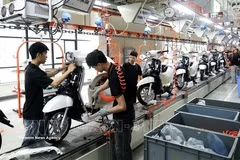
Vietnamese workers at a Japanese oyster processing factory (Photo: VNA)

Vietnam-Japan trade machine has room to run

Economic, trade and investment cooperation remains the core pillar and the main engine of comprehensive, sustainable bilateral ties. General Secretary of the Communist Party of Vietnam Central Committee and President To Lam’s official visit to Japan is therefore a key moment to reinforce political trust, deepen the Comprehensive Strategic Partnership and open new cooperation opportunities in the next growth phase.

Prof. Kenichi Ohno from Japan’s National Graduate Institute for Policy Studies (GRIPS) (Photo: vietnamfinance.vn)

Vietnam, Japan poised to shape new economic partnership: Japanese expert

Vietnam's progress in income levels and technological capabilities has opened up a new phase in economic ties with Japan, with both countries shifting from a model centred on Japanese support for Vietnam to one of jointly developing and operating business activities, he said, noting that this shift reflected Vietnam's development achievement.

The forum provides a platform for businesses from both countries to exchange market information, seek partners and explore concrete trade and investment opportunities. (Photo: VNA)

Vietnamese goods eye greater access to Australian market

Participants at the Vietnam-Western Australia Business Forum 2026 in Perth city on November 6 highlighted strong prospects for Vietnamese rice, agricultural produce and food products in the Australian market as local businesses seek to diversify supply chains.

Ambassador Mai Phan Dung (centre), Permanent Representative of Vietnam to the United Nations, the WTO and other international organisations in Geneva at Vietnam’s third Trade Policy Review (Photo: VNA)

Vietnam highlights integration achievements at WTO

Vietnam views the Trade Policy Review not merely as a transparency obligation but also as an opportunity to objectively assess its achievements, listen to other members’ views and identify areas for improvement.

Nectarines from California are on sale at a supermarket in Washington, D.C (Photo: VNA)

US to send largest-ever agricultural trade mission to Vietnam

The USDA’s statistics show that Vietnam was the seventh-largest export market for American agricultural and related products in 2025, with import turnover of nearly 5.6 billion USD. The US’s 2025 agricultural exports to Vietnam increased 38% from 2024.

At the opening of the Food Expo Vietnam 2025 (Photo: VNA)

Vietnam Food Forum 2026 to take place soon

Vietnam Food Forum 2026 is scheduled for November 11 in Ho Chi Minh City as one of a series of specialised activities designed to help Vietnamese food businesses keep abreast of policy developments, improve their ability to meet international standards and expand opportunities to participate in global supply chains.

Many foreign-invested enterprises have chosen Yen Phong Industrial Park in Bac Ninh city as a destination for their manufacturing and business operations. (Photo: VNA)

Bac Ninh seeks to attract high-quality investment, create fresh appeal

Bac Ninh aims to attract projects that participate in global production and supply chains, apply advanced and green technologies, and support industries. Priority sectors include semiconductors, artificial intelligence, digital technology, robotics, new materials and renewable energy.

Col. Nguyen Ba Son, Deputy Director-General of the Ministry of Public Security’s Department of Cyber Security, speaks at the event. (Photo: thanhnien.vn)

Vietnam studies pilot system to trace cash flows in fraud cases

A representative of the Vietnam Banks Association said AI can help banks spot customer needs, detect unusual transactions and improve credit scoring. But poorly standardised input data or inadequately controlled AI models can create new risks in decision making and data protection.

The Vietnam Culture and Tourism Association in Europe (VNCT) signs a memorandum of understanding on cooperation with the Hoan Kiem Tourism Association. (Photo: VNA)

Responsible tourism key to tapping European market

Tran Doan The Duy, General Director of Vietravel Tourism JSC (Vietravel), said Vietnam is seeing strong growth in international arrivals, with Europe among its fastest-growing source markets and the UK recording particularly positive results.

Tsuchibashi Akito, Chairman of the Japan Chamber of Commerce and Industry in Vietnam (JCCI) (Photo: VNA)

Japanese businesses pledge long-term partnership with Vietnam: expert

Tsuchibashi Akito said the upcoming official visit to Japan by General Secretary of the Communist Party of Vietnam Central Committee and President To Lam is expected to open a new vision for the next 50 years of bilateral cooperation and further deepen the Vietnam-Japan Comprehensive Strategic Partnership.

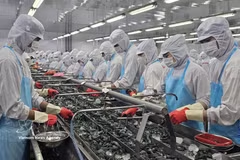
Processing shrimp for export (Photo: VNA)

VIFTA widens room for Vietnamese goods in Israel

Israel is a key Middle East market, with a developed economy, high per-capita income and demand for a diversified import mix. It is a potential outlet for Vietnamese farm produce, food, seafood, apparel, footwear and consumer goods.

Representatives of European businesses at the meeting with Vice President of the National Assembly (NA) Nguyen Hong Dien in Hanoi on November 5, 2026. (Photo: VNA)

Vietnam, European firms seek to boost investment, business links

NA Vice President Nguyen Hong Dien appreciated the European business community's contributions to Vietnam's socio-economic development, particularly in investment, technology transfer, production capacity building and high-quality human resources training.

Consumers shop at the 2026 Consumer Week. (Illustrative photo: VNA)

Drastic measures taken to protect consumer data in cyberspace

Under the Law on Personal Data Protection and the Law on Protection of Consumers' Rights, consumers are entitled to be informed, give or withdraw consent, and request the correction or deletion of their personal data, regardless of where it is processed.