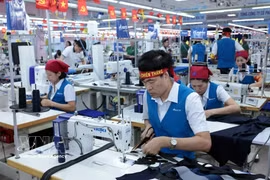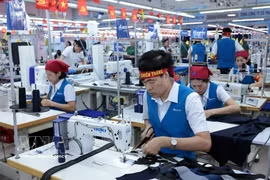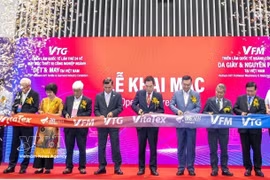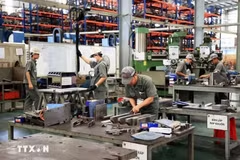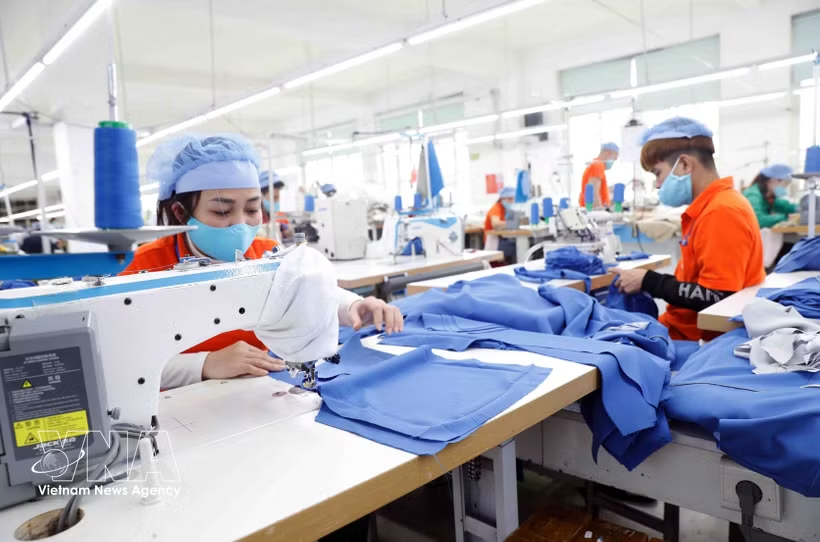
Hanoi (VNA) – Vietnam’s textile and garment exports surpassed 36 billion USD in the first nine months, up 3.3% from a year earlier, as companies adapted to an uncertain market.
General Director of the Vietnam National Textile and Garment Group (Vinatex) Cao Huu Hieu said the group posted revenue of nearly 1.6 trillion VND (61.94 billion USD) in the first nine months of this year, or 57.1% of plan, and pre-tax profit of 336.6 billion VND, 129.5% of plan and up 218.7%.
Yarn was the bright spot: revenue of 6.66 trillion VND and profit of more than 381.8 billion VND, with all 12 yarn units profitable and more efficient.
Garment remained Vinatex’s biggest profit engine, with revenue of 5.85 trillion VND and pre-tax profit of 679.2 billion VND, for an 11.6% pre-tax margin, above the 10% plan. But margins varied widely across units, and the broader trend is rising revenue with falling margins - evidence of pressure from unit prices, costs and production management on difficult, small orders.
Hieu’s growth strategy has three legs, including better capacity in weaving, dyeing and materials to close the domestic supply chain and reduce supply dependence; deeper investment in equipment, automation and advanced technology to lift productivity, launch new products and move into higher-value segments; and stronger digital management, data connectivity and operational optimisation.
The sector is entering a tougher phase. International buyers now demand fast delivery and competitive costs, and high standards on quality, social responsibility and product sustainability, he said.
Chairman of the Vietnam Textile and Apparel Association (VITAS) Vu Duc Giang said firms must invest not just in scale and technology but in their ability to join the global value chain. That means upgrading factory infrastructure to international standards, using automation to cut costs and lift labour productivity, developing raw material supply chains, building textile and garment industrial zones and clusters, and shifting exports from cut-make-trim to Free On Board (FOB) and Original Design Manufacturing (ODM).
Deputy Director of the Industry Department under the Ministry of Industry and Trade Pham Van Quan called textile and garment a key export engine, with 1.86 million workers across more than 14,300 enterprises. In 2025, exports approached 46.2 billion USD, up 6% from 2024, with a trade surplus above 20.7 billion USD. Vietnam remains among the world’s top three textile and apparel exporters, with added value at 52% of exported products.
Quan said the ministry will work with localities, associations and companies on supplier capacity, chain links, technology upgrades, workforce training and market information.
He urged firms to map supply risks; diversify products, markets and customers; raise domestic sourcing where quality, price and delivery are met, and team up with mechanical, electronics and digital tech companies to gradually master equipment, components and production technology./.
See more
Top ten securities firms hold 10.6 billion USD in margin loans
Based on third-quarter 2026 financial statements and company disclosures, the figure represents principal outstanding from margin lending and excludes advances against proceeds from securities sales.
Traditional grocery stores adapt to rise of modern retail
Traditional retailers do not necessarily need to expand or imitate modern chains. Instead, they should build on their existing strengths and meet the needs of specific customer groups.
Vietnam, China seek to boost economic, investment and financial cooperation
China remains one of the leading foreign investors in terms of new investment project numbers in Vietnam, reflecting the appeal of the Vietnamese market and Chinese businesses’ interest in its investment environment and business opportunities.
Experts advise Vietnamese businesses on how to enter low-altitude economy value chain
Dr Nguyen Thi Hai Hang, Vice Chairwoman of the Vietnam Low Earth Economic Alliance (LAEP), said a network of businesses with different approaches to the low-altitude economy ecosystem has taken shape in Vietnam. Some focus on manufacturing components and parts for UAV production, aiming to participate more deeply in supply chains.
Autumn Economic Forum 2026 promotes green logistics and advanced manufacturing
Bui Ba Nghiem, senior expert at the Ministry of Industry and Trade’s Import-Export Department, outlined five priorities, including improving institutions and coordination, promoting multimodal transport, applying digital technologies to emissions management, supporting SMEs in the green transition, and piloting measurable green logistics models.
EFTA expects trade and investment with Vietnam to grow
Regarding market access and trade benefits, the EFTA countries expect the agreement to gradually eliminate tariffs on almost all goods exported by the four countries to Vietnam, either upon its entry into force or within a maximum period of 16 years.
Vietnam, China explore cooperation potential in AI, digital economy
Discussions focused on three main areas, namely the digital economy, artificial intelligence (AI) and finance, investment in industrial parks and smart technology applications, and investment connectivity, digital infrastructure and services.
ASEAN digital pact key to facilitating cross-border business
At a panel discussion on policy frameworks for the digital economy, held as part of the Autumn Economic Forum 2026 on October 27, speakers said ASEAN needed to ensure national systems could work together while protecting data and facilitating business, rather than impose uniform rules across the region.
Vietnam cashew sector looks to reshape global supply chains
According to VINACAS Chairman Pham Van Cong, Vietnam exported nearly 800,000 tonnes of cashew nuts in 2025, earning a record 5.4 billion USD. For nearly two decades, the country has led the world in cashew processing and exports, accounting for more than 80% of global exports.
Vietnam, ASEAN seek to be repositioned in global value chains
ASEAN is becoming increasingly attractive thanks to its market of more than 680 million people, rapid urbanisation and growing demand for electrification and digital infrastructure.
Vietnam seeks to modernise state audit amid emerging challenges
As public decisions grow more complex and risks become increasingly interconnected, SAIs must move beyond detecting irregularities to identify root causes, analyse emerging trends and issue early warnings to protect public resources and improve policy implementation, said INTOSAI Chair Mohamed el-Faisal Youssef.
Vietnam steps up sci-tech application in agriculture
The northern region has advantages in research institutes, universities, scientific expertise and technology businesses. However, links between research and production, as well as technology transfer and practical application, remain limited, an official has said.
Ho Chi Minh City seeks private investment to develop transport infrastructure
The municipal People’s Committee is collecting feedback on a draft resolution proposing incentives and mechanisms to mobilise resources for the construction, development and maintenance of infrastructure. The move aims to implement Article 14 of the Urban Development Law No. 18/2026/QH16.
Vietnam–EFTA deal opens access to advanced European manufacturing technologies
While Vietnam’s free trade agreements often draw attention for their benefits to traditional exports such as agricultural products, seafood and textiles, electronics and mechanical components hold significant strategic potential in trade with EFTA, comprising Switzerland, Norway, Iceland and Liechtenstein.
Panama’s export processing zones offer opportunities for Vietnamese firms
After more than 15 years of operation, Panama’s system comprises 27 export processing zones, including 20 operational and seven under development. They host 201 companies conducting 282 business activities, nearly half of which involve logistics, services, and the processing of finished or semi-finished products.
Vietnam seeks to unlock growth potential of low-altitude economy
Vietnam had significant opportunities to develop the low-altitude economy, given strong market demand and its potential applications across various sectors.
Measures sought to remove bottlenecks to reduce logistics costs
Experts emphasise that reducing logistics costs requires integrated planning, investment, operations and data sharing. Developing infrastructure projects separately, without considering regional demand and stable cargo flows, risks duplication and wasted resources.
Ho Chi Minh City opens GRECO 2026 to push green growth
GRECO 2026 is meant to turn those goals into deals covering technology connectivity, trade and investment promotion and international cooperation. The show gives firms access to advanced technology and sustainable production models, helping build a green consumer market.
Reference exchange rate up 6 VND on October 27
With the current trading band of ±5%, the ceiling rate applicable to commercial banks stood at 26,915 VND/USD, while the floor rate was 24,351 VND/USD.
Vietnam can’t win high-tech investment on land alone: 2026 Autumn Economic Forum
Bill Giannikos, Director of the Global Services Centre and Data Centre at Aurecon Vietnam, said data centre development has to be planned alongside land, power, telecoms and supporting services. Investors need clear information on land availability, power capacity, supply timelines and connectivity before committing to large projects.