Green industry lures more FDI to Mekong Delta

The Mekong Delta region, having earned the monikers of the rice bowl, fruit and seafood basket of the country, and following the restructuring of administrative units, is now standing at the threshold of becoming a modern, sustainable industrial centre.

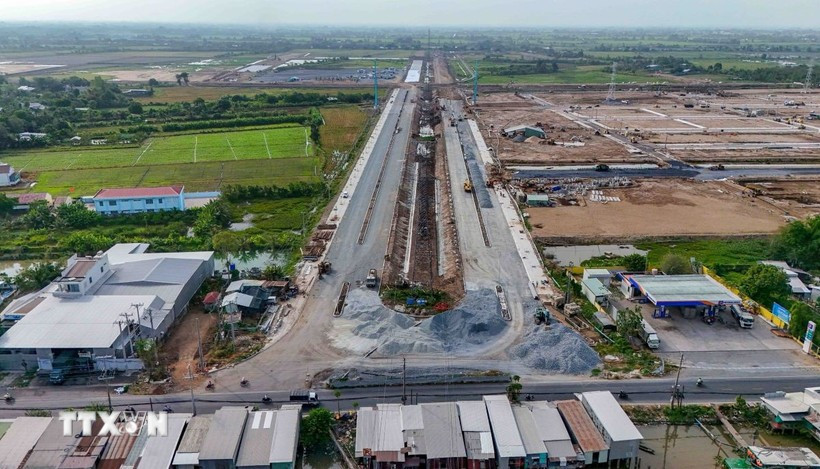
Road leading to VSIP Can Tho at the intersection with National Highway 80 (Photo: VNA)

Can Tho (VNA) - The Mekong Delta region, having earned the monikers of the rice bowl, fruit and seafood basket of the country, and following the restructuring of administrative units, is now standing at the threshold of becoming a modern, sustainable industrial centre.

The global shift towards green production models and the circular economy is opening up a strategic direction, transforming the green industry into a new "magnet" with strong appeal for high-quality foreign direct investment (FDI). The initial success of the Vietnam-Singapore Industrial Park in Can Tho City (VSIP Can Tho) is a clear demonstration of this enormous potential.

VSIP Can Tho is setting a new standard for industrial infrastructure in the Mekong Delta region. Not just offering land leasing and basic infrastructure, it provides a comprehensive ecosystem and acts as a reliable “partner” for investors from the very first steps.

According to Leaw Wee Ming, General Director of VSIP Can Tho Joint Stock Company, the competitive advantage of VSIP lies not only in its strategic location and integrated infrastructure but also in its “one-stop” legal support services. VSIP’s customer service team handles all procedures on behalf of investors, from obtaining the Investment Registration Certificate (IRC) and the Enterprise Registration Certificate (EIC) to dealing with more complex issues related to taxes, land, and permits for foreign experts.

In particular, the concepts of "green" and "sustainability" are seen as the core development philosophy of VSIP Can Tho. The IP is designed with a significant portion of its area dedicated to green spaces and recreational zones. The wastewater treatment system is built according to stringent international standards, ensuring environmental protection requirements are met. At the heart of the green ecosystem at VSIP Can Tho is the renewable energy infrastructure, managed by Becamex-VSIP Power Investment and Development Joint Stock Company (BV Power).

“We will invest in the entire rooftop solar system and energy storage batteries for our customers. Businesses coming here only need to focus on production; the green energy part is taken care of by us,” said Nguyen Ly Trung, Deputy General Director of BV Power.

Although the overall outlook is optimistic, the process of attracting investment to the Mekong Delta still faces certain bottlenecks that need to be addressed.

​Pham Ngoc Thach, Deputy Head of the Legal Affairs Department at the Vietnam Chamber of Commerce and Industry (VCCI), cited surveys on the Provincial Competitiveness Index (PCI) as saying that foreign investors and domestic enterprises have different concerns. While domestic businesses are mostly troubled by cumbersome administrative procedures, FDI investors find the quality of infrastructure, especially transport and logistics, as well as the quality of human resources, to be the biggest obstacles.

Recognising these challenges, the newly merged Can Tho city is taking decisive action. Le Cong Ly, Head of the Management Board of Can Tho Export Processing and Industrial Zones, stated that the city is focusing all its resources on completing strategic infrastructure, particularly the Can Tho–Ca Mau and Chau Doc–Can Tho–Soc Trang expressway axes. New industrial parks and clusters will be planned along these key transport routes to provide the most convenient connectivity for businesses.

In addition, Can Tho has identified improving the investment environment and developing human resources as a key priority. It is committed to creating a transparent and favourable investment environment, while focusing on training a high-quality workforce to meet the requirements of high-tech and green industries./.
VNA

See more

Production at Viet Hai High-Tech Structure Production Company Limited in Vung Ang Economic Zone. Ha Tinh province aims to develop Vung Ang Economic Zone into a regional centre for industry, energy, seaports and logistics (Photo: VNA)

Revised master plan of Vung Ang EZ approved

The adjustment aims to create a more rational development framework to maximise the zone’s potential and advantages while providing a legal foundation for construction management and ensuring sustainable development.

Illustrative image (Photo: VNA)

Vietnam looks to domestic market to sustain wood industry growth

Vietnam’s wood sector has long been a top foreign-currency earner. Exports of wood and wooden products neared 17.3 billion USD in 2025, reaching more than 160 countries and territories and clearing the high bars set by the US, the European Union and Japan.

Delegates at the event (Photo: VNA)

Vietnam remains key market for Polish food producers

The campaign promotes selected European Union agricultural and food products, including fresh, chilled and frozen beef and pork, fresh apples, apple juice and dried apples, targeting consumers, importers, distributors, retailers and the hospitality sector.

Wei Xiaoli, a representative of Shandong Jindafeng Machinery Co., Ltd., in an interview granted to the Vietnam News Agency. (Photo: VNA)

Chinese firms see strong potential for agricultural mechanisation cooperation with Vietnam

Business representatives said mechanisation not only helps reduce reliance on manual labour but also improves production efficiency, shortens planting and harvesting times, reduces post-harvest losses and enhances the quality of agricultural products. For rice-producing countries like Vietnam, they noted, accelerating mechanisation is an inevitable trend to strengthen the competitiveness of the agricultural sector.

Community-led fisheries groups have become frontline defenders of coastal fisheries. (Photo: VNA)

Community-led fisheries groups strengthen IUU fight in Ha Tinh

With a long coastline and abundant inshore fishing grounds, Ha Tinh has long identified the marine economy as a key growth driver. However, growing fishing pressure and destructive practices have posed major management challenges. Community-led self-management initiatives are now providing an effective solution.

At the VIFC-HCMC (Photo: VNA)

700 bln USD for net zero: Vietnam bets on VIFC

Assoc. Prof. Dr. Nguyen Huu Huan, Vice Chairman of the Executive Board of VIFC-HCMC, said the VIFC will focus on building market infrastructure needed to bridge the gap between big investment pledges and bankable projects.

A view of the launch ceremony for the expanded Vietnam–China cross-border QR payment service. (Photo: NAPAS)

Over 1 billion Weixin Pay users can make QR code payments in Vietnam

NAPAS, Weixin Pay, and BIDV will study the rollout of the reverse payment service, enabling users of Vietnamese banking applications and e-wallets to make QR code payments in China, with the aim of completing a comprehensive cross-border payment ecosystem between the two countries.

Vietnam cuts retail fuel prices on August 6. (Photo: VNA)

Vietnam cuts retail fuel prices on August 6

The maximum retail price of E5RON92 biofuel was reduced by 1,160 VND to 21,728 VND (0.83 USD) per litre, while that of E10RON95-III fell by 1,035 VND to 22,324 VND per litre.

Production of electronic components at Star Engineers Vietnam Co. Ltd. in Binh Xuyen I Industrial Park in Phu Tho province. (Photo: VNA)

Vietnam targets higher-quality FDI under Resolution 10

During the first seven months of 2026, Vietnam attracted more than 38 billion USD in registered FDI, up nearly 58% year-on-year. More importantly, the increase was driven by large-scale, high-tech projects rather than a surge in the number of new investments, signalling a significant improvement in the quality of capital inflows.

A woodchip production line at a plant in Vinh Thuy commune, Quang Tri province (Photo: VNA)

Tackling timber supply bottlenecks needed for value-added processing: experts

Vietnam's wood industry has grown rapidly in recent years, with exports reaching 17.2 billion USD in 2025. Wood and wood products are now shipped to more than 140 countries and territories, making Vietnam an important processing hub in the global supply chain, with key markets such as the US, Japan, China, the European Union and the Republic of Korea.