Hanoi's youth: "Beautiful as roses, stronger than steel"

The student movement against French forces blossomed in Hanoi from 1947 to 1954. With a strong sense of patriotism, thousands of students there supported the resistance and became a solid foundation for the Vietnamese revolution, even from within the enemy base.

1.jpeg
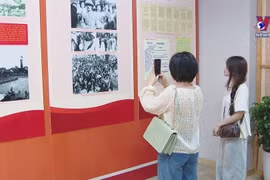
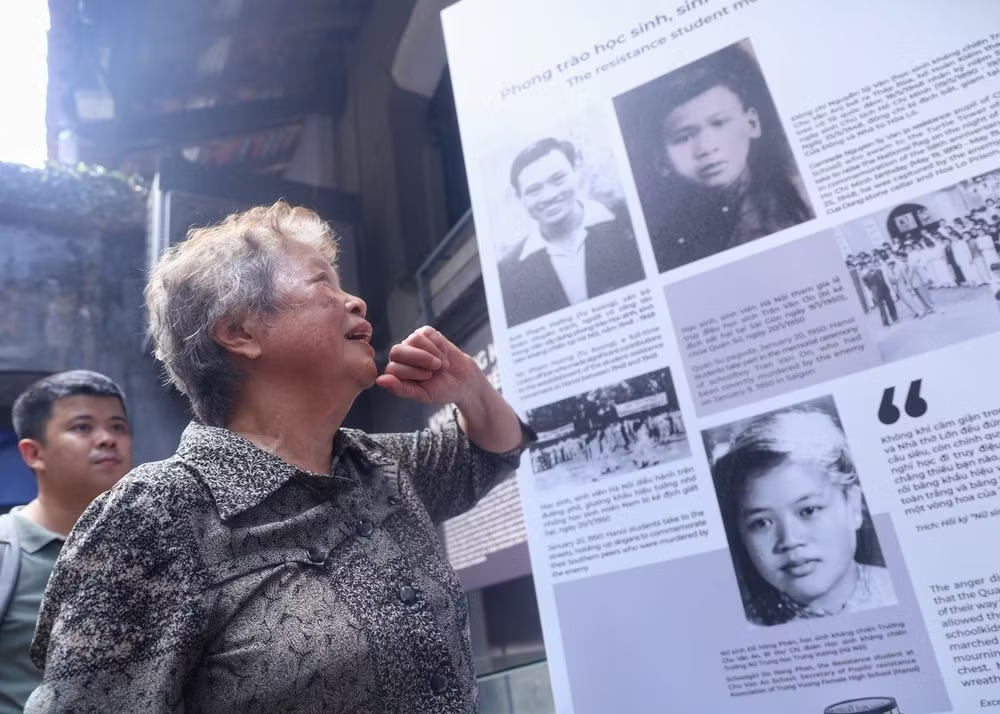
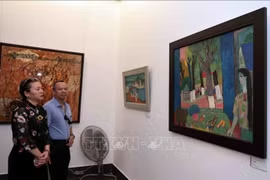
Do Hong Phan looks at pictures of revolutionary activities and figures in her days. (Photo: VNA)

Hanoi (VNA) - The student movement against French forces blossomed in Hanoi from 1947 to 1954. With a strong sense of patriotism, thousands of students there supported the resistance and became a solid foundation for the Vietnamese revolution, even from within the enemy base.

Walking down the cold, dim corridor of the Hoa Lo Prison relic site, Do Hong Phan, 91, former director for international cooperation at the then Ministry of Water Resources (now the Ministry of Agriculture and Rural Development), recalled her days as a young revolutionary. Phan vividly remembered the passionate spirit of Hanoi’s youth, who were willing to face danger for their city, back when she was a high school student at Chu Van An.

“At that time, every Hanoi household had at least one or two young people involved in the resistance, either male or female, in one way or another. Girls, mostly from affluent families, stood side by side with their male friends on the front lines, defending every inch of the capital with a strong resolve,” Phan shared.

Talking about when she first joined the movement in late 1949, she remembered the drive that marked her youth, calling it the most exciting time in her life. By June 1950, the 17-year-old girl was inducted into the Communist Party of Vietnam despite not yet meeting the age requirement. Her induction took place at a storage facility at the Dong Xuan Market in the capital, a base for Dong Xuan women in the resistance.

The revolutionary fervour among Hanoi’s youth often started at home, inspired by older siblings and relatives. Nguyen Dinh Tan, for instance, followed his older brother Nguyen Sy Van, a martyr, into the resistance. On May 18, 1948, Van (born in 1936) and two friends – Nguyen Van Kham and Nguyen Trong Quang – swam to the turtle tower on the heart of Hoan Kiem Lake to hang the national flag, an act that stirred great patriotic pride among the people of Hanoi. Later, Van was sentenced and sent to the labour camp at Khe Tu, Tien Yen. He attempted a daring escape, but was recaptured and tortured to death in prison in 1948.

His steadfast example inspired his younger brother to become actively involved in Hanoi's student resistance movement. Alongside his classmates from the Chu Van An High School, Tan participated in various activities, including performing patriotic songs, distributing leaflets, and organising protests, in a bid to raise awareness, rally support for the revolution, and oppose the conscription of students into the military.
Nguyen DInh Tan.jpg
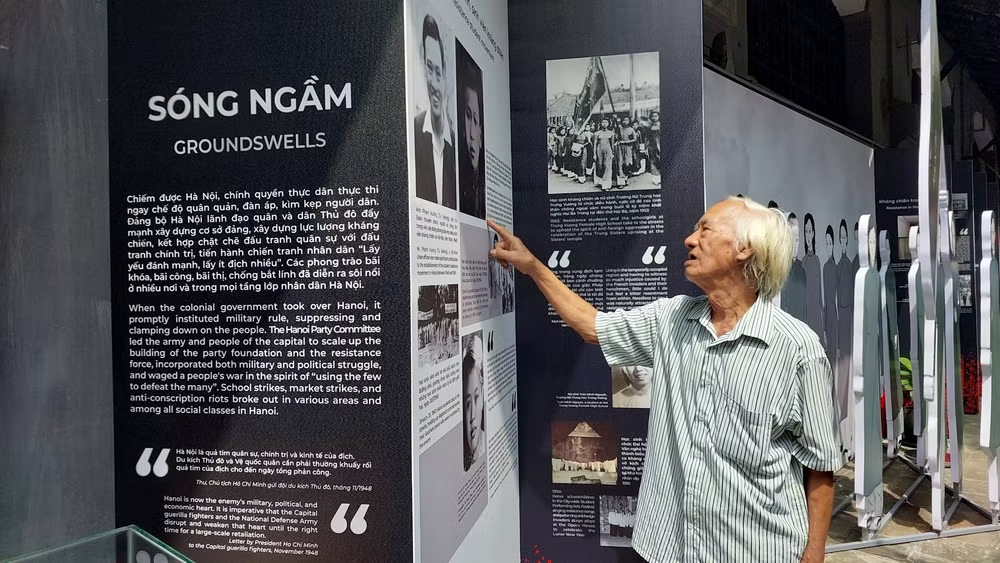
Nguyen Dinh Tan visits the Hoa Lo Prison relic site in downtown Hanoi (Photo: VietnamPlus)

“Student resistance group activities were like waves beneath the surface,” Tan explained. “The enemy constantly tried to quash us, but the more they did, the more determined we became. As one group was arrested, another would take its place.”

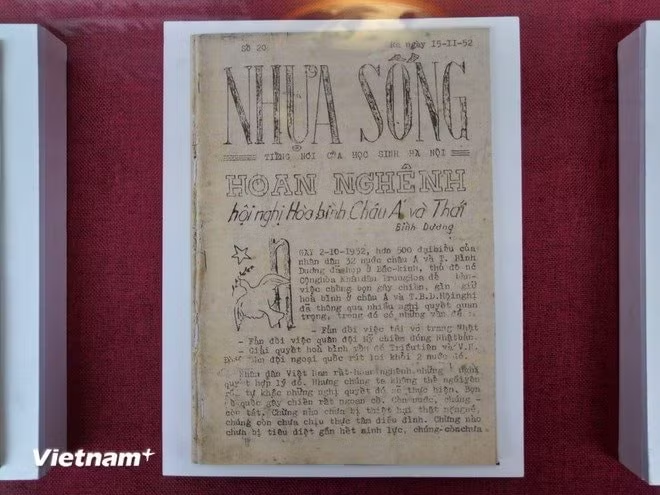
Nguyen Hac Dam Thu (born in 1935), a former Deputy Head of the International Department at the Vietnam Women's Union, was similarly inspired by her cousin, Do Hong Phan. Back then, Thu joined the underground publication Nhua Song, the precursor of Tien Phong newspaper.
nhua song.jpg
A copy of Nhua Song (Photo: VietnamPlus)

Producing and distributing Nhua Song was challenging and dangerous, but essential for spreading revolutionary ideas among the youth. It was printed on small sheets, the size of a notebook, and hidden in students' bags. Beyond distributing the publication through youth organisations, students also took advantage of recess to covertly slip copies into desk drawers or discreetly pass them to classmates, then observing how peers reacted to the paper. Those who quietly tucked it into their bags to read at home were likely supporters of the resistance.

Reflecting on those days, Thu said, “People thought we were privileged students, living comfortably. In reality, we scrimped and saved every penny to support our newspaper. Nhua Song gave us hope and resilience to endure the hardships of living in occupied Hanoi.”

Talking to VietnamPlus, she recounted the intense influence of the paper, which led to the arrest and brutal torture of many student activists by French forces. Despite these arrests, new groups continually emerged, determined to keep the spirit alive so that the underground newspaper continued to pulse within the hearts of a generation fueled by revolutionary fervour, nurturing their hopes for the liberation of Hanoi./.

VNA

See more

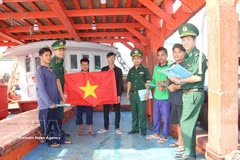
At the handover of 33 Chinese nationals who had violated Vietnamese law to Chinese authorities in Quang Ninh on May 15, 2026. (Photo: VNA)

Vietnam hands over 33 law violators to China

Investigations found that the individuals had violated Vietnamese laws relating to illegal entry and unlawful residence in Vietnam. The handover was conducted safely and in compliance with Vietnamese law and international practice.

At the talks between authorities of the northern province of Lang Son and Pingxiang city in the Guangxi Zhuang Autonomous Region of China (Photo: VNA)

Vietnam, China seek to build modern, smart border gates

Authorities of the northern province of Lang Son and Pingxiang city in the Guangxi Zhuang Autonomous Region of China held talks on May 15 at Tan Thanh (Vietnam) – Po Chai (China) clearance point near markers 1090–1091 in Hoang Van Thu commune of Lang Son to promote trade, develop smart border gates and expand cross-border tourism cooperation.

The Vietnam Association for Victims of Agent Orange (VAVA) has carried out various activities to support Agent Orange/dioxin victims. (Photo: VNA)

Over 9.3 billion VND raised for AO/dioxin victims in 2025

VAVA President Lieutenant General Nguyen Huu Chinh said that although the war ended more than 50 years ago, the consequences of toxic chemicals remain severe and long-lasting, with millions of people affected during the war and hundreds of thousands continuing to suffer serious physical impacts in peacetime.

An overview of the meeting (Photo: VNA)

Measures sought to accelerate construction of inter-level boarding schools in border areas

The construction of boarding schools in land border communes is a particularly important political task receiving close attention from the Politburo and Party General Secretary and State President To Lam. The programme not only aims to improve learning conditions for students in border areas, but also carries strategic significance for social welfare, human development, national defence and security, and safeguarding territorial sovereignty.

An overview of the court on May 14 (Photo: VNA)

Man gets life sentence for terrorism, anti-State activities

The People’s Court of Ho Chi Minh City on May 14 handed down life imprisonment to Dao Minh Quan on charges of “terrorism aimed at opposing the people’s administration” and “activities aimed at overthrowing the people’s administration”.

Secretary of the Ho Chi Minh Communist Youth Union Central Committee and VYF President Nguyen Tuong Lam addresses the event (Photo: VNA)

“I love my fatherland” journey 2026 launched

The “I Love My Fatherland” journey will comprise seven stages linked to historical, cultural and revolutionary sites across the country. The journey will begin in Nghe An on May 16 to mark President Ho Chi Minh’s birthday, before continuing through Hue city, Tuyen Quang–Lung Cu Flag Tower, Dien Bien, Khanh Hoa, Ca Mau and Ho Chi Minh City, and concluding in Hanoi in October.

Students in the Mekong Delta city of Can Tho are honoured for their outstanding performance in startup activities. (Photo: VNA)

Education ministry targets five digital technology incubators at universities

A key target under the new plan is the establishment of five digital technology incubators, or Deeptech Hubs, at universities and research institutes with strong potential. The education ministry also plans to launch a training programme for 1,000 outstanding technology entrepreneurs and develop criteria for selecting and supporting startup ecosystems within educational institutions.

At the equipment handover ceremony for the Narcotics Targeting Centre of Vietnam Customs. (Photo: cand.com.vn)

Vietnam Customs expands capacity to tackle cross-border narcotics crime

Established in November 2025, the NTC comprises six officers from the Anti-Smuggling Investigation Sub-Department specialising in surveillance, intelligence collection and information analysis. The centre is tasked with strengthening customs capacity in risk assessment and drug crime targeting, helping authorities detect and prevent illicit cross-border trafficking of narcotics and other dangerous substances at an early stage.

Representatives of the Club of Cambodian Journalists and the Vietnam Journalists Association at the working session in Hanoi on May 12 (Photo: VNA)

Vietnamese, Cambodian journalists strengthen cooperation

The Vietnam Journalists Association and the Club of Cambodian Journalists agreed to enhance coordination and information sharing between media agencies, exchange experience in professional training and technology application in journalism, and regularly organise training programmes for reporters and editors.

Ca Mau province has consistently attached importance to developing human resources and investing in infrastructure in ethnic minority areas. (Photo: VNA)

Vietnam steps up implementation of ethnic affairs strategy through 2030

To accelerate the implementation of the the Ethnic Affairs Strategy by 2030, with a vision toward 2045, the Prime Minister requested ministries, agencies and local authorities to continue thoroughly carrying out the Party and State’s policies on ethnic affairs, enhancing the effectiveness of State management and strengthening oversight of policy implementation.