HCM City to boost urban agriculture linked with tourism

Ho Chi Minh City aims to promote sustainable urban agriculture linked with tourism, as well as digital transformation in this field this year, heard a conference held on January 10.

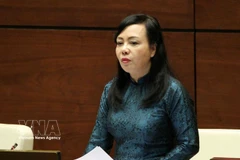
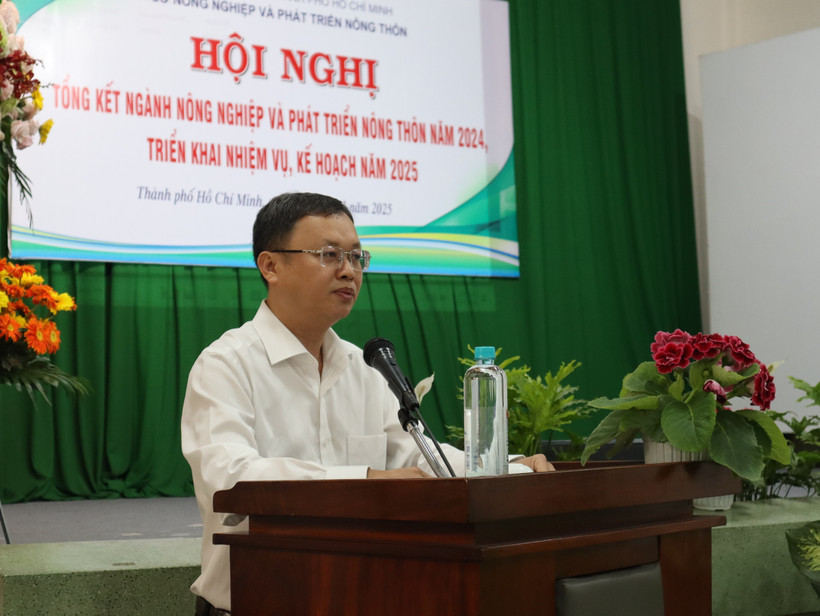
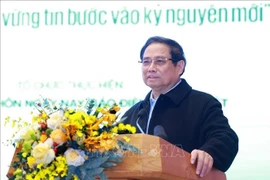
Nguyen Xuan Hoang, acting Director of HCM City's Department of Agriculture and Rural Development, speaks at the conference on January 10. (Photo: VNA)

HCM City (VNA) - Ho Chi Minh City aims to promote sustainable urban agriculture linked with tourism, as well as digital transformation in this field this year, heard a conference held on January 10.

This is among the tasks for this year identified by the municipal Department of Agriculture and Rural Development.

Highlighting this year's priorities, Nguyen Xuan Hoang, acting Director of the municipal Department of Agriculture and Rural Development, said to continue implementing the urban agriculture strategy for 2021 - 2030, with a vision to 2050, the city will focus on developing eco-friendly production models, key and potential agricultural products, along with advanced new-style countryside and urbanisation in outlying areas. Besides, it will step up researching and applying biotechnology to produce high-quality and high-yield crop varieties and animal breeds in order to become a regional hub in this regard.

Efforts will also include effectively implementing specific policies and mechanisms to attract investment to agricultural production and services along with rural areas. Support will also be provided for connecting production and the market.

For 2025, the local agricultural sector targets a growth rate of 1 - 1.5%, with the production value reaching 650 - 750 million VND (25,600 - 29,500 USD) per hectare and high-tech farming accounting for 50 - 60% of the total agricultural production value.

To that end, the department will focus on transitioning from traditional agriculture with low efficiency to urban and highly efficient one while fostering high-tech, organic and circular production. Land use will be optimised by shifting from low-yield crops to more profitable alternatives.

The city will also expand concentrated production zones tied to value chains in line with with national and local plans, including the national green growth strategy and the HCM City Master Plan for 2021 - 2030.

Rural development targets include 50% of the communes meeting advanced new-style rural area standards, two rural districts meeting the advanced standards, and at least 93 OCOP (One Commune, One Product) items rated at least three stars.

Despite challenges like shrinking farmland, the city agricultural sector reported growth in 2024. The agricultural, forestry, aquatic production value approximated 20 trillion VND, up 0.2 year on year, according to the department.

Vice Chairman of the municipal People’s Committee Vo Van Hoan praised these achievements, underscoring the sector's role in maintaining stability in rural areas and developing urban and high-tech farming in southern Vietnam.

In the coming time, he noted, the sector should will further promote green agriculture, digital transformation, and development plans for key and potential products./.
VNA

See more

Hanoi has over 1,100 libraries and numerous cultural and educational spaces in the community. (Photo: VNA)

Spreading value of books, building foundations of learning society

Each weekend in Hanoi, the “Reading with Children” Club brings together students to practise reading, explore language, and express ideas creatively. According to founder of the club Nguyen Thuy Anh, the club encourages children to reflect, retell stories, and connect books with personal experiences, making reading more vivid and meaningful.

Automated ticketing system is used on the urban railway Cat Linh-Ha Dong line in Hanoi. (Photo: VNA)

Digital transformation powers Hanoi metro expansion

Beyond convenience, stable fares and the elimination of fuel, parking and maintenance costs have made urban rail increasingly attractive. The growing preference for metro travel is also contributing to a greener, more modern urban lifestyle.

Delegates cut the ribbon to inaugurate the operation of electric bus route No. 43. (Photo: VNA)

Hanoi accelerates shift to green buses, targets 100% by 2030

In the 2027–2030 period, the city will accelerate the transition towards the complete phase-out of fossil fuel-powered buses. The share of electric and green energy-fueled buses is projected to reach 79–89% by 2029 and 100% by 2030.

At the second session of the Ho Chi Minh City People’s Council (Photo: VNA)

Ho Chi Minh City greenlights central square, administrative centre in Thu Thiem

The new central city square and administrative centre will create a modern, centralised political-administrative complex for Ho Chi Minh City, designed to house around 8,000 officials, civil servants, and employees. It will also handle daily traffic of 1,500- 2,000 citizens and business representatives through a unified one-stop-shop administrative service system.

A working session at the job fair (Photo: VNA)

Vietnamese students flock to Seoul Job Fair 2026

The second annual Job Fair 2026 was held for Vietnamese students in the Republic of Korea. Organisers pitched it as a straight-up bridge between eager students and bosses hungry for young talent who can actually handle multicultural workplaces.

Defendants at the court (Photo: VNA)

Ho Chi Minh City court opens trial over Agribank lending scandal

The investigation revealed that multiple credit files were incomplete or riddled with inaccurate information, while some pledged assets lacked proper legal standing yet were accepted and grossly overvalued. As a result, the loans became high-risk and largely unrecoverable, leading to losses surpassing 1 trillion VND.

Hanoi introduces 53 electric buses from April 18 (Photo: VNA)

Hanoi to add 53 electric buses from April 18

According to the plan, all buses operating within Ring Road 1 will use green energy by July 1, 2026. The requirement will expand to Ring Road 2 by January 1, 2028, and to Ring Road 3 by 2030.

Illustrative image (Photo: VNA)

National, local traffic safety committees to be dissolved from June 1

Under the dicision, ministries and ministerial-level agencies will assume responsibility for tasks previously performed by the committee, in line with their mandates under the Law on Government Organisation, the Law on Road Traffic Order and Safety, the Law on Roads and other relevant legal frameworks, ensuring that traffic safety and order are maintained without disrupiton.