Ho Chi Minh City sees need to build tourism security shield

The rapid growth of tourism, together with the expansion of travel businesses and new tourism services, have created fresh challenges for state management, particularly in maintaining security and public order.

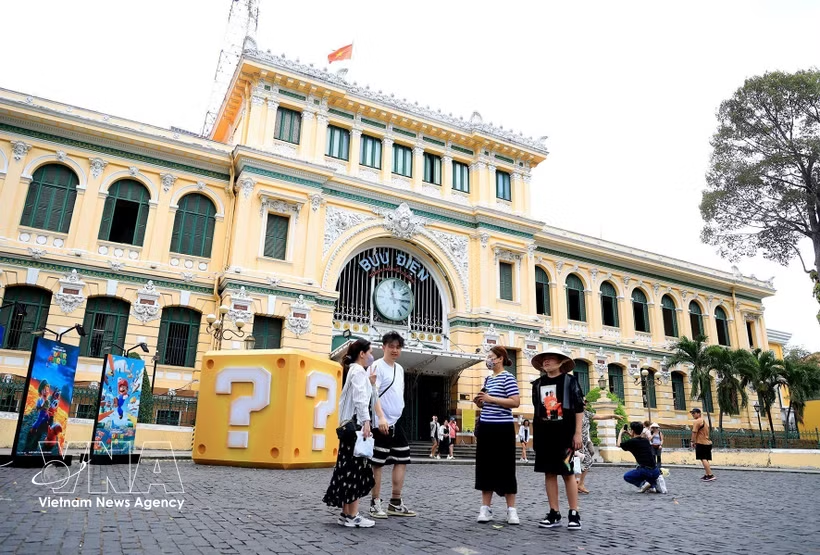
The Saigon Central Post Office, a unique architectural landmark in the heart of Ho Chi Minh City. (Photo: VNA)

Ho Chi Minh City (VNA) – As Vietnam’s largest economic, cultural and tourism hub and a major gateway for international visitors, Ho Chi Minh City is stepping up measures to strengthen tourism security and ensure a safe, friendly and attractive environment for tourists.

The rapid growth of tourism, together with the expansion of travel businesses and new tourism services, have created fresh challenges for state management, particularly in maintaining security and public order.

Le Truong Hien Hoa, Deputy Director of the municipal Department of Tourism, said ensuring security, safety and order for tourists, businesses and tourism activities is essential to enhancing management efficiency and building the city’s image as a safe, friendly, attractive and responsible destination.

The requirement has become more pressing as the city expanded its administrative boundaries through the merger with former Binh Duong and Ba Ria-Vung Tau provinces and adopted the two-tier local administration model. Close coordination and timely information sharing between the tourism sector and police are therefore increasingly important.

Ho Chi Minh City is home to 1,906 travel businesses, 77 travel agencies and 20 representative offices of foreign tourism enterprises, along with 4,805 accommodation establishments offering more than 106,000 rooms. The city also has over 9,000 licensed tour guides and 39 recognised tourism sites and destinations.

Between 2021 and 2025, the city served about 155.2 million tourist arrivals, including more than 20.8 million international visitors and 134.3 million domestic tourists.

During the period, local police detected and handled 8,436 cases involving foreigners violating immigration regulations, collecting nearly 56 billion VND (2.1 million USD) for the state budget.

However, the emergence of increasingly sophisticated online scams, along with touting, overcharging, service disputes and theft, requires tourism security measures to be continuously reviewed and improved.

Nguyen Tam Ha, Deputy Director of the Ho Chi Minh City Tourism Promotion Centre, said the rapid increase in international arrivals, the expansion of digital platforms and the growth of new services require stronger management and tourist support.

She stressed that tourism promotion should go beyond showcasing attractions to position the city as a safe, friendly and reliable destination.

The centre has integrated information about tourist information and support stations, provided guidance on scam prevention and property protection for visitors, and introduced QR codes at tourist sites to facilitate access to information and emergency reporting, Ha added.

Meanwhile, police are promoting legal guidance as an early prevention measure, administrative reform and digital transformation while strengthening inspections and management to prevent and combat crimes involving foreigners, according to Lieutenant Colonel Tran Van Thanh, deputy head of the immigration unit under the municipal Department of Public Security.

To improve management, the immigration unit proposed closer coordination between police and the tourism sector in legal dissemination, information sharing and specialised inspections of accommodation and travel service providers serving large numbers of foreigners. It also called for stronger guidance and training for businesses, particularly short-term rental apartments, homestay facilities and serviced apartments, in temporary residence declarations and foreigner management.

The municipal Department of Public Security and Department of Tourism have signed a new coordination agreement for 2026–2031 on ensuring security and improving tourism management. The agreement aims to translate the resolution of the 3rd plenum of the 14th Party Central Committee on building a disciplined, safe, civilised, harmonious and developed society, and the Prime Minister’s Directive No. 24/CT-TTg, dated May 28, 2026, on strengthening national security protection and ensuring social order and safety in tourism activities into practical measures, helping turn Ho Chi Minh City into one of the region’s leading safe, civilised and attractive destinations./.
VNA

See more

Resorts set along some of the world’s most beautiful beaches make a vacation in Phu Quoc even more rewarding. Photo: Premier Village Phu Quoc.

Thailand's newspaper spotlights Phu Quoc as luxurious vacation island for 2026

In an article highlighting islands suited to luxury vacations, Thairath placed particular emphasis on Phu Quoc’s appeal to Thai travellers. The newspaper described Vietnam’s largest island as an ideal choice for those seeking the privacy and comfort of a five-star retreat without spending hours in transit.

Karst limestone mountains in the Phong Nha - Ke Bang National Park, with large cave entrances opening amid the primeval forest, reflect a geological formation process spanning millions of years. (Photo: VNA)

Phong Nha - Ke Bang named among Vietnam’s 11 most beautiful destinations

According to the magazine, boat trips into Phong Nha Cave and strolls through Paradise Cave (both family-friendly) offer a tantalising glimpse of their astonishing scale, but the real adventure lies deeper within the park, where cavers wade through underground rivers and weave among stalagmites.

The Trang An Festival 2026 opens at Trang An Ecotourism Site in Ninh Binh province on May 3 (Photo: VNA)

Tourism seeks new growth momentum under Resolution 26

Tourism effectiveness should be measured not only by visitor numbers and revenue, but also by spending, length of stay, repeat visits, job quality, visitor satisfaction and environmental carrying capacity, said experts.

Vietnam welcomes nearly 2 million international visitors in August, up 19.7% from July and 18.4% year-on-year. (Illustrative photo: VNA)

Vietnam tourism maintains strong growth, expands international markets

The National Statistics Office under the Ministry of Finance reported that Vietnam welcomed nearly 2 million international visitors in August, up 19.7% from July and 18.4% year-on-year. The figure represented 63.6% of the tourism sector’s full-year target of 25 million arrivals.

News website news.ru reports that the number of Russian visitors to Vietnam could reach a historic record of 1.5 million in 2026. (Photo: VNA)

Russian arrivals to Vietnam forecast to reach record high

Russian arrivals to Vietnam surpassed 1 million in the first eight months of 2026, representing a remarkable 165.7% increase year-on-year. This was the highest growth rate among Vietnam’s major international tourist markets.

Secretary of the Party Central Committee and Deputy Prime Minister Pham Thi Thanh Tra speaks at the conference. (Photo: VNA)

Vietnam moves to make tourism a true new growth driver

Resolution No. 26-NQ/TW, issued on August 22, sets out a new vision, with a focus on fundamentally renewing the mindset, methods and approaches to tourism development and governance, shifting from quantity to quality and increasing the sector’s contribution to the national economy.

Tourists visit Golden Bridge in Da Nang city in the rainy season. (Photo: hanoimoi.vn)

Turning rainy season into tourism opportunity

Seasonality has long been a challenge for Vietnam’s tourism industry. In many localities, tourism peaks in summer but visitor numbers fall during the rainy months. Destinations are now seeking to restructure their tourism ecosystems and develop products that can operate year-round.

A pot of Mi Quang (Quang noodles). (Photo: VNA)

Da Nang promotes distinctive cuisine as key tourism attraction

As travellers increasingly seek authentic local experiences, the central coastal city of Da Nang is stepping up efforts to integrate cuisine into tourism itineraries, linking culinary promotion with destination branding and cultural preservation.

Flower vendors form a distinctive feature of Hanoi’s autumn. (Photo: VNA)

Hanoi builds four-season tourism appeal

Hanoi’s tourism events are increasingly designed to inspire exploration beyond individual festivals. At the Hanoi Tourism Gift Festival, for instance, visitors can make handicrafts with artisans, explore destinations through virtual reality and discover new tours and tourism stimulus programmes.

A view of the Lo Lo Chai community tourism village in Tuyen Quang province (Photo: VNA)

Vietnam taps community tourism potential for sustainable development

The tourism market is shifting from sightseeing towards living and connecting with destinations. Visitors increasingly seek authentic and locally rooted experiences, interaction with local people, culture and nature, as well as small-group and personalised trips with limited environmental impact and clear benefits for communities.