Sustainable travel gains momentum among Vietnamese tourists: Booking.com report

According to the online travel platform Booking.com, 85% of Vietnamese travellers consider sustainable travel a priority, while the same proportion want their trips to leave a positive impact on destinations.

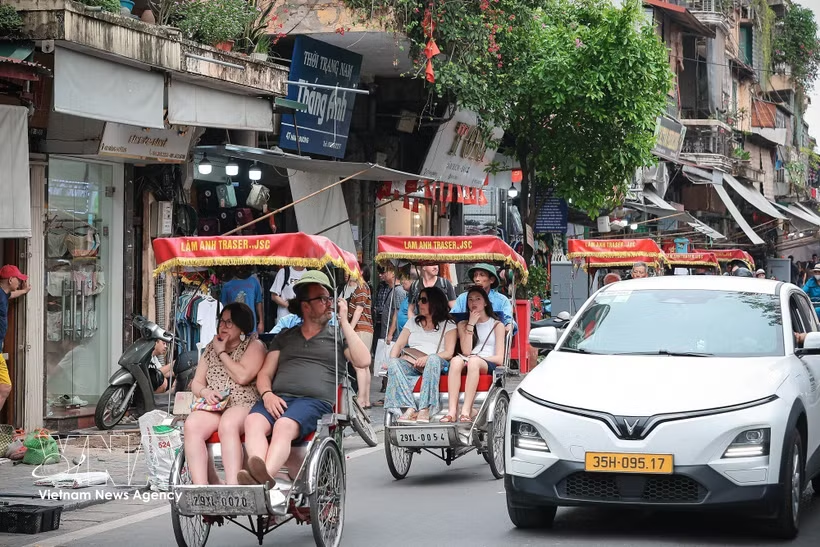
Visitors explore Hanoi's Old Quarter by cyclo, experiencing the capital's distinctive architecture and vibrant daily life (Photo:VNA)

Hanoi (VNA) – Sustainable tourism is becoming a defining trend among Vietnamese travellers as they increasingly seek to balance memorable experiences with positive contributions to local communities and the environment, according to Booking.com's 11th annual Travel & Sustainability Report.

The report points to a shift in travel behaviour, with holidays no longer seen solely as opportunities for leisure but also as a way to support local economies, preserve cultural heritage and reduce environmental impacts.

According to the online travel platform, 85% of Vietnamese travellers consider sustainable travel a priority, while the same proportion want their trips to leave a positive impact on destinations.

Based on a survey of 32,500 respondents across 35 countries and territories, the report shows broad recognition of tourism's economic benefits. In Vietnam, 76% of respondents view tourism as a positive driver of economic growth.
Among those surveyed, 60% said tourism has boosted local economies, 55% cited increased employment opportunities, and 50% noted a wider range of entertainment and tourism services, highlighting the industry's contribution to livelihoods and local development.

However, respondents also acknowledged tourism's downsides. Around 41% expressed concerns over traffic congestion and waste, 32% cited rising living costs, and 25% were worried about overcrowding, underscoring the need to balance tourism growth with environmental and cultural preservation.

The report suggests easing pressure on popular destinations by encouraging travellers to explore lesser-known locations. In Vietnam, emerging destinations such as Phu Yen and Ninh Thuan, with their unspoiled coastlines, and Cao Bang and Mu Cang Chai, known for their majestic landscapes and slower pace of life, offer attractive alternatives.

Spreading visitor flows more evenly can reduce pressure on infrastructure in major tourism hubs while creating more equitable economic opportunities for remote regions, where tourism revenue is vital for local communities.

The report also encourages travellers to venture beyond the busiest areas in major cities. In Bangkok, for example, choosing the quieter Ari neighbourhood instead of the bustling Thonglor district offers a more authentic local experience.

Travelling during the off-season is another growing trend. About 35% of Vietnamese travellers said they intentionally avoid peak periods to escape crowds and enjoy a more relaxed experience. More even visitor numbers throughout the year can also provide local businesses with steadier incomes.

Transport choices are another key element of sustainable tourism. Nearly half of Vietnamese respondents hope for better public transport to support tourism.

Walking, cycling and using buses or metro systems in cities such as Hanoi and Ho Chi Minh City can help reduce carbon emissions while allowing visitors to experience local life more closely. Traditional cyclo rides also support local drivers while preserving a distinctive cultural feature.

Tourist spending patterns are equally important. Rather than patronising international restaurant chains or buying mass-produced souvenirs, travellers are increasingly encouraged to support family-run eateries and local artisans. The report found that 38% of Vietnamese travellers plan to prioritise small businesses, helping preserve traditional crafts while ensuring tourism revenue benefits local communities.

Environmental responsibility is also gaining importance. With waste pollution remaining a challenge at many tourist sites, 54% of Vietnamese travellers said they intend to reduce waste during their trips.

Simple actions such as carrying reusable water bottles and cloth bags or staying on designated trekking trails can help protect fragile ecosystems. The report also encourages tourism businesses to develop conservation-focused experiences, including sea turtle protection programmes in Con Dao and trekking tours combined with tree planting and litter collection.

According to Booking.com, sustainable tourism is not an abstract or distant concept. As travellers increasingly recognise their role within the tourism ecosystem, travel is evolving beyond sightseeing into an opportunity to learn, to connect, to give back, and to help protect the places and communities they visit./.

VNA

See more

Ruwan Ranasinghe, Deputy Minister of Tourism at Sri Lanka's Ministry of Foreign Affairs, Foreign Employment and Tourism, speaks at a Vietnamese tourism promotion event in Colombo on the evening of July 31, 2026. (Photo courtesy of Vietnamese Embassy in Sri Lanka)

Vietnam steps up tourism promotion ahead of direct flights to Sri Lanka

The new direct routes will not only shorten travel times between Vietnam and Sri Lanka but also provide fresh impetus for cooperation in tourism, trade, investment and people-to-people exchanges, helping to deepen the longstanding bilateral friendship in a more substantive and comprehensive manner.

Experiences in Phu Quoc made a Dubai traveler describe the destination as “far exceeded expectations.” (Photo: Fabl Belek)

What makes Dubai visitors say Phu Quoc “far exceeded expectations”?

While Phu Quoc was once primarily known for its turquoise waters, white-sand beaches, and beachfront resorts, the island is now attracting visitors with a full-day journey of experiences stretching from morning until night, rather than simply offering a traditional beach holiday.

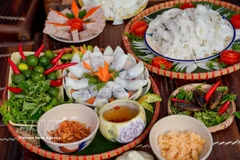
The craft of making banh cuon Thanh Tri (Thanh Tri steamed rice rolls) has officially been recognised as part of Vietnam’s National Intangible Cultural Heritage, upholding Hanoi’s long‑standing culinary traditions (Photo: VNA)

Hanoi ranks among world's top 10 street food cities

With its rich culinary diversity, distinctive flavours and affordable prices, Hanoi's street food has long been one of the capital's signature tourism products, helping promote its image and attract an increasing number of international visitors.

International tourists enjoy boat tour in Tam Coc, Ninh Binh province. (Photo: VNA)

Red River Delta: Turning potential into tourism advantages

Vu The Binh, Chairman of the Vietnam Tourism Association (VITA), said provinces should strengthen regional cooperation by developing integrated tourism routes linking Hanoi, Quang Ninh, Hai Phong, Ninh Binh and neighbouring localities such as Hung Yen and Bac Ninh. Such cooperation would create complementary tourism products instead of isolated competition.

The wedding of an Indian couple in Da Nang. Vietnam is gradually becoming a hot wedding destination for global billionaires. (Photo courtesy of the Da Nang Culture, Sports and Tourism Department)

Vietnam emerges as premier wedding destination

With advantages such as scenic landscapes, increasingly developed infrastructure and the capacity to host large-scale events, Vietnam is well-positioned to develop wedding tourism into a specialised product, helping to attract high-spending visitors and enhance the destination's competitiveness, an official has said.

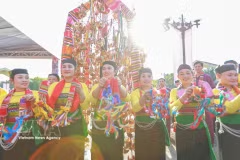
An ethnic festival at the Vietnam National Village for Ethnic Culture and Tourism (Photo: VNA)

Hanoi brings new life to suburban tourism villages

Hanoi has long been known for the heritage cachet of a thousand-year-old capital. Hoan Kiem Lake, the Old Quarter, the Temple of Literature, the Thang Long Imperial Citadel and a network of craft villages have given the city a singular pull.

A booth promoting Ho Chi Minh City's tourism is set up at Tan Son Nhat International Airport. (Photo: VNA)

Integrated tourism strategy draws more visitors to Ho Chi Minh City

According to the municipal Department of Tourism, the city welcomed more than 7.1 million international visitors from January to July, up 42.7% year-on-year, while domestic tourists reached 31.6 million. Tourism revenue surged 55.3% to nearly 237.5 trillion VND (9.01 billion USD), achieving 72% of this year's target.

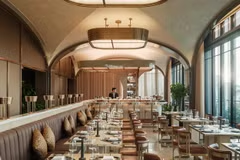
The elegant rooftop setting of The Hudson Rooms at Capella Hanoi.

A Sun Group hotel's bar makes Asia's 50 Best Bars

The Hudson Rooms, the rooftop bar perched atop Capella Hanoi, has been ranked No. 46 in Asia's 50 Best Bars 2026. It marks the first time a bar in Hanoi has entered Asia's Top 50, making Vietnam one of the few countries represented in this highly respected ranking. This year, only two Vietnamese bars secured a place in the Top 50.

An artistic performance at the "Ky Anh Tunnels – Epic Beneath the Earth" programme. (Photo: Nhandan.vn)

Da Nang builds heritage tourism around Ky Anh Tunnels

The 2026 Ky Anh Tunnels–Dam River Reed Bed Cultural and Tourism Festival featured a rich programme of cultural, tourism and sporting events, including art performances, traditional ceremonies at Thach Tan and Vinh Binh communal houses, a re-enactment of soldiers returning to their village during wartime, a fish and shrimp release to replenish aquatic resources in the Dam River, and a community folk dance contest.

Thailand has become the sixth international destination of Vietnam's newest carrier, Sun PhuQuoc Airways. (Photo: The courtesy of Sun PhuQuoc Airways)

Thailand is sixth international destination of Vietnam's newest airline

Speaking at the recent launch event for the Bangkok route, La Vinh Nam, the airline's Deputy Commercial Director, said the full-service carrier, owned by Vietnam's Sun Group, views Thailand as an important partner in promoting two-way tourism and attracting international transit passengers, rather than as a competitor.

Vietnam Railways has introduced a range of tourism, heritage and dedicated train services, attracting growing numbers of passengers. (Photo: VNA)

Railways reinvent themselves with tourism, heritage trains

One of the most notable successes is the premium Hoa Phuong Do (Flamboyant Flower) train operating between Hanoi and Hai Phong city. Since entering service in May 2025, the train has completed nearly 3,000 trips and carried around 1.33 million passengers.

A rammed-earth house of the Mong ethnic community in the mountainous province of Tuyen Quang. (Photo: VNA)

Heritage fuels distinctive destination brands across Vietnam

As localities move beyond resource-based tourism towards value-driven cultural development, they are creating distinctive destination brands while reinforcing Vietnam's position as a culturally rich and compelling destination on the global tourism map.

Foreign tourists explore Hoi An ancient town in Da Nang city. (Photo: VNA)

Tourism sector pivots to quality-led growth in second half of 2026

According to the Vietnam National Authority of Tourism (VNAT), Vietnam welcomed 12.3 million international visitors in the first six months of 2026, up 15% year-on-year. The figure is the highest first-half number in recent years and puts the country close to halfway towards its target of 25 million foreign arrivals this year.

Travel guide Lonely Planet describes Da Nang as an outdoor lover’s paradise. (Photo: VNA)

Da Nang proves Lonely Planet right as Asia’s must visit summer destination

According to Lonely Planet, Da Nang stands out for its harmonious blend of beautiful beaches, an energetic yet relaxed lifestyle, a rich culinary scene and a diverse range of experiences spanning nature, culture, leisure and entertainment. The city is also praised as an ideal gateway to central Vietnam, offering convenient access to Hoi An, Hue and My Son Sanctuary.

Sun PhuQuoc Airways' new aircraft livery (Photo: Sun Group)

Vietnam's newest airline races from Phu Quoc onto the global stage

Sun PhuQuoc Airways, the airline of Sun Group, officially launched in October 2025 and began commercial flights the following month, entering a Vietnamese aviation market riding a wave of post-pandemic recovery, but also grappling with rising costs, fleet constraints, talent shortages, infrastructure pressure, and intensifying service competition. Less than a year in, this newcomer has already made its presence felt.

A Korean tourist family poses for a photo in the coastal city of Da Nang. (Photo: VNA)

Vietnam remains second most popular destination for Korean tourists

Japan remained the top destination, attracting about 951,000 Korean visitors, accounting for 40.6% of total outbound tourists. Vietnam ranked second with approximately 278,000 visitors, followed by the US with 100,000, Taiwan (China) with 79,000, Thailand with 64,000, the Philippines with 61,000 and Hong Kong (China) with 59,000.

Tourists explore a tourist attraction in Hue city. (Photo: VNA)

Wellness tourism helps Hue shape identity as Asia’s emerging "healing city"

The development of wellness tourism is also aligned with the Politburo's Resolution No. 57-NQ/TW on breakthroughs in science and technology development, innovation and national digital transformation. For Hue, the strategy provides an opportunity to combine modern medicine with traditional healthcare, biotechnology, indigenous medicinal herbs and tourism to create high-value services.