Indonesian President approves seven key strategies to stabilise rupiah

Indonesia’s foreign exchange reserves are more than sufficient to stabilise the rupiah, said Bank Indonesia (BI) Governor Perry Warjiyo.

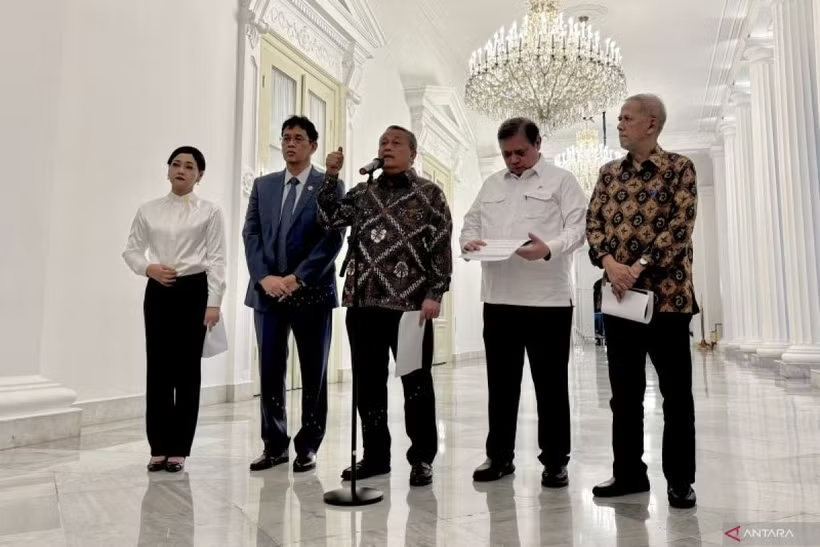
Bank Indonesia Governor Perry Warjiyo (centre) outlines seven strategies to strengthen the rupiah during a press briefing at the Merdeka Palace courtyard in Jakarta, May 5, 2026. (Photo: ANTARA)

Jakarta (VNA) – Bank Indonesia (BI) Governor Perry Warjiyo announced that President Prabowo Subianto has officially approved seven major intervention strategies aimed at strengthening and stabilising the rupiah, which has come under severe depreciation pressure in recent days.

​Speaking at a press conference following an emergency meeting between the President and the Financial System Stability Committee (KSSK) on the evening of May 5, Perry said BI possesses ample resources to support the currency. Referring to the first strategy of intensifying foreign-exchange market intervention, both onshore and offshore, he stressed that Indonesia’s foreign exchange reserves are more than sufficient to stabilise the rupiah.

​To address capital outflows, the second and third strategies focus on issuing Rupiah Securities (SRBI) to attract foreign capital and offset withdrawals from the stock market and government bonds (SBN). BI will also coordinate closely with the Finance Ministry. Since the beginning of this year, the central bank has purchased 123.1 trillion IDR (nearly 7.5 billion USD) worth of SBN from the secondary market.

​Notably, to curb foreign currency speculation and hoarding, the fourth and fifth strategies involve tightening limits on US dollar purchases in the domestic market for transactions lacking supporting underlying assets. The monthly ceiling for dollar purchases has been reduced from 100,000 USD to 50,000 USD per person.

​Perry also said that BI is preparing to further lower the limit to 25,000 USD, under which all dollar purchases from 25,000 USD upward would require proof of underlying assets. At the same time, BI reaffirmed its commitment to maintaining accommodative liquidity for the banking system.

​To diversify intervention tools, the sixth strategy allows domestic banks to sell offshore non-deliverable forwards (NDFs) to boost foreign currency supply.

​Finally, the seventh strategy focuses on systemic risk control. BI will work with Indonesia’s Financial Services Authority (OJK) to dispatch inspection teams to banks and business groups recording unusually high USD purchases in order to safeguard national financial security./.

VNA

See more

Aftermath of the fatal collision between a passenger bus and a tanker truck in the Trans-Sumatra Road in North Musi Rawas district, South Sumatra, Indonesia, on May 6, 2026. (Photo: ANTARA)

Indonesia: Bus–tanker collision leaves multiple dead

The North Musi Rawas Regional Disaster Mitigation Agency (BPBD) rescue officers are coordinating with traffic police to carry out evacuation efforts, focusing on clearing the accident site and assisting the victims.

ASEAN Secretary-General Kao Kim Hourn (Photo: VNA)

ASEAN chief spotlights Vietnam’s role in shaping bloc’s future

Vietnam is expected to maintain active contributions across ASEAN’s three pillars - the political-security community, the economic community, and the socio-cultural community; while further enhancing regional connectivity through infrastructure projects and stronger economic linkages.

Representatives of the Vietnamese community in India welcome Party General Secretary and State President To Lam in New Delhi on May 5, 2026. (Photo: VNA)

India media hails Vietnamese leader’s visit as catalyst for stronger strategic partnership

Indian news outlets noted that Vietnam is currently one of India’s most important partners in Southeast Asia, particularly as the two sides share strategic interests in the Indo-Pacific region. Priority areas for cooperation include defence and security, trade and investment, digital transformation, high technology, supply chain connectivity, and maritime collaboration.

Portable solar panels charge a power station outside a suburban home at dusk (Photo: solarquarter.com)

Solar generator demand surges in Malaysia

According to solarquarter.com, prices have risen by about 20% since February, yet consumers continue to invest in these systems as reliable backup power sources against outages and rising energy costs.

Thailand: BOT warns SMEs and vulnerable groups face hardest economic shock (Photo: The Nation)

Thailand faces economic shock from Middle East tensions

Bank of Thailand Governor Vitai Ratanakorn said the economy was likely to slow as many parties had assessed. The clear impact was higher inflation, affecting both businesses and households, which were beginning to face more pressure from rising costs, as well as effects on debt and liquidity.

Malaysia pursues balanced economic diplomacy

Malaysia pursues balanced economic diplomacy

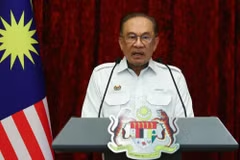
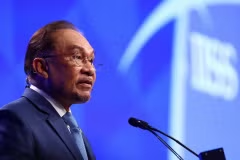
Malaysian Prime Minister Datuk Seri Anwar Ibrahim said Malaysia will continue to strengthen economic cooperation with key trading partners, including China and the US, despite differences in views on geopolitical issues.

Party General Secretary and State President To Lam (R) receives Japanese Prime Minister Sanae Takaichi in Hanoi on May 2 (Photo: VNA)

Japanese PM highlights outcomes of visits to Vietnam, Australia

Speaking to the press in Canberra on May 4, the Japanese PM stressed that during her visits to Vietnam and Australia, in addition to deepening personal trust among leaders, she and the leaders were able to reach agreement on advancing concrete cooperation toward their shared objective of enhancing national resilience and autonomy, and becoming stronger and more prosperous together as a region.

Foreign investment in Thailand surges in Q1

Foreign investment in Thailand surges in Q1

According to Thailand's Board of Investment (BOI), the combined value of the 624 project applications submitted during the January-March period was roughly 2.4 times the value recorded in the same period last year, reflecting strong foreign interest despite global economic volatility.