Philippine aviation sector records fastest growth in Southeast Asia

The Philippines emerged as the region’s third-largest aviation market in terms of seat capacity, with 5.82 million seats in April 2026, behind Indonesia with 10.31 million seats and Thailand with 7.9 million seats.

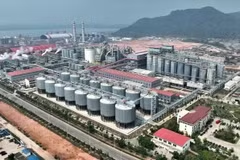
Philippines aviation registers fastest growth in SE Asia (Photo: philstar.com)

Hanoi (VNA) – The Philippine aviation sector posted the fastest growth in Southeast Asia in April despite the fuel price shock, according to data from aviation analytics firm OAG.

The Philippines emerged as the region’s third-largest aviation market in terms of seat capacity, with 5.82 million seats in April 2026, behind Indonesia with 10.31 million seats and Thailand with 7.9 million seats.

Notably, the country recorded the strongest growth in capacity, adding 687,000 seats, up 13.4% year-on-year. In the domestic market, the Philippines also led the region with a 16% increase to 4.15 million seats, bucking the broader downward trend.

Ninoy Aquino International Airport remained one of the busiest aviation gateways in the region, handling 2.91 million departing passengers in April, ranking fifth in Southeast Asia. Singapore’s Changi Airport topped the list with 3.49 million passengers, followed by airports in Kuala Lumpur, Bangkok and Jakarta.

Among airlines, AirAsia maintained its lead in regional seat capacity with 2.8 million seats, despite a slight decline. Cebu Pacific ranked second with 2.64 million seats, followed by Thai AirAsia with 2.18 million seats.

Amid AirAsia’s restructuring efforts and weakening demand in some markets, Cebu Pacific accelerated capacity expansion, increasing seat capacity by 20% in April – the second-fastest growth rate among major regional carriers. However, Cebu Pacific CEO Michael Szucs said the airline may need to revise its target of carrying nearly 30 million passengers this year as consumers cut back on non-essential spending amid inflationary pressures.

Airlines also continue to face pressure from rising jet fuel prices, with jet fuel reaching 181.22 USD per barrel as of May 1, driving up operating costs across the industry.

Despite these challenges, data showed that the Philippine aviation sector has maintained strong growth momentum in the region, reflecting robust domestic travel demand and airlines’ adaptability to economic volatility./.


VNA

See more

ASEAN Secretary-General Kao Kim Hourn (Photo: VNA)

ASEAN chief spotlights Vietnam’s role in shaping bloc’s future

Vietnam is expected to maintain active contributions across ASEAN’s three pillars - the political-security community, the economic community, and the socio-cultural community; while further enhancing regional connectivity through infrastructure projects and stronger economic linkages.

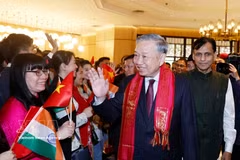
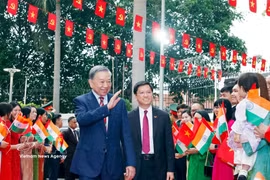
Representatives of the Vietnamese community in India welcome Party General Secretary and State President To Lam in New Delhi on May 5, 2026. (Photo: VNA)

India media hails Vietnamese leader’s visit as catalyst for stronger strategic partnership

Indian news outlets noted that Vietnam is currently one of India’s most important partners in Southeast Asia, particularly as the two sides share strategic interests in the Indo-Pacific region. Priority areas for cooperation include defence and security, trade and investment, digital transformation, high technology, supply chain connectivity, and maritime collaboration.

Portable solar panels charge a power station outside a suburban home at dusk (Photo: solarquarter.com)

Solar generator demand surges in Malaysia

According to solarquarter.com, prices have risen by about 20% since February, yet consumers continue to invest in these systems as reliable backup power sources against outages and rising energy costs.

Thailand: BOT warns SMEs and vulnerable groups face hardest economic shock (Photo: The Nation)

Thailand faces economic shock from Middle East tensions

Bank of Thailand Governor Vitai Ratanakorn said the economy was likely to slow as many parties had assessed. The clear impact was higher inflation, affecting both businesses and households, which were beginning to face more pressure from rising costs, as well as effects on debt and liquidity.

Malaysia pursues balanced economic diplomacy

Malaysia pursues balanced economic diplomacy

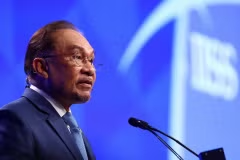
Malaysian Prime Minister Datuk Seri Anwar Ibrahim said Malaysia will continue to strengthen economic cooperation with key trading partners, including China and the US, despite differences in views on geopolitical issues.

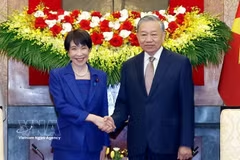
Party General Secretary and State President To Lam (R) receives Japanese Prime Minister Sanae Takaichi in Hanoi on May 2 (Photo: VNA)

Japanese PM highlights outcomes of visits to Vietnam, Australia

Speaking to the press in Canberra on May 4, the Japanese PM stressed that during her visits to Vietnam and Australia, in addition to deepening personal trust among leaders, she and the leaders were able to reach agreement on advancing concrete cooperation toward their shared objective of enhancing national resilience and autonomy, and becoming stronger and more prosperous together as a region.

Foreign investment in Thailand surges in Q1

Foreign investment in Thailand surges in Q1

According to Thailand's Board of Investment (BOI), the combined value of the 624 project applications submitted during the January-March period was roughly 2.4 times the value recorded in the same period last year, reflecting strong foreign interest despite global economic volatility.

Malaysia accelerates economic restructuring to tackle energy crisis (Photo: Straitstimes.com)

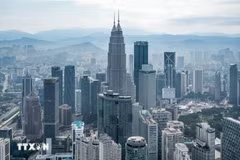
Malaysia steps up economic restructuring amid energy crisis

Participants agreed the crisis, though expected to last up to 18 months, offers a key opportunity for Malaysia and ASEAN to reshape their economic models through innovation, stronger public-private partnerships, and data-driven governance.