Exploring intangible cultural heritage of conical hat making in Binh Dinh

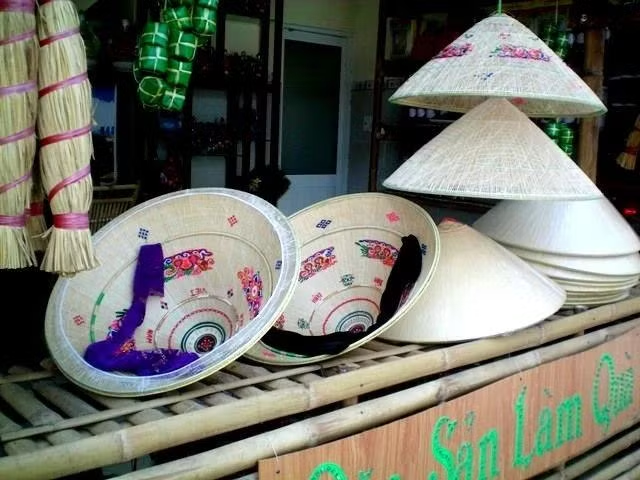
Phu Gia, a 300-year-old village in Cat Tuong commune in Phu Cat district of the south-central province of Binh Dinh, about 40km northeast of Quy Nhon city, has long been known for its traditional craft of making “horse” conical hats, once an indispensable accessory for court officials.

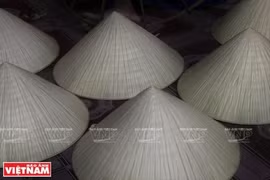
Phu Gia horse conical hats (Photo: Binh Dinh online portal)

Hanoi (VNA) – Phu Gia, a 300-year-old village in Cat Tuong commune in Phu Cat district of the south-central province of Binh Dinh, about 40km northeast of Quy Nhon city, has long been known for its traditional craft of making “horse” conical hats, once an indispensable accessory for court officials.

“Horse” conical hats, or Go Gang conical hats, used to be put on head for horse-rides in past times. In the old days, only mandarins and landlords had the right to wear horse conical hats while common people were allowed to wear other ordinary kinds of conical leaf hats. Horse conical hats require meticulous processing with a silver-peaked cap and sophisticated decoration of a dragon and a phoenix.

The embroidered patterns on each hat are also different, corresponding to the position and dignity of the person who wears it.

The horse conical hat making craft in Phu Gia village was recognised by the Ministry of Culture, Sports and Tourism as a national intangible cultural heritage on April 9.

Making a conical hat requires many meticulous steps, from creating ribs and tying ribs to embroidering patterns. Artisans embroider patterns such as the dragon, unicorn, mandarin, phoenix, plum, orchid, chrysanthemum, bamboo and poetry themes.

Phu Gia horse conical hats are very durable because they are made from 10 layers of leaves. Palm leaves that grow in the wild, along with bamboo stems, and pineapple roots are the main components used to make the specialty hats.

According to villagers, the palm leaves must not be too old or too young. They must be dried in the sun or dew so that the leaves are both dry and have the necessary flexibility. Meanwhile, pandanus roots must be roots that have been in the ground for 2-3 years, and have good durability and elasticity.

There are 20 steps to make a horse conical hat, including four major stages. They include creating the rib, rib cyst ligation, embroidery patterns on the ribs, and roofing.

For rib creating, villagers take the roots of the sycamore tree from the mountains, dry, and split them into small fibers as thin as twine. The knitting method is in the style of basket knitting, the hexagonal holes form a large patch.

In the rib cyst ligation stage, they put the anesthetic piece on the template cone, sew the bottom cyst to create a cone rib. Next, hat makers sew the vertical and horizontal ribs with yarn the size of toothpicks. These two stages of making cones must be performed by professional workers so that ordinary hat makers can continue to perform the following stages.

Horse conical hats are usually embroidered with patterns according to the themes such as the dragon, unicorn, turtle, phoenix, apricot orchids and bamboo shoots, verses, couplets or scenes on the rib capsule.

The final stage is the roofing. Fresh palm leaves must be picked from the mountains of Vinh Thanh district or neighbouring Gia Lai province and processed meticulously, stripped alive, dried in the shade, placed on fire pots and bamboo cages to ripen the leaves, then brought out. The sun is exposed to dew and is heated by fire to keep the leaves straight and flat. Artisans use specialised scissors with thin plates and long blades to cut leaves into small pieces according to the height of the cone, stack the edges of the leaves evenly around the side of the cone from the top down, and stitch the leaves to the side of the cone. Makers cut off the excess threads sticking to the surface of the hat and decorate the top of the hat with five-coloured thread.

Currently, along with traditional horse conical hats, local artisans have created many other modern styles for the product, which have become popular souvenirs for domestic and foreign visitors to Binh Dinh./.
See more

Participants in the 20th Cong hien (Devotion) Awards presentation ceremony in Hanoi on April 15 (Photo: VNA)

Devotion Awards mark two decades of honouring excellence in music, sports

Nguyen Thien Thuat, Editor-in-Chief of the The Thao & Van Hoa newspaper and Head of the organising board of the awards, said, noting that their achievements reflect the spirit of the Politburo’s Resolution No. 80, which emphasises preserving national cultural values while selectively absorbing the essence of world culture.

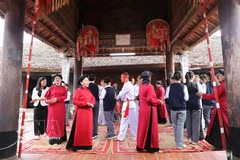
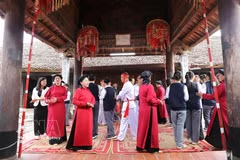
Artisans and students take part in cultural activities and exchanges in the Xoan singing performance space at Hung Lo ancient communal house in Phu Tho province (Photo: VNA)

Ancestral legends revived through contemporary performance

Beyond cultural value, well-organised festival programmes linked with tourism and media can contribute to the development of cultural industries and enhance Vietnam’s cultural soft power, positioning heritage-based events as distinctive national cultural brands in the international arena.

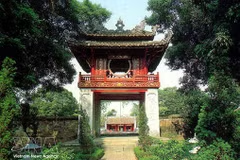
Khue Van Cac (Khue Van Pavilion) stands as a defining cultural symbol of Hanoi, closely associated with Vietnam’s long-standing tradition of valuing education and honouring knowledge. (Photo: VNA)

Greater efforts needed for heritage to shape Hanoi’s identity

As suggested by UNESCO experts, heritage should be approached as an integrated system encompassing space, people and everyday life. This perspective can inform urban planning, cultural tourism development and the creation of clear economic drivers.

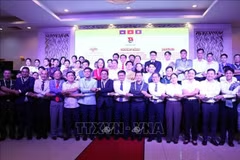
Participants at the gathering (Photo: VNA)

Lao, Cambodian students welcome traditional New Year in Ho Chi Minh City

In his speech, Vice Chairman of the municipal People’s Committee Nguyen Manh Cuong said the municipal Party organisation, authorities and people always value the close ties and solidarity among Vietnam, Laos and Cambodia. He described the three nations’ longstanding ties, forged through shared hardships, as an invaluable spiritual asset and a bedrock for sustainable development.

Vietnamese kickboxers win 32 gold medals at the Kickboxing World Cup 2026. (Photo: Vietnam Kickboxing Federation)

Vietnam finish third at Kickboxing World Cup 2026

According to Vu Duc Thinh, President of the Vietnam Kickboxing Federation, the strong results reflected careful preparation by local training centres and the determination of Vietnamese fighters. The team’s participation, funded largely through socialised and local resources, also demonstrated growing support for the development of kickboxing in Vietnam.

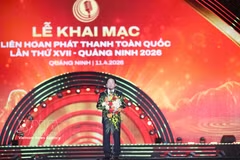
Politburo member, Secretary of the Party Central Committee and Head of the Party Central Committee’s Commission for Information, Education and Mass Mobilisation Trinh Van Quyet speaks at the event (Photo: VNA)

National Radio Festival opens in Quang Ninh

The opening night was combined with an artistic programme titled “sounds of the new era,” drawing around 50,000 spectators. The programme was structured in three chapters: Origins of Sound, Heritage Sound, and Sound of the New Era.

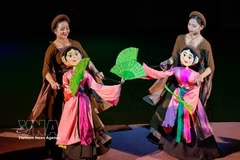
Vietnamese puppetry faces pressure to adapt to modern lifestyles, particularly amid growing competition from diverse entertainment forms (Photo: VNA)

Vietnamese puppetry seeks renewal amid preservation challenges

People’s Artist Nguyen Hoang Tuan, Chairman of the Hanoi Theatre Association, noted that while northern Vietnam had 27 puppetry guilds in 1986, only 14 remain today. Many traditional plays and original scripts have been lost, hurting restoration and preservation efforts.