Hanoi (VNA) - Placing people at the centre and considering people as the objective, subject and driving force of national development, with the State respecting, guaranteeing and protecting human rights and citizens’ rights are a major principle outlined in the 13th Party Central Committee's Resolution No. 27-NQ/TW dated November 9, 2022, on continuing to build and perfect the socialist rule-of-law State of Vietnam in the new era.
This principle - putting people at the heart of development - is not merely an aspirational goal but is being systematically implemented in Vietnam.
Discussing human rights, in his book “Some theoretical and practical issues on socialism and the path towards socialism in Vietnam”, when he was alive, Party General Secretary Nguyen Phu Trong emphasised that: “We should not wait until the economy reaches a high level of development to realise social progress and justice, nor should we ‘sacrifice’ social progress and justice in pursuit of mere economic growth.”
Caring for the material and spiritual life of the people - such as poverty reduction, access to education and healthcare services - is a concrete expression of the policy of placing people at the core and as the subject of socio-economic development.
Vietnam has issued eight iterations of poverty standards, each time raising the basic needs threshold: 1993–1995; 1995–1997; 1997–2000; 2001–2005; 2006–2010; 2011–2015; 2016–2020; and 2021–2025.
Under the 1993–1995 standards, hungry households had a per capita monthly income (converted to rice) of less than 13kg in urban areas and less than 8kg in rural areas, while poor households had a per capita monthly income below 20kg in urban areas and 15kg in rural areas.
From 2001–2005, the term “hungry household” was no longer used. Instead, “poor household” was defined by income: 80,000 VND (3.08 USD following current exchange rate)/person/month in mountainous and island rural areas; 100,000 VND/person/month in lowland rural areas; and 150,000 VND/person/month in urban areas.
From 2016–2020, Vietnam adopted the “multidimensional poverty standard”, which included criteria on income and basic service access (health care, education, housing, clean water and sanitation, and information). It defined poor, near-poor and average-income households.
In the 2021–2025 period, the multidimensional poverty standard set income thresholds at 1.5 million VND/person/month in rural areas and 2 million VND/person/month in urban areas.
In 1993, 58.1% of Vietnamese households were considered poor. By 2015, the rate fell to 9.88%, and by 2024, the figure was just 1.93%, or about 600,000 households according to the new multidimensional poverty standards. The combined rate of poor and near-poor households in 2024 was 4.06% (over 1.2 million households), a decrease of 1.65% compared to 2023.
Ho Chi Minh City and Ba Ria–Vung Tau province reported a 0% multidimensional poverty rate (including both poor and near-poor households). Hanoi, Hai Phong, Quang Ninh and Bac Ninh no longer had any households classified as poor.
Vietnam is the first country in Asia to adopt the multidimensional poverty standards and is among the world's top 30 in this regard.
According to the Global Multidimensional Poverty Index (MPI) report released on July 15, 2023 by the United Nations Development Programme (UNDP) and the Oxford Poverty and Human Development Initiative (OPHI), Vietnam was one of 25 countries to have halved its MPI within 15 years.
Alongside poverty reduction, Vietnam has also achieved strong growth in gross domestic product (GDP) and per capita GDP.
In 1974, the combined economy of North and South Vietnam was less than 22 billion USD. From 1976–1980, GDP growth averaged only 1.4%; in 1980, it was actually negative (-1%). By 2024, Vietnam’s GDP had reached 476.3 billion USD - nearly 129 times higher than that of 1975 - and ranked 24th globally in terms of Purchasing Power Parity (PPP). According to IMF forecasts, the Vietnamese economy is projected to reach 506 billion USD in 2025.
In 1989, per capita income was just 96 USD. By 2009, Vietnam had reached lower-middle-income status with 1,120 USD per capita. In 2024, per capita GDP was 4,700 USD (around 114 million VND), 58.75 times higher than in 1975.
Rising income levels have also coincided with increased life expectancy. The average life expectancy of Vietnamese people rose from about 38 in 1945, to 60 during 1975–1980, and to 74.5 today.
Vietnam currently has nearly 432,000 healthcare personnel, equating to 14 doctors per 10,000 people, and a network of 1,645 hospitals, including 34 central-level and nearly 500 provincial-level hospitals. The country is aiming to exempt hospital fees for all people.
 successfully researches the project "Salt production of ethnic minorities in the Central Highlands - Amreč Salt". (Photo: VNA)")
According to the Ministry of Health, by 2026–2030, 90% of the population is expected to have full access to disease prevention and health promotion services. Every citizen will receive an annual health check-up. By 2035 or 2045, Vietnam’s healthcare system aims to fully and promptly meet the population’s needs in terms of health care, ensuring that people pay no additional costs for health services covered by insurance.
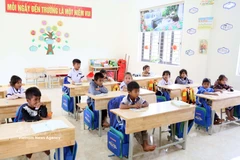
Vietnam also plans to offer free education to all students - from nursery (from three months old) through to the end of public upper secondary school (over 22 million students) - starting from the 2025–2026 academic year. Non-public school students (over 1 million) will be subsidised from the State budget with an amount equivalent to public school tuition fees.
Vietnam’s education expenditure from the State budget accounts for approximately 4.9% of GDP. By 2017, the country had achieved universal preschool education for five-year-old children. Today, all 63 provinces and cities have achieved 100% coverage of universal primary education standards.
These achievements - resulting from a people-centred development approach - have been recognised and highly praised by the United Nations.
According to the Human Development Report (HDR) 2025 released by UNDP in Vietnam on May 12, 2025, Vietnam’s Human Development Index (HDI) in 2023 reached 0.766, placing it among countries with high human development, ranking 93rd out of 193 countries and territories. From 1990 to 2023, Vietnam’s HDI rose from 0.499 to 0.766, an increase of 53.5%.
The Human Development Report has been published almost annually since 1990. The HDI is a comparative index measuring income, literacy, life expectancy, and other human development factors across countries.
The key characteristics of the human development approach include placing people at the centre of development; identifying people as the goal of development; enhancing people’s status (in both enjoyment and contribution); promoting equality for all regardless of religion, ethnicity, gender, nationality, or skin colour; and enabling optimal choices for citizens in economic, political, social, and cultural domains.
The HDI measures a nation’s average achievement in three basic dimensions of human development: Health (LEI) - a long and healthy life measured by life expectancy; Education (EI) - measured by mean years of schooling (MYSI) and expected years of schooling (EYSI); and Income - measured by Gross National Income (GNI) per capita.
Speaking at the High-Level General Debate of the 79th Session of the United Nations General Assembly on September 24, 2024, under the theme “leaving no one behind: acting in solidarity to promote peace, sustainable development, and human dignity for present and future generations”, General Secretary of the Communist Party of Vietnam To Lam, who was then also the State President of Vietnam, shared Vietnam’s vision for a peaceful, stable, cooperative, prosperous, and sustainable future for all.
The leader emphasised: “People are placed at the centre as the main subject in order to realise visions. People are considered the centre, the objective, and the driving force of all policies and actions at all levels.”/.