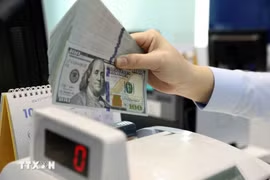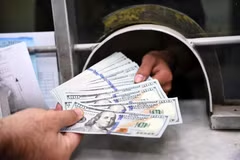
Hanoi (VNA) – Amid continued uncertainty in global financial markets, remittances are not only a vital income source for millions of households but have increasingly become an important anchor for Vietnam’s macroeconomic stability.
As the US dollar remains strong and the US Federal Reserve maintains a cautious stance on interest rate cuts, pressure on exchange rates and global capital flows has intensified. Against this backdrop, remittance inflows, estimated at around 16 billion USD in 2025, continue to serve as a stable source of foreign currency, contributing significantly to macroeconomic balance and providing greater flexibility for monetary policy management in Vietnam.
Expanding efforts to attract remittances
Vietnam has consistently ranked among the world’s top 10 remittance-receiving countries. In 2024, total remittances reached approximately 16 billion USD, equivalent to nearly 4% of GDP. In a volatile global financial environment, these inflows have become a reliable economic buffer.
Ho Chi Minh City remains the largest recipient of remittances nationwide. According to Tran Thi Ngoc Lien, Deputy Director of the State Bank of Vietnam’s Regional Branch 2, remittances to the city are projected to reach about 10.5 billion USD in 2025, representing a substantial resource for both the city’s economy and the country as a whole.
She noted that remittance inflows in 2026 are expected to remain positive, supported by stable macroeconomic conditions, flexible exchange rate management, and appropriate interest rate policies. These funds not only support consumption but also supplement capital for production and business activities.
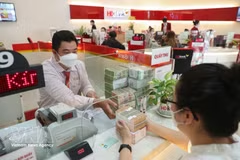
Year-end periods and the Lunar New Year traditionally mark peak remittance seasons. To attract more inflows, financial institutions have continuously introduced new products, upgraded technology, and simplified payment procedures.
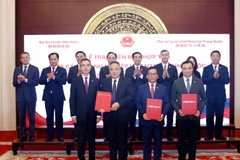
Some banks, including Agribank, Nam A Bank, HDBank, and MSB, have launched promotional programmes and tailored remittance services. MSB, for instance, is rolling out a remittance promotion programme for customers until March 31, under which clients receiving remittances via their accounts at the bank and wishing to sell US dollars for Vietnamese dong will be offered preferential exchange rates of up to 0.5 percentage point above the listed transfer buying rate. The bank also reduces the fee for cash withdrawal in USD for customers receiving remittances via SWIFT into payment accounts at the bank. Nguyen Duc Dang Quang, Head of Business Development at Vietcombank Remittance Company (VCBR), said the firm has worked closely with authorities to develop effective policies to attract remittance resources. The company has invested in specialised core software integrating partner management, customer services, and multi-channel payout solutions, including bank transfers, e-wallets, counter payments, and home delivery.
Stable pillar of the economy
Economists note that strong remittance inflows help increase foreign currency supply within the banking system, balance supply and demand in the foreign exchange market, and ease pressure on exchange rates and national reserves. This has helped Vietnam maintain relative monetary stability while many regional currencies face depreciation pressures.
From a banking perspective, remittances transferred through official channels improve foreign currency liquidity and create additional room for commercial banks to expand lending. When converted into VND, these funds also support domestic capital supply, particularly as credit demand recovers unevenly.
Banking experts describe remittances as a relatively low-cost and stable source of capital that supports both bank liquidity management and the State Bank of Vietnam’s exchange rate and monetary policy operations during periods of global volatility.

Remittances are considered more resilient and stable in the short term, versus indirect investment flows and even parts of foreign direct investment.
Associate Professor Dr Dinh Trong Thinh said remittances help improve Vietnam’s balance of payments, strengthen foreign exchange reserves, stabilise the Vietnamese dong, and reduce reliance on external borrowing, thereby easing long-term public debt pressures.
Unlocking long-term potential
Despite their importance, experts believe the long-term spillover effects of remittances remain below potential, as most funds are still directed toward consumption and savings rather than productive investment.
Dr Nguyen Tri Hieu emphasised that remittances are closely tied to overseas Vietnamese confidence in the domestic economic environment.
The issue is not only attracting remittances but ensuring the funds stay longer and participate more deeply in the economy, he said.
However, much of the inflow remains concentrated in consumption and savings rather than productive investment. Experts recommend developing tailored financial products and expanding investment channels to encourage remittances to participate more deeply in production, innovation, high-tech agriculture, and the green economy.
Reducing transfer costs and expanding official digital remittance channels are also seen as key measures to attract sustainable inflows.
As Vietnam pursues ambitious growth and sustainable development goals, remittances are increasingly seen not only as a source of foreign currency but also as a bridge linking overseas Vietnamese communities with national development. Effectively harnessing this unique capital flow will play a crucial role in maintaining macroeconomic stability and creating room for long-term growth./.