Residents in Hanoi’s Old Quarter to be resettled over Red River

Chairman of Hanoi’s municipal People’s Committee Nguyen The Thao, confirmed on Nov. 19, that people living in Hanoi ’s Old Quarter will be relocated to Long Bien and Gia Lam districts.
Chairman of Hanoi’s municipal People’sCommittee Nguyen The Thao, confirmed on Nov. 19, that people living inHanoi ’s Old Quarter will be relocated to Long Bien and Gia Lamdistricts.

The move is to improve their living standard, especially theiraccommodation, Chairman Thao talked with the local media on thesidelines of the 6 th session of the 12th National Assembly about thecapital city’s plans. He said that the Viet Hung and Sai Dong urbanareas which lie across the Red River will be their new homes.

The city will also provide vocational training for the relocatedresidents and build a commercial centre inside the Viet Hung urban areato make it easier for those who want to pursue business.

Hanoi ’s Old Quarter is situated in Hoan Kiem district on an areaof around 100 hectares, roughly about 1.5-2 sq. metres per capita.

The Old Quarter now boasts 4,000 houses. Nearly 1,000 of them werebuilt over 100 years ago. Most of the houses are dilapidated or havebeen repaired unprofessionally so the original architecture hasdisappeared and some have even turned into slums.

Given this, the local authorities have proposed to relocate 30,000people outside of the area by 2020 to reduce the population density to50,000 people per sq. km from the current 84,000 people per sq. km.

The first phase of the project, which will cost around 4,000 billionVND, was submitted to the city’s Planning and Investment Department andwill be later submitted to the municipal People’s Committee forapproval.

This phase will see around 1,900 households living in the Old Quarter resettled in the Viet Hung urban area./.

See more

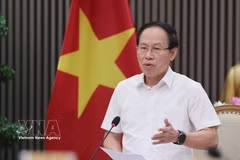
Deputy Prime Minister Le Tien Chau addresses the meeting (Photo: VNA)

Deputy PM asks for highest education quality, safety for students

Regarding the construction of inter-level boarding schools in border communes, all 108 schools under Phase 1 opened for the 2026-2027 academic year, with 40 having completed all construction items. Procedures for groundbreaking at 121 schools under Phase 2 across 17 provinces and cities have been completed, with all projects targeted for completion before August 30, 2027.

Hanoi leaders attend the inauguration and groundbreaking ceremonies for projects. (Photo: VNA)

Hanoi launches 18 key projects worth nearly 4.94 billion USD

The city announced 292 projects with a combined investment of 384.886 trillion VND (14.92 billion USD), including 18 key projects worth 127.46 trillion VND, focusing on transport, infrastructure, environmental protection and public services.

With just a smartphone, a wealth of knowledge spanning tens of thousands of books can now be accessed in an instant. (Photo: Thanh Nien Newspaper)

Vietnam’s first shared digital library platform launched

Vietnam Digital Library Joint Stock Company (ViLiB) launched its “Digital Knowledge Space – Shared Digital Library” platform in Ho Chi Minh City on October 8, enabling libraries, schools and organisations to connect and share digital resources, thereby broadening access to books and knowledge.

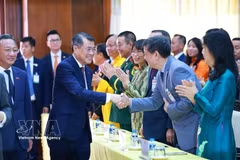
Prime Minister Le Minh Hung are welcomed by staff of the Vietnamese Embassy, representatives of Vietnamese agencies and associations, and members of the Vietnamese community in Laos on October 9, 2026. (Photo: VNA)

Vietnam–Laos special ties nurtured by the people: PM Le Minh Hung

Prime Minister Le Minh Hung urged Vietnamese people in Laos to maintain solidarity, integrate proactively, respect Lao laws and educate younger generations about their national roots and the special Vietnam–Laos relationship. Calling Laos a country undergoing dynamic transformation with emerging opportunities

A cultural, sports, and tourism exchange of the Vietnam-Laos border areas in 2022. (Photo: VNA)

Vietnam, Laos enhance legal awareness among border village leaders

The conference aimed to help officials, specialised forces and village leaders gain a better understanding of border-related policies and laws, thereby enhancing their sense of responsibility for managing and protecting the border line and markers, maintaining public order and promoting economic development in border areas.

The international workshop on empowering women in the care economy on October 8, 2026 (Photo: VNA)

Int’l workshop focuses on women’s empowerment in the care economy

Vietnam has built a relatively comprehensive legal and policy framework to underpin the sector, including the Labour Code, the Law on Gender Equality, the Law on Social Insurance, the Law on Population and the National Strategy on Gender Equality for 2021-2030. Together, they set goals and measures to narrow gender gaps and give women and men equal opportunities to benefit across a range of areas.

A sea turtle nest found at Mui Tau Beach on Hon Cau Island after a night of rain. (Photo: VNA)

Sea turtle nests on Lam Dong's Hon Cau island for sixth time this year

Since the beginning of 2026, sea turtles have nested six times at three beaches on Hon Cau island, namely Nhat, Mui Tau and Ba Hon. Three nests were left undisturbed at safe locations, while another three were relocated to the incubation area for protection, involving a total of 246 eggs.

The “Colours of the Five Continents” street festival tales place at the Hoan Kiem Lake pedestrian zone, attracting large crowds of locals and international visitors (Photo: VNA)

Vietnam tourism gains appeal from safety, diverse experiences

According to international reports referenced by the WEF, Vietnam has a high level of safety awareness, a low crime rate and a terrorism impact score of zero. These factors helped place the country’s Safety and Security indicator among the world’s highest in the TTDI 2026 rankings.

At Phong Nha communal Public Administration Service Centre in Quang Tri province (Photo: VNA)

Administrative reform shifts focus to practical results

Agencies largely kept the receipt, processing and return of administrative results running continuously, openly and transparently, with citizens and firms at the centre of public service delivery. They also kept upgrading, linking and using the databases serving administrative processing, carried out tasks under the 100-day Action Plan for the Politburo's Resolution 57-NQ/TW, and rolled out new initiatives and models to lift service quality.