Ho Chi Minh City needs comprehensive solutions to tackle flooding: experts

An official stressed the need to strengthen drainage and flood prevention across catchments and sub-catchments while coordinating irrigation, disaster prevention, drainage and urban development plans.

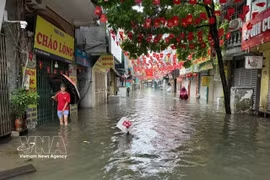
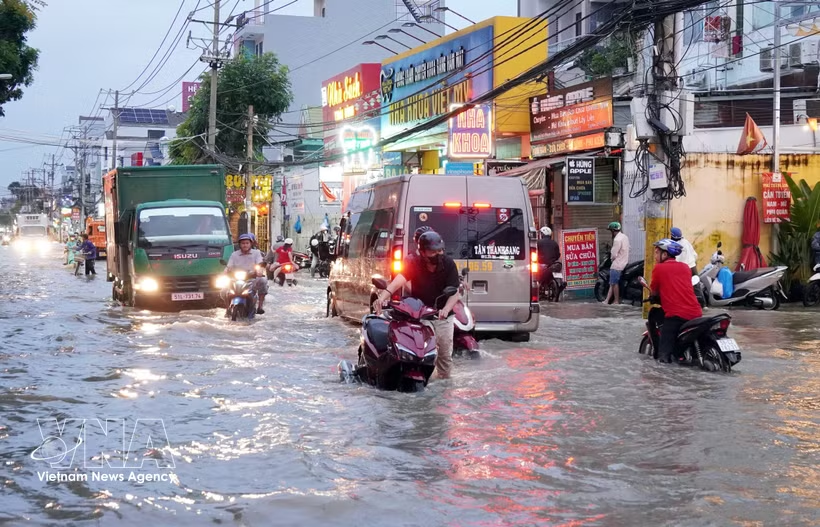
Commuters and vehicles wade through a flooded street in Ho Chi Minh City. (Photo: VNA)

Ho Chi Minh City (VNA) – Ho Chi Minh City plans to invest more than 142 trillion VND (5.49 billion USD) in 87 flood control projects during 2026–2030 to tackle flooding at 50 hotspots, with a focus on addressing root causes and developing integrated drainage systems to ensure investment effectiveness and deliver measurable reductions in flooding.

Large investment requires targeted solutions

Urban flooding stems from multiple factors, including heavy rain, high tides, low-lying terrain, land subsidence, inadequate drainage systems and shrinking water-retention areas. Identifying the causes at each location is essential to choosing effective solutions, insiders said.

Architect Nguyen Dinh Hoa of the Ho Chi Minh City Institute of Economics and Management said flood mitigation planning should cover entire drainage basins as water flows follow terrain and drainage networks rather than administrative boundaries.

He called for a shared, regularly updated and verified map of ground elevations, drainage directions, water-retention areas, system capacity and bottlenecks to guide investment priorities. Projects must also connect with downstream drainage routes and discharge points as expanding pipelines alone will not ease flooding if downstream bottlenecks remain.

Assoc. Prof. Dr Nguyen Phu Quynh, Deputy Director of the Southern Institute of Water Resources Research, said infrastructure built 20–30 years ago may no longer meet current needs due to changes in river and tidal levels and ground elevations.

As water flows through the entire network, flood-control measures must be planned at basin level, linking rivers, canals, drainage systems and upstream factors, rather than addressing isolated sections, he said.

Le Ngoc Linh, Deputy Director of the municipal Department of Construction, said Ho Chi Minh City has 23 main drainage catchments, but urban expansion has widened topographical and hydrological disparities, while some plans are outdated. Canals, drainage systems and pumping stations remain poorly connected, and water-storage capacity is limited.

The 2026–2030 flood control plan requires a review of narrowed drainage routes, subsidence-affected gradients, sediment buildup and discharge outlets affected by high tides.

Linh stressed the need to strengthen drainage and flood prevention across catchments and sub-catchments while coordinating irrigation, disaster prevention, drainage and urban development plans.

Urban planning must reduce flood risks

Hoa stressed that flood control planning must be integrated with land use and urban development as road elevation, ground filling, residential construction and canal narrowing can affect water flows and storage capacity. Both individual projects and their combined impacts across catchments should be assessed.

Canals, regulating lakes, low-lying areas and green spaces help retain rainwater and reduce pressure on drainage systems. Given this, Hoa called for protecting these areas and major drainage routes by making planning maps and devising land-use controls.

He said that in high-risk residential areas, measures could include infrastructure upgrades, lower building density, improved drainage corridors or resettlement where necessary, while ensuring residents’ livelihoods and access to essential services.

The city should combine conventional infrastructure, including pumping stations and tide-control works, with nature-based solutions such as enlarging permeable surfaces, restoring low-lying areas, establishing distributed retention ponds and expanding green spaces, he suggested.

Meanwhile, Linh stressed that tide-control works must operate in coordination with drainage systems, canals, pumping stations and water-storage areas, as blocking tidal water alone cannot prevent flooding if internal drainage remains inadequate.

To ensure investment effectiveness, experts called for prioritising flood mitigation projects based on flood severity and frequency, the number of people protected, expected effectiveness, connectivity with existing systems, environmental and social impacts, and long-term operating costs. Clear responsibility for operation and maintenance is also essential.

Effective flood control requires coordinated planning, integrated infrastructure, and better water-space management, with projects connected across catchments to achieve lasting reductions in flooding./

VNA

See more

The seminar entitled “65 Years of the Agent Orange/Dioxin Disaster in Vietnam” takes place in Hanoi on October 21, 2026. (Photo: VNA)

Seminar calls for long-term support for Agent Orange/dioxin victims

VAVA President Lt. Gen. Nguyen Huu Chinh stressed that assistance should extend beyond immediate relief to ensure victims have better access to healthcare, rehabilitation, education, vocational training and livelihood opportunities, enabling them to integrate into society.

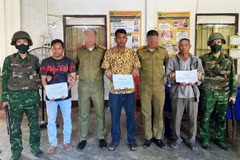
Three suspects are arrested during a crackdown on a cross-border ring involved in stockpiling, trading and transporting fireworks illegally from Laos into Vietnam. (Photo published by VNA)

Cross-border illegal fireworks trafficking ring dismantled, 30 tonnes seized

Authorities in Vietnam's central province of Quang Tri and Laos’ Savannakhet province have successfully dismantled a cross-border ring involved in stockpiling, trading and transporting fireworks illegally from Laos into Vietnam, seizing around 30 tonnes of various types of fireworks and arresting three Lao nationals linked to the case.

Pho Duc Nam, alias Mr Pips (Photo povided by the police)

Mr Pips case to be heard at three locations via hybrid trial

Given the large number of participants in the proceedings, including 188 defendants, more than 200 defence lawyers and hundreds of related parties and witnesses, the court has decided to hold the trial in a hybrid format, combining in-person and online proceedings.

At the second session of the 16th NA on October 20 (Photo: VNA)

Draft law proposes decentralising management of culture, sports and tourism

Minister of Culture, Sports and Tourism Lam Thi Phuong Thanh said the draft aims to institutionalise the Party’s policies on restructuring the state apparatus, operating the two-tier local administration model, strengthening decentralisation, cutting administrative procedures and business conditions, promoting digital transformation, and resolving problems arising during the implementation of existing laws.

An international delegation experiences the ticket control system at Cau Giay Station. (Photo: VNA)

EU provides 10 million EUR to prepare Hanoi Metro Line 3 extension

Hanoi's Metro Line 3 is 12.5 km long and has 12 stations, including eight elevated and four underground stations. The elevated section from Nhon to Cau Giay began commercial operations in August 2024, providing an additional high-capacity public transport option in western Hanoi.

Professor and Doctor Phan Thi Tra My, Chairwoman of the Association of Vietnamese Enterprises in China (Photo published by VNA)

Overseas Vietnamese women offer ideas for national development

In this process, overseas Vietnamese women play a natural, persistent and enduring role. Vietnamese mothers continue to speak Vietnamese with their children every day, prepare Vietnamese dishes and preserve family traditions, lifestyles and Vietnamese ways of interacting with others. Vietnamese women wearing traditional “ao dai” in their host societies also help introduce and promote the country’s cultural identity to international friends.

The frontpage of the bilingual Vietnamese–English photo book entitled “The Legendary Ho Chi Minh Trail at Sea” (Photo: VNA)

Bilingual photo book on Ho Chi Minh trail at sea launched

The 288-page book brings together hundreds of photographs, archival documents, maps, artefacts and graphic illustrations arranged chronologically. It recounts the perilous journeys of unnumbered ships that braved storms, enemy bombs and gunfire to transport weapons, equipment and medicine from the northern rear to the southern front, contributing to the victory in the resistance war against the US for national salvation.

President of the Vietnam Fatherland Front Central Committee Bui Thi Minh Hoai and Permanent Deputy Prime Minister Pham Gia Tuc honour organisations and individuals contributing to social welfare. (Photo: VNA)

Vietnam launches 2026 Month for the Poor campaign

VFF Central Committee President Bui Thi Minh Hoai highlighted the strong public response to social welfare initiatives amid increasingly severe natural disasters and floods in recent years. Support from businesses, organisations, and individuals both locally and internationally has helped affected families rebuild their homes, restore their livelihoods, and get their lives back on track.