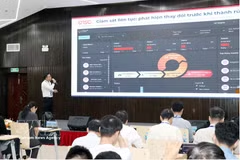
Gia Lai (VNA) – More than 100 delegates from Vietnam, Southeast Asia, and international partners are expected to attend the first Quy Nhon Dialogue on Climate and Transitions, to take place on October 10-11 at the International Centre for Interdisciplinary Science and Education (ICISE) in Gia Lai province.
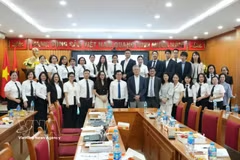
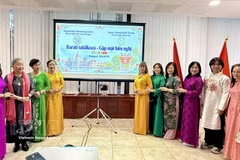
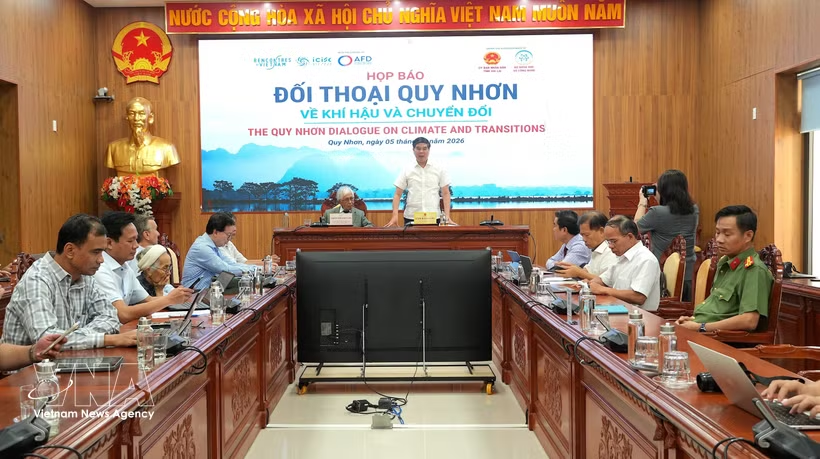
The information was announced by the People’s Committee, the Rencontres du Vietnam (Meet Vietnam) Association and ICISE at a press conference on October 5 in the locality.
Supported by the French Development Agency (AFD) and held under the patronage of the Ministry of Science and Technology and the provincial People’s Committee, the dialogue serves as a pilot “Zero Version” to test the model ahead of annual editions from 2027. It aims to connect science, policy, finance and practice to promote cooperation and initiatives on climate change response and the low-carbon transition.
The dialogue will bring together representatives from governments, international organisations, financial institutions, development banks and businesses, as well as scientists, to discuss climate science, energy security, decarbonisation, transition finance, value chains, climate risks and resilience.
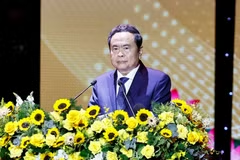
Prof. Tran Thanh Van, Chairman of Rencontres du Vietnam, said climate change was no longer solely an environmental issue but was directly linked to energy, food, jobs, health, national budgets and people’s lives.
For developing countries, transition should not mean sacrificing development but should contribute to emissions reduction and climate adaptation while ensuring energy and food security and creating jobs, he said.
The dialogue is therefore designed as an open and trusted forum connecting responsible and capable actors to exchange views and seek avenues for cooperation, Van noted.
It will feature high-level plenary sessions, dialogues and technical workshops, where delegates will discuss climate science amid geopolitical and economic challenges; shifts in transition finance; the political economy of a just climate transition; minerals for the transition; ASEAN regional power grids; and global energy security, value chains and decarbonisation.
They will also focus on extreme climate risks and resilience, economic policy scenarios for climate and nature, long-term policy and investment frameworks, green public financial management and financial instruments.
The closing session is expected to discuss a roadmap towards future climate forums and the 2027 Quy Nhon Dialogue.
Lam Hai Giang, Vice Chairman of the provincial People’s Committee, said the event would create opportunities for the locality to strengthen links with international partners, scientific organisations, businesses and financial institutions, thereby expanding cooperation and mobilising resources for sustainable development.
The province hopes the pilot will help the Quy Nhon Dialogue gradually become a reputable forum on climate, transition and international cooperation, with initiatives and partnerships developed into concrete programmes benefiting the locality and the region./.