Russia hands over research vessel "Professor Gagarinsky" to Vietnam

Designed for oceanographic research, the vessel is equipped to operate in deep and offshore waters.

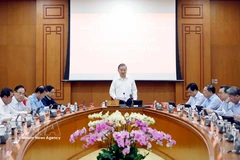
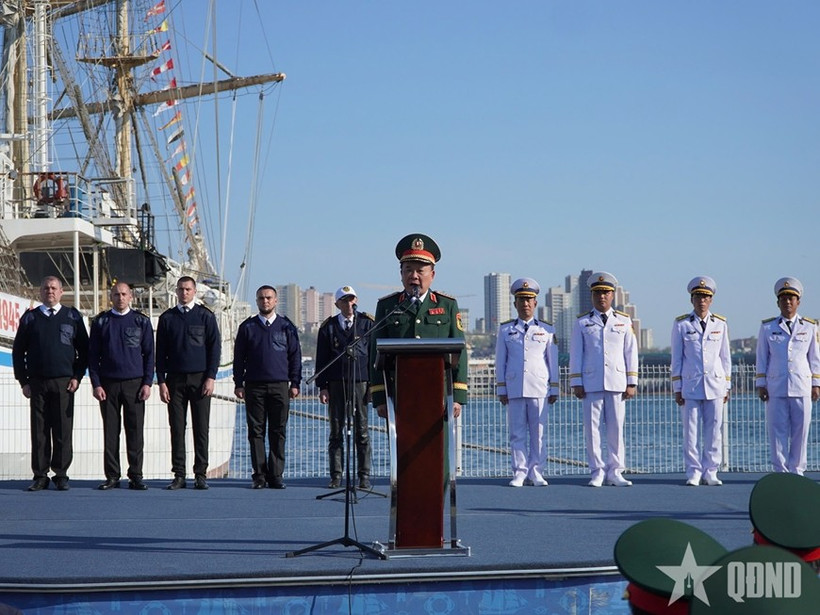
Vietnamese Deputy Minister of National Defence Senior Lieutenant General Hoang Xuan Chien speaks at a ceremony to hand over the research vessel Professor Gagarinsky to the Joint Vietnam-Russia Tropical Science and Technology Research Centre. (Photo: qdnd.vn)

Hanoi (VNA) – The research vessel Professor Gagarinsky was transferred to the Joint Vietnam-Russia Tropical Science and Technology Research Centre (VRTC) at a ceremony held on May 11 in Vladivostok city, Russia.

Designed for oceanographic research, the vessel is equipped to operate in deep and offshore waters. It is expected to mark a new chapter in marine research, enabling scientists from both countries to explore previously uncharted areas, deepen their understanding of marine ecosystems, biodiversity, and resources, and propose strategies for conservation, restoration, and sustainable use.

The vessel will help the centre modernise and significantly enhance its research capacity and operational efficiency. It allows the centre to take in the initiative in designing research programmes and conducting field surveys at sea. With Professor Gagarinsky, Vietnam’s offshore marine research capabilities are set to be significantly strengthened.

Addressing the handover ceremony, Senior Lieutenant General Hoang Xuan Chien, Deputy Minister of National Defence, expressed his sincere gratitude to the Russian Government and the Ministry of Science and Higher Education for presenting Vietnam with the vessel.
russia.jpg
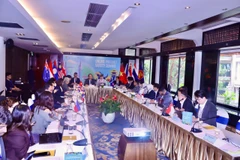
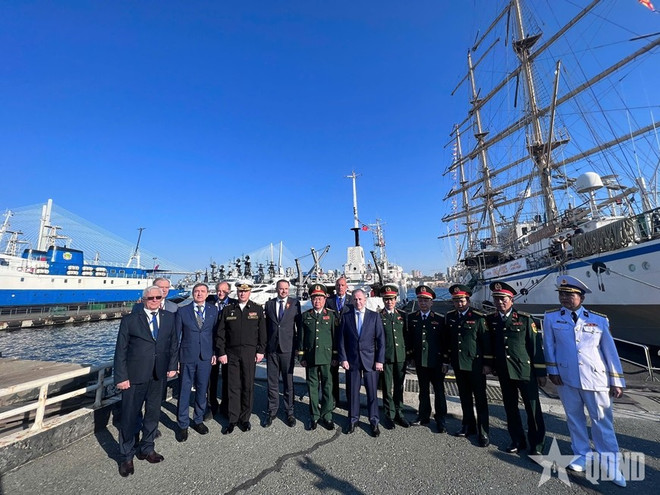
Vietnamese Deputy Minister of National Defence Senior Lieutenant General Hoang Xuan Chien (fifth, left) and other delegates attend a ceremony to hand over the research vessel Professor Gagarinsky to the Joint Vietnam-Russia Tropical Science and Technology Research Centre in the Far Eastern port of Vladivostok, Russia. (Photo: qdnd.vn)

He described Professor Gagarinsky as a new symbol of Vietnam–Russia cooperation and a shared maritime platform for scientific collaboration. The gift not only reflects the deep friendship between the two countries but also serves as motivation for scientists to further contribute to their mutual benefit, Chien added.

Upon receiving the vessel, the VRTC pledged to work closely with the Vietnam People’s Navy to ensure it remains in good technical condition. It also committed to cooperating with the Russian side to develop interdisciplinary research programmes focused on Vietnam’s maritime regions, making optimal use of the vessel while honouring the trust and meeting the expectations of both nations.

During his visit to the ship and its crew, Chien wished them smooth sailing on their voyage to Vietnam and encouraged them to preserve the vessel well, use it sustainably, and maximise its research potential./.
VNA

See more

An expert speaks at the International Conference on Semiconductors (ICOS) 2026 (Photo: VNA)

ICOS 2026 highlights pathways for Vietnam’s semiconductor development

This was the first international, specialised semiconductor conference held in central Vietnam and the first time the country hosted a large-scale academic forum dedicated exclusively to this sector. Organised in line with international standards, it featured plenary sessions, technical presentations and industry forums, reflecting major research trends shaping the semiconductor sector.

Resolution No.57: People should be put at centre of AI governance

Resolution No.57: People should be put at centre of AI governance

Assessing the role of AI, Minister of Science and Technology Nguyen Manh Hung emphasised that it is an “intellectual infrastructure.” More than an applied technology, AI is increasingly becoming a form of national infrastructure, comparable to electricity, telecommunications or the Internet.

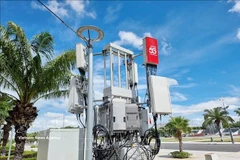
In Vietnam, 5G technology infrastructure has begun to be widely deployed by domestic network operators (Photo: VNA)

5G technology expansion expected to boost Vietnam’s digital economy

The Ministry of Science and Technology reported that by 2025, 5G had been commercialised nationwide, covering more than 90% of the population. Viettel alone has deployed 30,000 5G base stations, achieving 90% outdoor coverage and 70% indoor coverage, exceeding its commitments to the Government.

At a display of UAVs (Photo: VNA)

HCM City pilots UAVs for delivery services

HCM City aims to promote UAV use in urban delivery - a promising field contributing to smart logistics and postal services for e-commerce, smart cities and high-tech public services, while fostering UAVs as a strategic technology sector underpinning the innovation ecosystem.

Viettel's virtual assistant for searching administrative units helps shorten time and simplify searches for people. (Photo: Viettel)

Viettel’s virtual assistant among Top 10 technology products

The accolade recognises the mastery of core technologies by the Viettel Artificial Intelligence and Data Services Centre (Viettel AI), while reaffirming the group’s capacity to successfully deploy “Make in Vietnam” artificial intelligence solutions in international markets.

Workers are operating a robotic wafer conveyor assembly line in the semiconductor industry. (Illustrative image. Photo VNA)

Innovation – Driver for new development phase

The draft action programme of the Party Central Committee to implement the Resolution of the 14th National Party Congress identifies the shift to a new growth model, economic restructuring, and accelerated industrialisation and modernisation, with science, technology, innovation and digital transformation as the core engines, as key tasks.

Participants at the 5th ASEAN Digital Ministers Meeting (ADGMIN) in Thailand. (Photo: VNA)

Hanoi to host 6th ASEAN Digital Ministers’ Meeting in January

Held annually on a rotating basis among ASEAN member states, the meeting plays a key role in shaping strategic orientations, formulating policies and promoting digital cooperation within ASEAN, while strengthening collaboration with partners and international organisations amid rapid digital and digital-economy transformation globally.

(Illustrative photo: Viettel)

Viettel records breakthrough in first 5G Advanced trial

The achievement, marked as Vietnam’s first 5G Advanced trial, was made possible by carrier aggregation (CA) technology, enabling mobile devices to operate across multiple frequency bands simultaneously instead of a single band.

A biotechnology laboratory of the International University at Vietnam National University-Ho Chi Minh City. (Photo: VNA)

Resolution 57: Role of intellectuals in advancing science and technology research

Prof. Dr. Tran Dai Lam, Director of the Institute of Materials Science at the Vietnam Academy of Science and Technology (VAST), emphasised that intellectuals should nurture national responsibility and ambition, be ready to take on challenges, evaluate research outcomes by international standards, and engage in collaboration across different sectors.

Professor Vu Minh Khuong, of the Lee Kuan Yew School of Public Policy (right), talks to a Vietnam News Agency correspondent in Singapore. (Photo: VNA)

Resolution 57 - catalyst for scientific and technological breakthroughs

The resolution also seeks to create stronger mechanisms to mobilise social and private resources and support an innovation ecosystem; link digital transformation in the public sector with the modernisation of national governance; and prioritise the development of elite human resources and internationally-standard research infrastructure.

Workers produce electronic components (Photo: VNA)

Science, technology drive Vietnam’s rising global profile: expert

Assoc. Prof. Le Duc Anh from Tokyo University held that for fast and sustainable development, Vietnam should prioritise science – technology and innovation as the main driver of productivity, focusing on sectors with high spillover effects such as semiconductors, AI, data, new energy and materials, biomedical technology, automation – robotics, and cybersecurity.