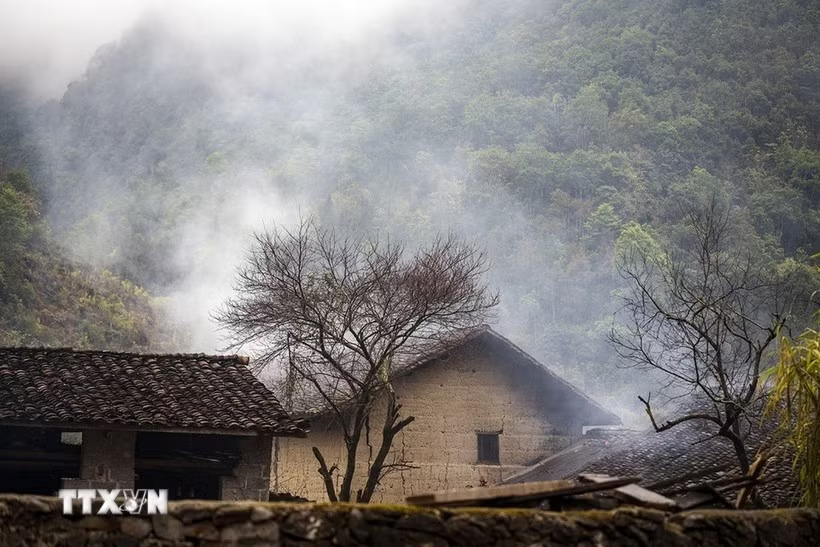
Hanoi (VNA) - Without a single trace of cement or steel, the Mong ethnic group of Vietnam’s northwestern highlands have, for generations, built rammed-earth houses with walls nearly half a meter thick – durable dwellings that conceal time-honoured secrets of construction.
Anyone who has ever ventured to the Dong Van karst plateau (Tuyen Quang), Mu Cang Chai and Sa Pa (Lao Cai), Loc Binh (Lang Son) or Muong Te (Lai Chau) will recall the beguiling tranquility of Mong villages. There, golden-brown earth houses nestle against an endless backdrop of emerald mountains and forests.
These dwellings are more than just shelters, with their half-metre-thick earthen walls, dark yin-yang tiled roofs, and rustic stone fences, where thin smoke drifts in the early morning or at dusk. They stand as quiet testaments to the community’s bond with the mountains, and to their traditional customs and rituals.
Other ethnic groups such as the Dao, Tay, Nung, Ha Nhi, and Lo Lo in Vietnam’s northern highlands also build rammed-earth houses. Yet, the Mong’s are distinctive for one defining feature: the stone fence encircling the home.
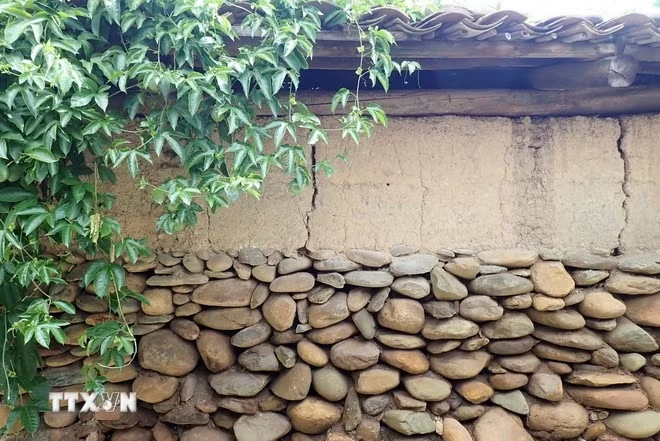
Without lime mortar or cement, these fences are fashioned entirely from mountain stone, carefully selected and stacked by hand. Stones of varying shapes and sizes are arranged to interlock, forming human-height barriers that are remarkably solid.
The fence serves multiple purposes: it marks the boundary between home and field, keeps out livestock and wild animals, and acts as a windbreak, insulating the living space during the bitter winter.
The gateway is often a simple wooden frame with a roof, opening into a wide rammed-earth courtyard where children play and bundles of maize or hay are left to dry in the sun.
Choosing a site for the house is a task entrusted to the village elders. Locations prone to flooding or perched on wind-swept ridges are avoided. Gentle slopes backed by a mountain, facing a valley, near a water source yet away from landslide-prone terrain, are deemed ideal.
Once a site is chosen, the builders dig a shallow foundation, setting rounded stones to create a stable base. A frame of durable timber – often po mu (Fokienia hodginsii), nghien (Burretiodendron hsienmu), or sa moc (Cunninghamia konishii) – is erected to define the house’s shape.
The walls are formed by filling large wooden moulds with yellow clay, then compacting the earth using heavy wooden mallets until it becomes as hard as concrete. This process, known in Mong as “trinh tuong”, gives the architecture its name.
Once a section reaches 40–50cm in thickness, the mould is removed and another layer is added on top, repeating until the desired height is achieved.
The clay used must be high-adhesion yellow clay, dried during the dry season and crushed finely before use. In some areas, chopped straw or sugarcane bagasse is mixed in to increase durability.
Repeated ramming creates dense, smooth walls that remain cool in summer and warm in winter, shielding the household from frost and mountain winds. A well-built house can endure for 50-70 years – even a century, with proper maintenance.
Traditional Mong homes typically have three compartments and two doors – a main entrance and a side door – along with several small windows. The roof is covered with yin-yang tiles, fish-scale tiles fired from clay, or thatch.
Construction usually begins after the harvest, in the crisp, dry days of late autumn and early winter, when the earth is easiest to compact and villagers have more time to spare.
Building a new house is a milestone marking a man’s maturity within the community. On such days, the entire village lends a hand – young and old alike. It is a long-held belief that a house should be completed before the Lunar New Year, to welcome the coming year in warmth and safety.
Today, amid the bustle of modern life, many villages have shifted to concrete houses. Yet, numerous Mong rammed-earth homes remain, preserved as living heritage.
Several have found new life as homestays or community tourism spots, allowing visitors to experience this traditional way of life – sitting by the crackling fire, sipping corn liquor brewed with forest herbs, and listening to tales of the Mong’s unique culture in the heart of Vietnam’s northwestern highlands region./.