Standards for foreign investment in education to be tightened

The government has recently issued Decree No. 124/2024/ND-CP, amending and supplementing several provisions of Decree No. 86/2018/ND-CP on foreign investment cooperation in education, introducing key changes compared to the original decree.

tc4z08pe.png
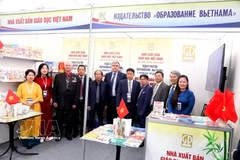
Ilustrative image (Photo: VNA)

Hanoi (VNA) - Decree No. 124/2024/ND-CP introduces key reforms to simplify and modernise procedures for foreign investment in education. It has revised and simplified 14 out of 21 forms in Decree No. 86/2018/ND-CP. Besides, there are new provisions for online submissions and reporting, and on data sharing among government agencies.

These changes aim to facilitate administrative procedures, reduce costs for individuals and organisations, and align with the government's viewpoint on creating favourable conditions for businesses and citizens engaging in economic activities.

It also introduces phased investment timelines for new educational institutions with limited initial student numbers. By the time an institution is reviewed for educational operations, it must have disbursed over 50% of the total investment value and commit to completing the investment within five years of receiving operating licence.

Furthermore, the decree emphasises transparency by requiring educational institutions to disclose detailed information about curricula, accreditation results, foreign teachers, international students, assessment methods, and other relevant data on their websites, ensuring accountability to students, parents, and society.
5oefd3qp.png
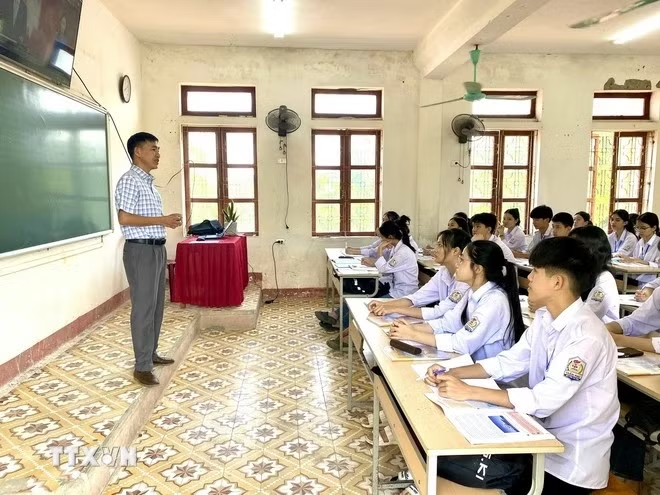
Class time at Tran Phu Junior High School, Duc Tho district, Ha Tinh province (Photo: VNA)

Regarding naming, the decree mandates that foreign-invested educational institutions adopt clear and appropriate names that avoid duplication, confusion with existing institutions, investing businesses or non-governmental organisations, or misrepresentation of their rank or educational programmes. The names must also respect Vietnam's cultural and ethical values.

Decree No. 124/2024/ND-CP mandates that foreign higher education institutions partnering with Vietnamese institutions must be reputable, accredited, and authorised to provide training and award degrees in the relevant fields in their home country. Foreign training programmes delivered in Vietnam must be authorised by the relevant authorities of the originating country or hold a valid quality accreditation certificate issued by a recognised accreditation organisation.

The decree introduces specific provisions for establishing branches of foreign higher education institutions in Vietnam, aiming to selectively attract high-quality institutions. These institutions must be legally established and operational abroad, and ranked among the top 500 globally on reputable university ranking lists at least once during the latest three years. Branches must adhere to the parent institution's training and accreditation standards, with facilities and faculty requirements not below Vietnamese regulations.

Additionally, the decree outlines quality requirements for foreign preschool and general education programmes in Vietnam. Such programmes must be recognised or accredited by relevant educational authorities abroad, have been implemented for at least five years in the originating country, and align with Vietnam's educational goals. Another new point is that foreign education providers offering these programmes must seek approval from local education authorities for oversight of content and quality.

The decree also assigns provincial and municipal governments the responsibility to manage, inspect and evaluate foreign investment in education in the localities, and resolve complaints or violations. This provision enhances local accountability and management of foreign educational partnerships and investments./.

See more

The “I Love My Fatherland" Journey 2026 kicks off in Nghe An province on May 16. (Photo: VNA)

"I Love My Fatherland” journey features diverse activities

The “I Love My Fatherland” journey will span seven stages across historical and cultural sites and “red addresses” nationwide. There will be a combination of education on traditions, field-based programmes, and digital communications.

At the handover of 33 Chinese nationals who had violated Vietnamese law to Chinese authorities in Quang Ninh on May 15, 2026. (Photo: VNA)

Vietnam hands over 33 law violators to China

Investigations found that the individuals had violated Vietnamese laws relating to illegal entry and unlawful residence in Vietnam. The handover was conducted safely and in compliance with Vietnamese law and international practice.

At the talks between authorities of the northern province of Lang Son and Pingxiang city in the Guangxi Zhuang Autonomous Region of China (Photo: VNA)

Vietnam, China seek to build modern, smart border gates

Authorities of the northern province of Lang Son and Pingxiang city in the Guangxi Zhuang Autonomous Region of China held talks on May 15 at Tan Thanh (Vietnam) – Po Chai (China) clearance point near markers 1090–1091 in Hoang Van Thu commune of Lang Son to promote trade, develop smart border gates and expand cross-border tourism cooperation.

The Vietnam Association for Victims of Agent Orange (VAVA) has carried out various activities to support Agent Orange/dioxin victims. (Photo: VNA)

Over 9.3 billion VND raised for AO/dioxin victims in 2025

VAVA President Lieutenant General Nguyen Huu Chinh said that although the war ended more than 50 years ago, the consequences of toxic chemicals remain severe and long-lasting, with millions of people affected during the war and hundreds of thousands continuing to suffer serious physical impacts in peacetime.

An overview of the meeting (Photo: VNA)

Measures sought to accelerate construction of inter-level boarding schools in border areas

The construction of boarding schools in land border communes is a particularly important political task receiving close attention from the Politburo and Party General Secretary and State President To Lam. The programme not only aims to improve learning conditions for students in border areas, but also carries strategic significance for social welfare, human development, national defence and security, and safeguarding territorial sovereignty.

An overview of the court on May 14 (Photo: VNA)

Man gets life sentence for terrorism, anti-State activities

The People’s Court of Ho Chi Minh City on May 14 handed down life imprisonment to Dao Minh Quan on charges of “terrorism aimed at opposing the people’s administration” and “activities aimed at overthrowing the people’s administration”.

Secretary of the Ho Chi Minh Communist Youth Union Central Committee and VYF President Nguyen Tuong Lam addresses the event (Photo: VNA)

“I love my fatherland” journey 2026 launched

The “I Love My Fatherland” journey will comprise seven stages linked to historical, cultural and revolutionary sites across the country. The journey will begin in Nghe An on May 16 to mark President Ho Chi Minh’s birthday, before continuing through Hue city, Tuyen Quang–Lung Cu Flag Tower, Dien Bien, Khanh Hoa, Ca Mau and Ho Chi Minh City, and concluding in Hanoi in October.

Students in the Mekong Delta city of Can Tho are honoured for their outstanding performance in startup activities. (Photo: VNA)

Education ministry targets five digital technology incubators at universities

A key target under the new plan is the establishment of five digital technology incubators, or Deeptech Hubs, at universities and research institutes with strong potential. The education ministry also plans to launch a training programme for 1,000 outstanding technology entrepreneurs and develop criteria for selecting and supporting startup ecosystems within educational institutions.

At the equipment handover ceremony for the Narcotics Targeting Centre of Vietnam Customs. (Photo: cand.com.vn)

Vietnam Customs expands capacity to tackle cross-border narcotics crime

Established in November 2025, the NTC comprises six officers from the Anti-Smuggling Investigation Sub-Department specialising in surveillance, intelligence collection and information analysis. The centre is tasked with strengthening customs capacity in risk assessment and drug crime targeting, helping authorities detect and prevent illicit cross-border trafficking of narcotics and other dangerous substances at an early stage.