Thailand approves fisheries management plan for 2023–2027 period

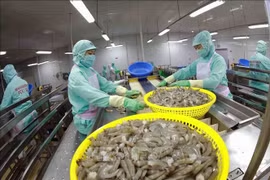
The Thai Government considers the fisheries sector a key pillar of national food security and an important contributor to the economy. Exports of processed aquatic products, including canned seafood, fresh shrimp and frozen shrimp, generate more than 200 billion THB (5.9 billion USD) in annual revenue.

Bangkok (VNA) – Thailand's Cabinet has approved the Fisheries Management Policy and Plan for 2023–2027, with the aim of promoting the sustainable development of the fisheries sector, enhancing the competitiveness of businesses, and striking a balance between resource exploitation and conservation amid declining fish stocks and increasingly stringent international trade standards.

According to Deputy Government Spokesperson Capt. Patdarasmi Thongsaluay, the plan, proposed by the Ministry of Agriculture and Cooperatives, will guide fisheries management and development for the 2023–2027 period in line with the country's fisheries resources, economic conditions, environmental requirements and international trade regulations, The Nation reported.

The Thai Government considers the fisheries sector a key pillar of national food security and an important contributor to the economy. Exports of processed aquatic products, including canned seafood, fresh shrimp and frozen shrimp, generate more than 200 billion THB (5.9 billion USD) in annual revenue.

However, the industry continues to face mounting challenges, including declining marine resources, the impacts of climate change, illegal, unreported and unregulated (IUU) fishing, and increasingly demanding requirements from international import markets.

The new plan will be implemented through four strategic pillars and 18 sets of measures, focusing on conserving and restoring aquatic ecosystems, ensuring the sustainable management of fisheries resources, strengthening the capacity of fishermen and enterprises, improving product quality standards, promoting the application of science, technology and innovation, and increasing the value of fisheries products.

With a total budget of 12.76 billion THB, the plan aims by 2027 to increase annual fishery output by at least 25,000 tonnes, maintain annual sectoral growth of at least 3%, eliminate IUU fishing, and ensure full traceability throughout the supply chain.

It also targets 100% compliance with legal requirements by Thai fishing vessels operating outside the country's waters, a minimum 5% annual increase in the net income of fishing communities, 95% of aquatic products meeting international standards without being rejected by importing markets, and the practical application of at least 40 research outcomes and technological innovations before 2027./.
VNA

See more

Indonesia exempts four countries from export earnings rule

Indonesia exempts four countries from export earnings rule

Indonesian Coordinating Minister for Economic Affairs Airlangga Hartarto said on July 24 that the exemption applies to nations with existing bilateral trade agreements with Jakarta, offering flexibility to preserve key diplomatic and economic partnerships.

Malaysia confirmed as host of Formula 1 Bahrain Grand Prix

Malaysia confirmed as host of Formula 1 Bahrain Grand Prix

Malaysia has long held an important place in the history of Formula 1 and the return of the Championship to Sepang is testament to our close relationship with the Motorsports Association of Malaysia, the continued commitment of the Malaysian Government, and the strength of international cooperation within our sport.

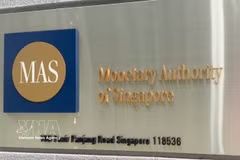
The Monetary Authority of Singapore (MAS) announces on July 27 that it will tighten monetary policy (Photo: VNA)

Singapore further tightens monetary policy

MAS said Singapore's economy is expected to post strong growth in the second half of this year, while external price pressures are likely to continue affecting consumers. Core inflation, which excludes private transport and accommodation, is projected to step up from July and remain elevated until early next year.

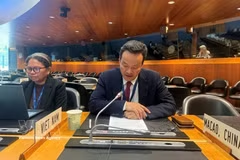
Ambassador Mai Phan Dung, Permanent Representative of Vietnam to the United Nations, the World Trade Organisation (WTO) and other international organisations in Geneva, speaks at the eight WTO Trade Policy Review of India. (Photo: VNA)

Vietnam attends India’s 8th WTO Trade Policy Review

India is one of Vietnam’s leading economic partners in South Asia and its eighth-largest trading partner of the Southeast Asian nation. Bilateral trade accounts for about 80% of Vietnam’s total trade with other South Asian countries. Meanwhile, Vietnam is currently India’s 22nd-largest trading partner globally and the fourth-largest in ASEAN.

Indonesia steps up efforts to reclaim cultural heritage

Indonesia steps up efforts to reclaim cultural heritage

Indonesia has recovered a collection of cultural artefacts from Papua that was illegally taken to the US, marking what Jakarta described as a significant step in restoring national ownership of its cultural heritage.

Thailand steps up fight against corruption

Thailand steps up fight against corruption

Chairing the first meeting of the Anti-Corruption Coordination Committee in 2026 on July 23, Thai Prime Minister Anutin Charnvirakul said the Government will prioritise structural reforms to prevent corruption rather than relying solely on punitive measures after offences have been committed.

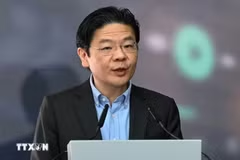
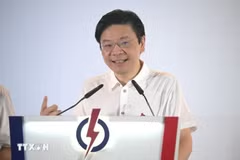
Singaporean Prime Minister Lawrence Wong (Photo: VNA)

Singapore reshuffles Cabinet

Among the changes, Foo Cexiang and Shawn Loh, who entered politics in the 2025 General Election, will join the government for the first time as ministers of State.

Thanaleng Vientiane Dry Port in Hadxaiphong district, in Vientiane capital of Laos (Photo: VNA)

Laos economy faces challenges after salary increases

According to the WB report, amid a fragile economic recovery, the salary increase is considered an important step to retain qualified civil servants while helping workers cope with rising living costs. Inflation in Laos remains high, reaching 10.2% in April due to the impact of the global fuel price crisis, directly affecting people’s livelihoods and real incomes.

Thailand unveils strategy for workforce reskilling

Thailand unveils strategy for workforce reskilling

Thai Government efforts will focus on raising productivity per worker rather than expanding the workforce size. This will require workers across the industrial, services and agricultural sectors to acquire new skills and adapt to production systems increasingly driven by AI, automation and digital technologies.