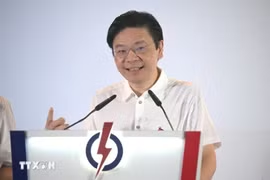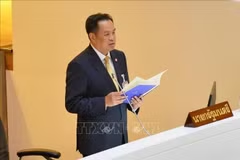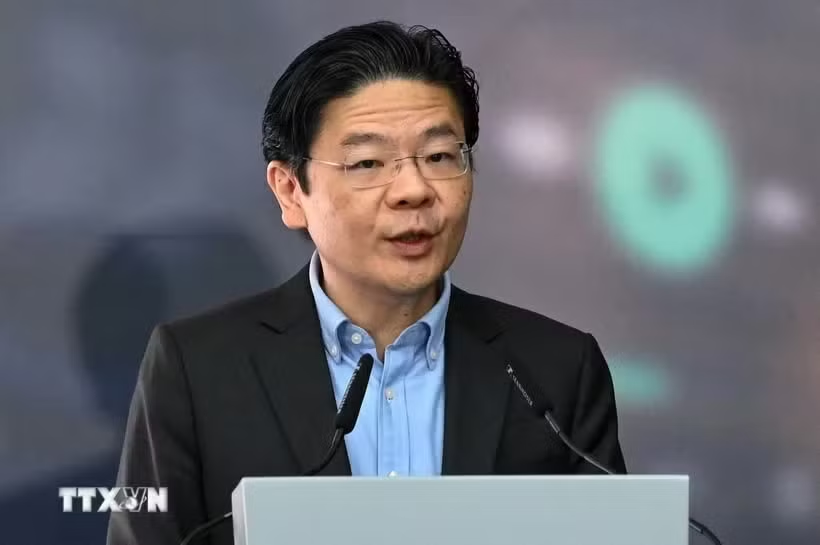
Singapore (VNA) – Singapore's newly appointed Cabinet, unveiled by Prime Minister Lawrence Wong, features a number of younger leaders taking on expanded responsibilities, underscoring the government's focus on addressing emerging challenges posed by geopolitical tensions and rapid technological change.
With his deployments, PM Wong looks to be strengthening the bench where the uncertainty is greatest, and where Singapore would most benefit from a clear way forward.
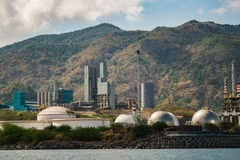
One such area is energy, where the challenge is to meet the nation’s growing demands while moving towards a low-carbon future.
To reflect this shift in emphasis, the Ministry of Trade and Industry (MTI) will be renamed the Ministry of Energy, Trade and Industry (METI) from October 1.
Manpower Minister Tan See Leng will relinquish his current role and focus his full attention on his new post: Minister for Trade and Industry (Energy and Industry). One of his immediate priorities will likely be to deal with the continued fallout from the Middle East tensions, which have caused oil prices to skyrocket.
Beyond that, there is the bigger question of energy security as Singapore works towards its net-zero target. Among other things, it has plans to import more low-carbon electricity from the region – a move that diversifies clean energy sources but potentially creates a dependency that could leave it vulnerable to future supply shocks.
There is also the nuclear question. At present, the country is studying the potential of deploying nuclear energy, and will undergo an assessment by the International Atomic Energy Agency (IAEA) in 2027 to determine if it is ready to make an informed decision on whether to do so.
Another source of uncertainty is growing anxiety over jobs and AI disruption – challenges that two new Cabinet appointments look to be aimed at tackling.
Previous Cabinet reshuffles have often been used to give ministers exposure to different portfolios, but the latest changes also seem geared towards challenging various members of PM Wong’s team to perform at a higher level.
This can be seen in how some individuals’ portfolios remained the same, even as their responsibilities grew./.