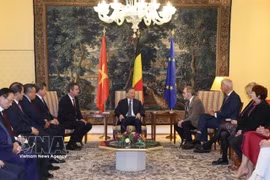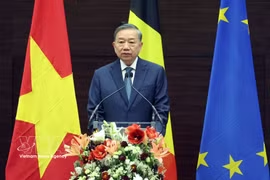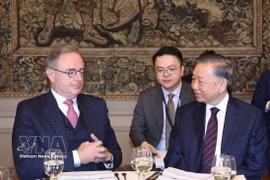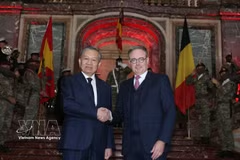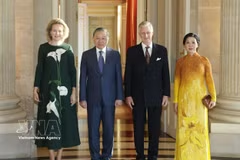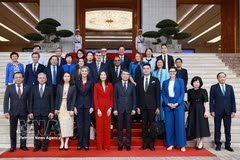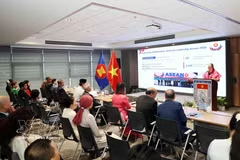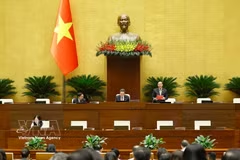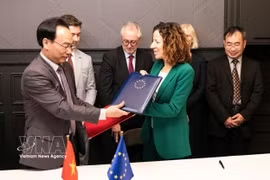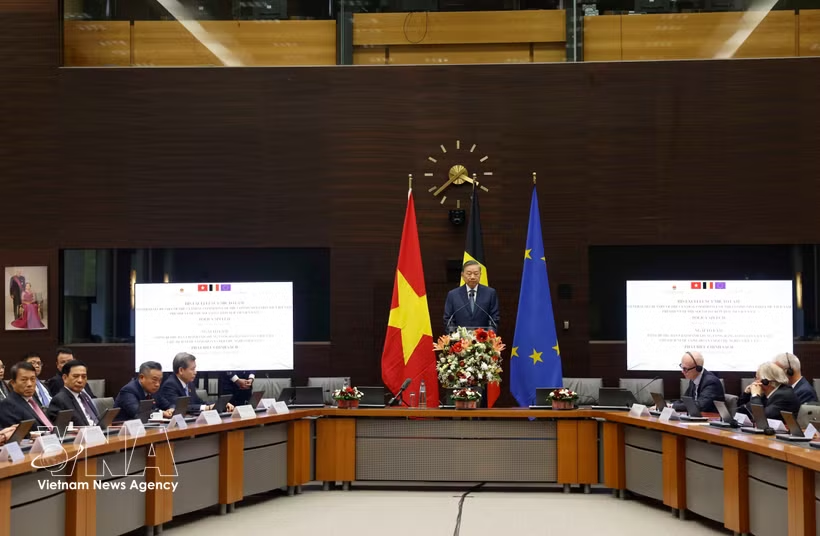
Brussels (VNA) – General Secretary of the Communist Party of Vietnam Central Committee and President To Lam delivered a policy speech titled "Turning vision into action – from political determination to a model for cooperation" at Egmont – The Royal Institute for International Relations in Brussels on October 23 afternoon (local time), part of his official visit to Belgium.
The following is a translation of the address.
Mr. Chair of Egmont – the Royal Institute for International Relations,
Distinguished guests, scholars, researchers, and representatives of the diplomatic corps,
It is a great pleasure for me and the high-level Vietnamese delegation to be here in the Kingdom of Belgium – the political hub of the European Union. The Kingdom of Belgium possesses an invaluable diplomatic legacy: the art of reconciling differences and building consensus. Its capacity to manage diversity has made it a symbol of the spirit of “Unity in Diversity” – a core philosophy that the EU, ASEAN, and the international community hold in high regard in today’s volatile world.
After four decades of Doi Moi (Renewal), Vietnam has transformed from a war-torn nation, beset by encirclement and embargoes, into the EU’s leading trade and investment partner in Southeast Asia. This journey affirms a fundamental truth: regardless of differences in political systems or levels of development, nations that share a commitment to dialogue, mutually beneficial cooperation, and respect for international law can successfully transcend their differences to shape a shared future.
Today, at Egmont – The Royal Institute for International Relations, I would like to share three key messages:
- First: Recognising the strategic shift of our era – a period of profound transformation that carries the risk of fragmentation while simultaneously opening up new opportunities, in which the EU continues to play a central, pioneering role.
- Second: An increasing alignment in vision, values, and the mindset of “strategic autonomy” between Vietnam and the EU – a solid foundation for both sides to advance further.
- Third: Breakthrough strategic orientations in Vietnam–EU relations, with the relationship between Vietnam and Belgium serving as a driver and the most vivid testament to this.
Ladies and gentlemen,
1. The world faces epochal shifts and the risk of fragmentation.
We are living through a period in which the international order is being profoundly reshaped. Strategic competition among major powers has deeply permeated every core structure: from economics, trade, and supply chains to strategic technologies, artificial intelligence (AI), and data standards. The emergence of policies centred on “Economic Security” or “De-risking” is drawing new boundaries across technological ecosystems and production chains, exposing the world to the serious risk of geo-economic fragmentation.
Multilateralism and the rules-based order are facing unprecedented challenges. Unilateralism and a tide of protectionism are on the rise, while central multilateral institutions such as the United Nations and the World Trade Organisation are under urgent pressure to reform. The world confronts a paradox: deeper connectivity driven by technology, yet accelerating fragmentation fuelled by geopolitics.
At the same time, the risks of geopolitical conflict and sovereignty disputes spanning the seas, oceans, outer space, and cyberspace are becoming intensely intertwined with severe non-traditional security challenges (ranging from climate change and energy or food crises to high-tech crime). Reality confirms that no single nation can address these global risks on its own.
The strategic challenge is this: How can we safeguard national autonomy while simultaneously contributing to the construction of a fair, open, and rules-based international order? This is a question that requires a shared solution from both Vietnam and the EU. And I believe that the more we engage in dialogue, the more both sides will realise that we share far more in terms of strategic common ground and core values than we have differences.
Ladies and gentlemen,
2. Vietnam’s path of development: Strategic autonomy coupled with deep and broad integration
To address this question, Vietnam has adopted a guiding philosophy for action: “Confidence – autonomy – self-reliance – self-strengthening – national pride.” The underlying logic is that self-reliance and self-strengthening build resilience and autonomy, while deep and broad international cooperation helps expand the space for national development. Emerging from the shadows of war and embargoes, Vietnam took the courageous step of Doi Moi. It has innovated its leadership mindset, reformed institutional frameworks, transformed operational approaches, and proactively integrated into the global community.
As a poor, war-torn nation, Vietnam’s GDP per capita stood at approximately 84 USD in 1975. By 2025, this figure surpassed 5,000 USD. Vietnam has become a dynamic economy with a GDP exceeding 500 billion USD (ranking among the 32 largest economies in the world).
We have established trade relations with over 230 countries and signed 18 free trade agreements (FTAs) with more than 60 partners. In 2026, we continue to sustain a strong growth momentum, targeting a total trade turnover of more than 1.2 trillion USD. More importantly, the fruits of this growth have been substantively translated into improvements in the people’s quality of life, the strengthening of social welfare, and sustainable poverty reduction.
Vietnam is confidently entering a new era of development with two centennial goals: to become a developing nation with a modern industrial base by 2030, and a developed, high-income nation by 2045. To realise this aspiration, we are moving away from a reliance on natural resources or low-cost labour, shifting instead toward a growth model driven by knowledge, innovation, digital transformation, and the green transition, with people at the centre. At the same time, Vietnam remains steadfast in its foreign policy of independence, self-reliance, and multilateralisation and diversification of external relations.
Nevertheless, the path ahead remains fraught with challenges: the risk of falling into the “middle-income trap”, the pressure to boost productivity, and the vulnerability of an open economy to geo-economic shocks. To overcome these hurdles, alongside its own efforts, Vietnam needs strategic, fair, balanced, and effective cooperation from international partners, among whom the European Union stands out as a premier, high-caliber partner.
Ladies and Gentlemen,
3. The position and role of the European Union in the global order
The birth of the European Union stands as a monumental milestone of the 20th century – transforming a continent once ravaged by war into a space of peace, prosperity, and extensive integration that is among the most of its kind in the world. It serves as an inspiring lesson on the capacity to transcend history and embrace differences to forge a shared future – a philosophy that deeply resonates with the Vietnamese people.
Today, the EU stands not only as a leading hub for the economy, science, and technology, but also as a pioneer in shaping international standards and global governance norms, spanning areas from the green and digital economies to artificial intelligence. We highly value the EU’s pursuit of “Strategic Autonomy” – an approach that fosters Europe’s autonomy in economic security while remaining firmly committed to multilateralism and international law. Through its Indo-Pacific Strategy, the EU is actively establishing its presence and making practical contributions to peace, stability, and freedom of navigation in the region.
For Vietnam, the relationship with the EU holds a special, structural significance. The EU was among the first strategic partners to accompany Vietnam from the very early days of the Doi Moi process. Vietnam takes pride in being the only Southeast Asian nation to maintain such a comprehensive network of cooperation with the EU (encompassing eight cooperation mechanisms) while also having established strategic or comprehensive partnerships with 11 of its member states.
Cooperation with the EU is not merely a conventional foreign relationship, it serves as a strategic pillar, directly aligned with Vietnam’s policy of multilateralisation and diversification, and its pursuit of an autonomous path of development. We deeply appreciate the equitable and invaluable cooperation and support that the EU and its member states have extended to Vietnam over the past decades.
Ladies and gentlemen,
4. Vietnam and the EU: Shared interests, values, and strategic vision
Transcending geographical distance and differences in levels of development, Vietnam and the EU find deep alignment across four strategic pillars:
First, the convergence between the “Strategic Autonomy” pursued by both sides and Vietnam’s own ethos of Self-strengthening: Autonomy does not imply isolation or disconnection; rather, it signifies an enhanced capacity to independently determine one’s own path of development and national destiny. Within the framework of the EU’s “De-risking” and “Global Gateway” strategies, Vietnam – given its central position in Southeast Asia and its highly open economy – serves as a “trusted link” that assists the EU in diversifying and securing its supply chains.
Second, a positive perspective on new green standards (CBAM, EUDR): We do not view CBAM or EUDR as protectionist barriers, but rather as catalysts for restructuring the economy toward green development. Vietnam is ready to be a pioneering developing nation in complying with these standards, while also looking to the EU for partnership in green technology and finance.
Third, a commitment to fairness, transparency, equality, and mutual benefit in Free Trade and Economic Security: The EVFTA and EVIPA demonstrate that a developing nation can fully integrate on equal terms, meeting the highest standards regarding labour, the environment, and sustainable development. The steadfast commitment of both sides to trade liberalisation serves as a counter-message to the tide of protectionism and unilateralism.
Fourth, upholding International Law and Maritime Security (UNCLOS 1982): Both sides regard the United Nations Charter and the 1982 United Nations Convention on the Law of the Sea (UNCLOS 1982) as the “constitution for the oceans and seas.” The East Sea serves as a vital maritime artery directly linked to Europe’s economic security. We highly value the EU’s strong voice in defending the integrity of UNCLOS 1982 and maintaining a peaceful presence in the Indo-Pacific.
Ladies and gentlemen,
5. Vietnam–EU and Vietnam–Belgium relations: From political resolve to breakthrough strategic cooperation programmes
A framework for relations only truly possesses vitality when it fosters a profound strategic understanding, intertwines interests, and yields concrete results. In this context, the relationship between Vietnam and Belgium serves as the most vivid testament to the depth of the Vietnam–EU partnership.
I propose the following areas for breakthrough strategic cooperation in the coming period:
First, elevate political trust and economic security: Establish Vietnam–EU cooperation as a core element of the EU’s Indo-Pacific Strategy. Both sides should strengthen ties in trade and investment, ensure the security of supply chains, and enhance collaboration in cybersecurity and maritime security, as well as coordination among the EU, Vietnam, and ASEAN to help shape a rules-based regional security architecture.
Second, institutionalise economic, trade, and investment cooperation at a new height: Building upon the EVFTA and EVIPA, collaboration should be expanded into the digital economy, the circular economy, and the carbon credit market. Vietnam proposes the EU provide technical assistance to help Vietnamese enterprises meet green standards (such as CBAM and EUDR), while also encouraging European investment funds to expand their presence in Vietnam’s strategic infrastructure and logistics sectors.
Third, achieve breakthroughs in science – technology, semiconductors, and innovation: In alignment with the EU Chips Act and AI Strategy, Vietnam proposes connecting the two sides' technology ecosystems. A key focus is cooperation with Belgium – home to IMEC, a world-leading semiconductor research centre. This includes establishing joint R&D centres for semiconductors, responsible AI, and biotechnology, as well as fostering connections between innovation and startup networks.
Fourth, accelerate the green transition and a just energy transition: Realise the Net Zero 2050 goal and the Just Energy Transition Partnership (JETP) by combining EU green finance and technologies (offshore wind power and green hydrogen) with Vietnam’s potential. Such cooperation should engage the private sector and local authorities from both sides, particularly in addressing climate change in the Mekong Delta.
Fifth, strengthen the foundation of education, training, and people-to-people exchanges: Build a sustainable “knowledge alliance” rooted in the legacy of cooperation between Belgian and Vietnamese universities, while leveraging the “soft power” of the Vietnamese community in Belgium and across Europe as a robust cultural bridge.
As one of the Southeast Asian nations with the most comprehensive partnership with the EU and currently serving as the coordinator for ASEAN–EU relations, Vietnam stands ready to act as a “pilot model” and a strategic bridge, helping turn ASEAN–EU cooperation into an exemplary inter-regional partnership, making a tangible contribution to peace and prosperity across both continents.
Ladies and Gentlemen,
6. A shared aspiration for a peaceful and prosperous future
Visiting the Egmont Institute today – standing in a place named after the Count of Egmont, who chose to side with the people and the ideals of freedom, becoming an immortal symbol of courage and dialogue – I realise a profound parallel. The Vietnamese people, too, have weathered countless historical storms, sustained by an indomitable spirit of independence, resilience, and a fervent yearning for peace.
Vietnam is entering a new era of development, with the goal of building a prosperous nation, a green and modern economy, and a humane society.
I hope that from this hall at the Egmont Institute today, European policymakers and scholars will come to see Vietnam as a “trusted partner” and a “strategic link” connecting the continents of Asia and Europe. As this vision is realised, the Vietnam–EU and Vietnam–Belgium relationships will transcend the pages of diplomatic documents, evolving into a vibrant economic, intellectual, and technological corridor that bridges Hanoi and Brussels.
Allow me to conclude by highlighting a remarkable convergence of two sources of inspiration: the motto on the Belgian coat of arms, “Unity makes strength,” and the timeless teaching of President Ho Chi Minh: “Unity, unity, great unity. Success, success, great success.”
This serves as a common denominator for our new era: Unity in diversity, moving forward together while respecting differences so that we may jointly write a new chapter of peace and prosperity for both our continents.
Thank you very much!
VNA