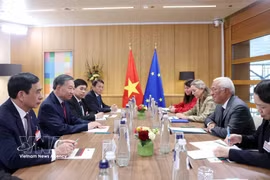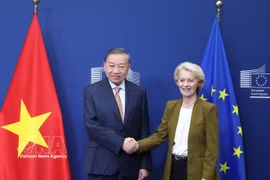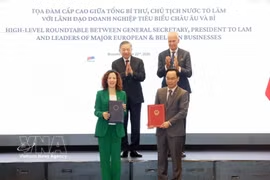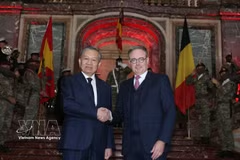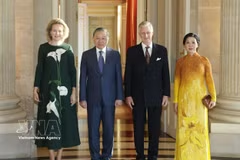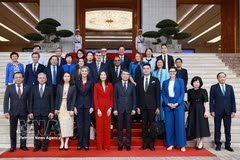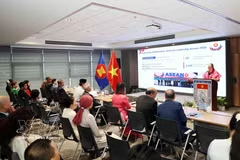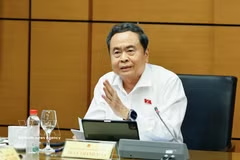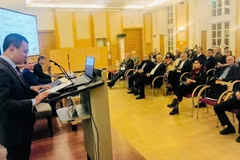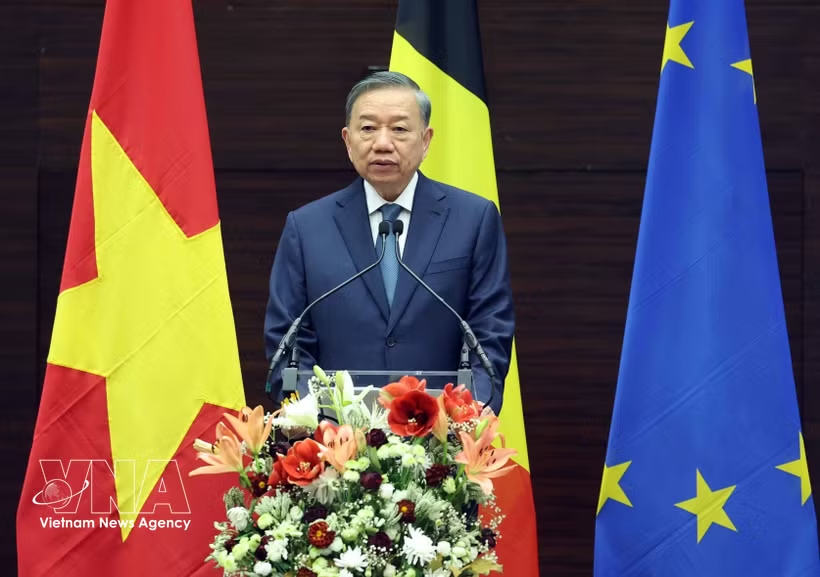
Brussels (VNA) – General Secretary of the Communist Party of Vietnam Central Committee and President To Lam delivered a policy speech at Egmont – The Royal Institute for International Relations in Brussels on October 23 afternoon (local time), with a focus on turning vision into action – from political determination to a model for cooperation.
Addressing distinguished guests, scholars, researchers, and diplomats, General Secretary and President Lam, who is on an official visit to Belgium, said that after four decades of Doi Moi (Renewal), Vietnam has transformed from a war-torn nation, beset by encirclement and embargoes, into the EU’s leading trade and investment partner in Southeast Asia. This journey affirms a fundamental truth: regardless of differences in political systems or levels of development, nations that share a commitment to dialogue, mutually beneficial cooperation, and respect for international law can successfully transcend their differences to shape a shared future.
Highlighting three key messages, he said the first is recognising the strategic shift of the era – a period of profound transformation that carries the risk of fragmentation while simultaneously opening up new opportunities, in which the EU continues to play a central, pioneering role.
The second is an increasing alignment in vision, values, and the mindset of “strategic autonomy” between Vietnam and the EU – a solid foundation for both sides to advance further. And the third is breakthrough strategic orientations in Vietnam–EU relations, with the relationship between Vietnam and Belgium serving as a driver and the most vivid testament to this.
As the world faces epochal shifts and the risk of fragmentation, the strategic challenge is how to safeguard national autonomy while simultaneously contributing to the construction of a fair, open, and rules-based international order. This is a question that requires a shared solution from both Vietnam and the EU, he noted.
To address this question, he went on, Vietnam has adopted a guiding philosophy for action: “Confidence – autonomy – self-reliance – self-strengthening – national pride.” The underlying logic is that self-reliance and self-strengthening build resilience and autonomy, while deep and broad international cooperation helps expand the space for national development. Emerging from the shadows of war and embargoes, Vietnam took the courageous step of Doi Moi. It has innovated its leadership mindset, reformed institutional frameworks, transformed operational approaches, and proactively integrated into the global community.
According to the top leader, Vietnam is confidently entering a new era of development with two centennial goals: to become a developing nation with a modern industrial base by 2030, and a developed, high-income nation by 2045. To realise this aspiration, it is moving away from a reliance on natural resources or low-cost labour, shifting instead toward a growth model driven by knowledge, innovation, digital transformation, and the green transition, with people at the core. At the same time, Vietnam remains steadfast in its foreign policy of independence, self-reliance, and multilateralisation and diversification of external relations.
Nevertheless, the path ahead remains fraught with challenges: the risk of falling into the “middle-income trap”, the pressure to boost productivity, and the vulnerability of an open economy to geo-economic shocks. To overcome these hurdles, alongside its own internal efforts, Vietnam needs strategic, fair, balanced, and effective cooperation from international partners, among whom the European Union stands out as a premier, high-caliber partner.
Stressing the EU’s position and role in the global order, General Secretary and President Lam noted that for Vietnam, the relationship with the EU holds a special, structural significance.
Vietnam takes pride in being the only Southeast Asian nation to maintain such a comprehensive network of cooperation with the EU while also having established strategic or comprehensive partnerships with 11 of its member states, he remarked.
Cooperation with the EU is not merely a conventional foreign relationship, it serves as a strategic pillar, directly aligned with Vietnam’s policy of multilateralisation and diversification, and its pursuit of an autonomous path of development, he said, adding that Vietnam deeply appreciates the equitable and invaluable cooperation and support that the EU and its member states have extended to the country over the past decades.
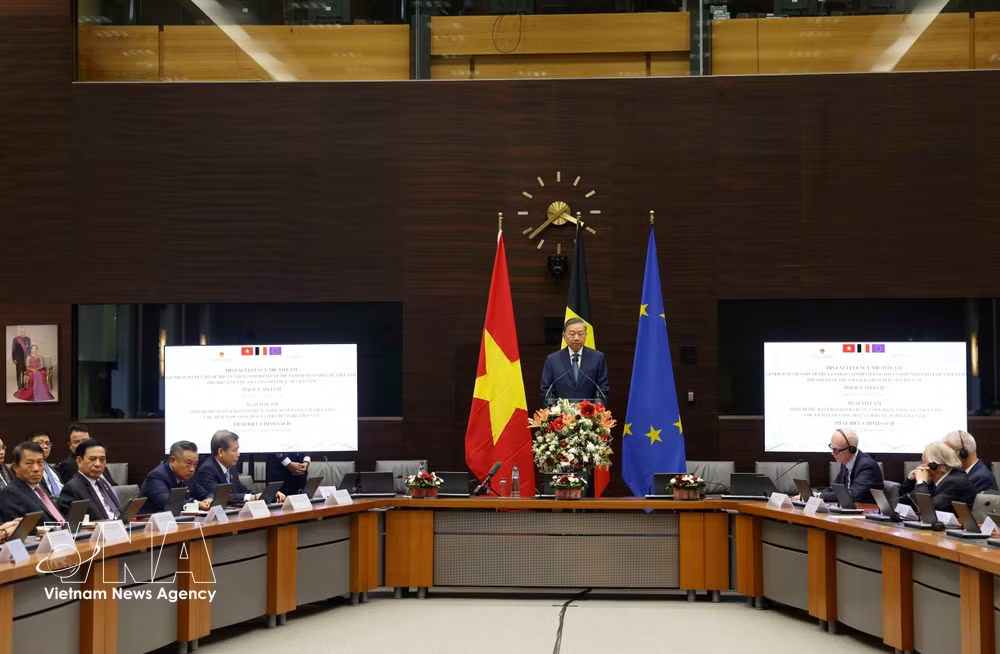
The leader went on to say that transcending geographical distance and differences in levels of development, Vietnam and the EU find deep alignment across four strategic pillars, namely the convergence between the “Strategic Autonomy” pursued by both sides and Vietnam’s own ethos of self-strengthening; a positive perspective on new green standards such as CBAM and EUDR; a commitment to fairness, transparency, equality, and mutual benefit in free trade and economic security; and upholding international law and maritime security.
He described the Vietnam–Belgium relationship as the most vivid testament to the depth of the Vietnam–EU partnership, proposing several areas for breakthrough strategic cooperation in the coming period.
He called on the two sides to elevate political trust and economic security. In particular, they should strengthen ties in trade and investment, ensure the security of supply chains, and enhance collaboration in cybersecurity and maritime security, as well as coordination among the EU, Vietnam, and ASEAN to help shape a rules-based regional security architecture.
They need to institutionalise economic, trade, and investment cooperation at a new height, the General Secretary and President said, proposing the EU provide technical assistance to help Vietnamese enterprises meet green standards such as CBAM and EUDR. He also encouraged European investment funds to expand their presence in Vietnam’s strategic infrastructure and logistics sectors.
Another proposed area is to achieve breakthroughs in science – technology, semiconductors, and innovation. Vietnam suggested connecting the two sides' technology ecosystems. A key focus is cooperation with Belgium – home to IMEC, a world-leading semiconductor research centre. This includes establishing joint R&D centres for semiconductors, responsible AI, and biotechnology, as well as fostering connections between innovation and startup networks.
He called for accelerating the green transition and a just energy transition, saying such cooperation should engage the private sector and local authorities from both sides, particularly in addressing climate change in the Mekong Delta of Vietnam.
Besides, it is necessary to enhance the foundation of education, training, and people-to-people exchanges. The two sides should build a sustainable “knowledge alliance” rooted in the legacy of cooperation between Belgian and Vietnamese universities, while leveraging the “soft power” of the Vietnamese community in Belgium and across Europe as a robust cultural bridge.
As one of the Southeast Asian nations with the most comprehensive partnership with the EU and currently serving as the coordinator for ASEAN–EU relations, Vietnam stands ready to act as a “pilot model” and a strategic bridge, helping turn ASEAN–EU cooperation into an exemplary inter-regional partnership, thus making a tangible contribution to peace and prosperity across both continents, General Secretary and President Lam stated.
He voiced his hope that European policymakers and scholars will come to see Vietnam as a “trusted partner” and a “strategic link” connecting the continents of Asia and Europe.
As this vision is realised, the Vietnam–EU and Vietnam–Belgium relationships will transcend the pages of diplomatic documents, evolving into a vibrant economic, intellectual, and technological corridor that bridges Hanoi and Brussels, he emphasised.
A common denominator for the new era is “unity in diversity”, moving forward together while respecting differences, so that the two sides may jointly write a new chapter of peace and prosperity for both continents, the top leader concluded./.