Hanoi (VNA) – As the Party broadens its vision for tourism development in both policy and strategic thinking, Vietnam's tourism sector is being called on to remove longstanding bottlenecks and unlock new growth to become a spearhead economic sector in the new era.
Nguyen Trung Khanh, Director General of the Vietnam National Authority of Tourism (VNAT), said the draft project on developing tourism into a spearhead economic sector in the new era covers a wide range of sectors and policy areas, requiring close coordination among ministries, agencies and stakeholders.
VNAT leaders said Vietnam's tourism industry recorded strong growth following the issuance of the Politburo's Resolution No. 08-NQ/TW. Between 2017 and 2019, international arrivals rose from 12.9 million to 18 million, while domestic travellers increased from 73.1 million to 85 million. Tourism revenue climbed from 541 trillion VND (20.6 billion USD) to 755 trillion VND, contributing 9.2% directly to GDP in 2019.
After being severely affected by the COVID-19 pandemic, the sector began a strong recovery in 2023. By 2025, Vietnam welcomed nearly 21.2 million international visitors and served 137 million domestic travellers, while tourism revenue exceeded 1 quadrillion VND, surpassing pre-pandemic levels and making a growing contribution to economic growth, employment and investment.
Despite the progress, VNAT Deputy Director General Ha Van Sieu said the industry's performance still falls short of its potential. Growth remains driven largely by visitor numbers rather than quality, tourism products lack differentiation, source markets are insufficiently diversified, destination management and promotion remain weak, and both businesses and the tourism workforce need improvement.
The draft project identifies three priority bottlenecks requiring urgent action: institutional and inter-agency coordination mechanisms, tourism infrastructure, and the development of a highly skilled tourism workforce.
Entering a new development phase, recent Politburo resolutions and the Resolution of the 14th National Party Congress have established a new policy framework linking tourism development with science and technology, innovation, digital transformation and private sector growth.
Under this vision, tourism is expected to evolve beyond a standalone economic sector to become the centrepiece of an integrated ecosystem. It encompasses services, culture, creativity, digital transformation, green growth and international integration, contributing directly to sustainable economic development.
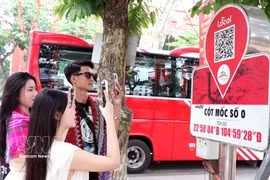
Policies adopted by the Party Central Committee, the Politburo, the Government and the Prime Minister are creating new momentum for tourism development. Advances in science, technology, innovation and digital transformation are expected to accelerate the shift towards data-driven growth, smart destination management and personalised travel experiences.
At the same time, deeper international integration is opening new opportunities to diversify markets, strengthen tourism value chains and elevate Vietnam's destination brand, while private-sector development is encouraging strategic investment and large-scale integrated tourism, entertainment and resort projects. The greatest potential lies in closer integration between tourism and culture, cultural industries, the heritage economy, healthcare, commerce, aviation and digital platforms.

Under the draft project, Vietnam aims to welcome 45-50 million international visitors and 160 million domestic travellers annually by 2030, with tourism contributing around 14% of GDP.
To achieve them, the draft proposes eight key groups of tasks, including institutional reform, infrastructure development, restructuring tourism markets and products, promoting green tourism, accelerating digital transformation, strengthening tourism promotion and branding, developing tourism enterprises and a high-quality workforce, while fostering new thinking and greater accountability across the sector.
Members of the drafting committee called for tourism to be developed as an integrated economic sector closely linked with culture, with greater emphasis on transforming cultural resources and heritage into higher value-added tourism products.
On visa policy, participants noted that Vietnam has made significant progress but recommended adopting a long-term, market-specific strategy that both facilitates tourism and safeguards national security.
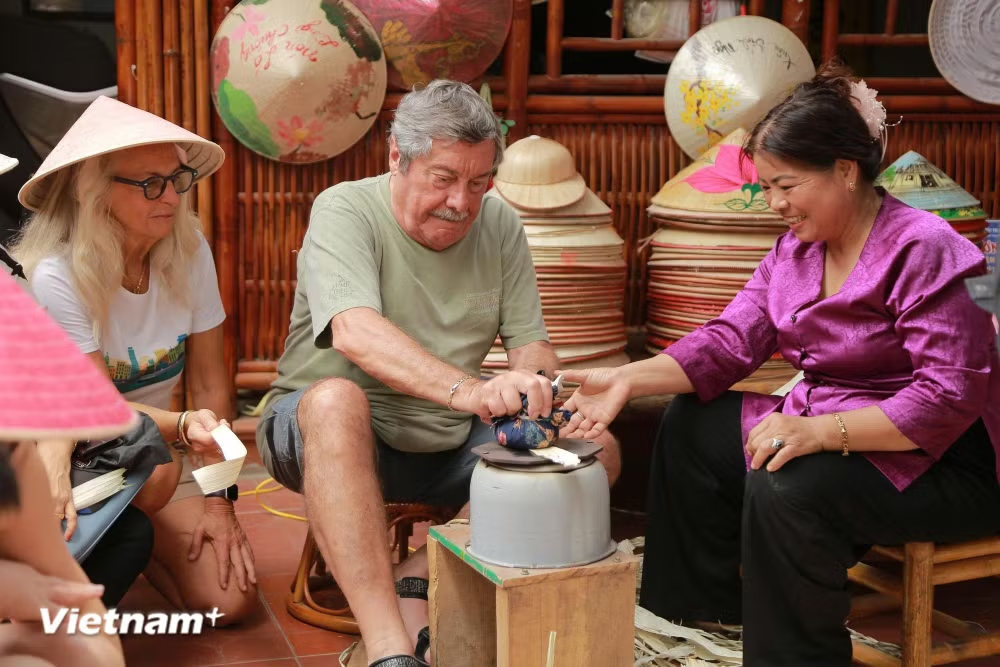
They also stressed the need to mobilise greater private investment through more attractive policy incentives and to develop higher-value tourism products. Key areas include those centred on cultural heritage, traditional craft villages and creative industries, enhancing visitor experiences and strengthening competitiveness as a destination./.