Vietnam launches two-tier local government model

Vietnam has entered a new chapter in public administrative reform as a nationwide shift to a two-tier local government structure officially took effect on July 1.

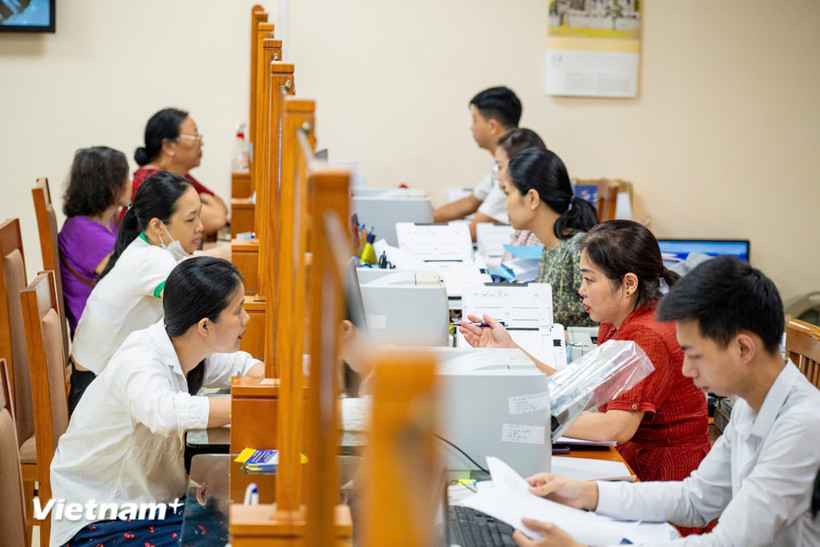
Vietnam rolls out two-tier local governance model for streamlined administration. (Photo: VietnamPlus)

Hanoi (VNA) – Vietnam has entered a new chapter in public administrative reform as a nationwide shift to a two-tier local government structure officially took effect on July 1. Under this model, only provincial and commune-level authorities remain, with the district level dissolved. The change marks not just an administrative adjustment, but a transformative step toward a more streamlined, citizen-focused governance system.

The reform follows eight years of strategic planning since the adoption of Resolution No.18-NQ/TW on streamlining the political apparatus for increased efficiency and effectiveness. Over the past eight months, the political system at all levels has implemented the change with urgency, driven by strong political will and a commitment to putting citizens at the heart of public service.

The elimination of the intermediate district level aims not merely at structural simplification but at unlocking resources, saving trillions of VND annually, reducing fiscal burden, and enhancing service delivery.

More importantly, this new structure is expected to bring local authorities closer to the people, enabling quicker and more synchronised policy implementation and direct communication between government and citizens.
thu-tuc-hanh-chinh-7.jpg
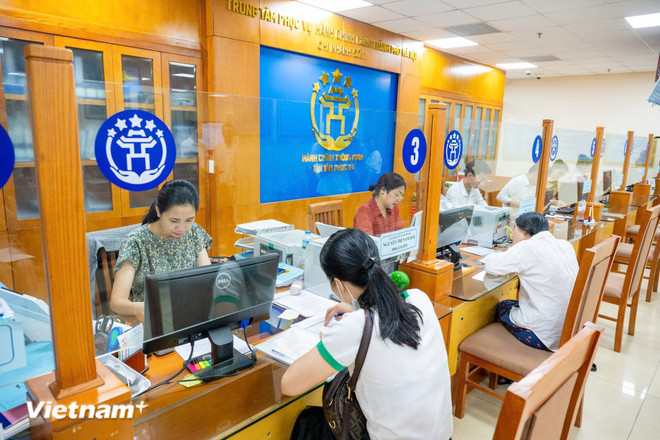
Under this model, only provincial and commune-level authorities remain, with the district level dissolved. (Photo: VietnamPlus)

Described as a comprehensive revolution, this reform is underpinned not by force but by innovation and determination to break with outdated practices. Civil servants at all levels are now seen as front-line agents of reform, tasked with building a modern, efficient, and service-oriented administration.

The Party’s leadership has been critical to the success of this transition. From strategic direction to implementation, consistent oversight and concrete actions reflect a unified political will.

Messages such as “move fast while staying in line,” “act without retreat,” and “ensure uninterrupted public service” have gone beyond slogans to become mandates during this critical transition.
quoc-hoi-thong-qua-nghi-quyet-cua-quoc-hoi-sua-doi-bo-sung-mot-so-dieu-cua-hien-phap-nam-2013-8094026.jpg
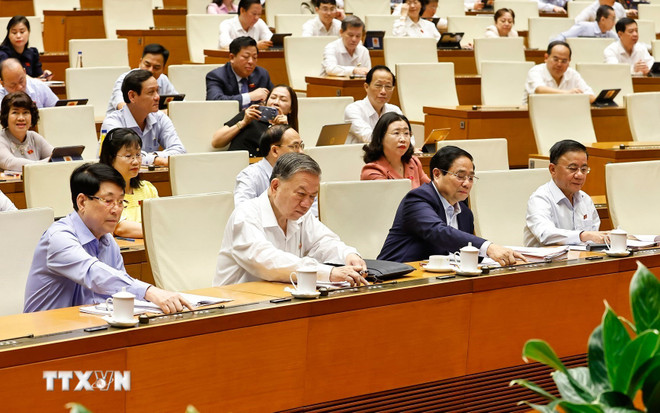
Party General Secretary To Lam, President Luong Cuong, Prime Minister Pham Minh Chinh, and other legislators press the button to adopt the resolution amending and supplementing several articles of the 2013 Constitution. (Photo:VNA)

Party General Secretary To Lam said the existing shortcomings, limitations, and slow, lackluster actions in implementing the renewal policy and reorganising the political system have caused severe consequences. A cumbersome administrative apparatus leads to waste and hinders development, and it is one of the reasons why many of the Party's policies and guidelines are slow to be implemented in practice or, in some cases, are either not carried out or only superficially executed.

In this context, the transition to a two-tier local government model (provincial and commune levels) is not only a strategic decision but also an inevitable step. This is not merely a structural change; it is a true revolution in how the state apparatus is organised and operates, he noted.

According to the Party leader, with the removal of the intermediary level, the handling of administrative procedures will become simpler and faster. The people will no longer have to wait long or navigate through many "gates" to get their work done. The commune-level government, being closest to the people, will be empowered with more authority to truly address the most practical issues of the community.

Former Deputy Minister of Home Affairs Nguyen Tien Dinh remarked that Vietnam is in a critical demographic phase - a “golden population structure.” If not leveraged effectively, the opportunity could be lost as the country transitions to an aging population.

Dinh stressed that the main constraint now lies in an overly layered bureaucracy with excessive administrative procedures that hinder progress and squander national potential.

Technology is seen as a key enabler of this transformation. From the National Public Service Portal to the growing adoption of e-government tools, digital systems are replacing outdated, paper-based processes, cutting out unnecessary intermediaries and reducing dependency on human resources.

Vietnam’s efforts to modernise its public sector are also tied to its broader digital transformation strategy. Resolution No. 57 on scientific and technological advancement and national digital transformation provides strong institutional support for this shift.
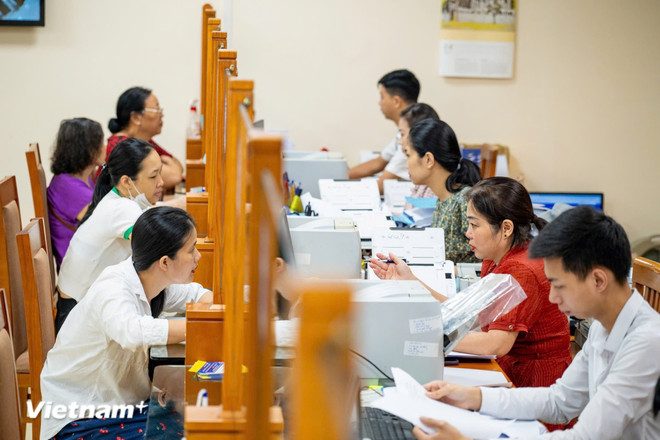
thu-tuc-hanh-chinh-6.jpg
Described as a comprehensive revolution, this reform is underpinned not by force but by innovation and determination to break with outdated practices. (Photo: VietnamPlus)

He said that the transition to two-tier governance has been methodically prepared. The Government has issued 28 decrees to guide decentralisation and devolution of power, laying a legal foundation for improved local governance. These are not merely regulatory texts but clear commitments to public service reform.

The 15th National Assembly’s ninth session laid the constitutional groundwork, while central and local agencies collaborated closely to ensure the smooth launch of the new system on July 1.

The Ministry of Home Affairs alone issued over 4,000 official documents in just the first half of the year, underscoring the urgency and scale of preparation.

Former Vice Chairman of the National Assembly Office Nguyen Si Dung called the rollout of 28 decrees a historic effort that addresses current administrative shortcomings while paving the way for a more responsive, modern governance model.

From July 1 onward, commune-level authorities are no longer an extension of provincial government, but its frontline representatives. Provincial authorities now play a coordinating and guiding role, with increased emphasis on decentralisation and local empowerment.

With nearly 2 million officials nationwide working tirelessly to ensure a seamless transition, including those involved in merging or dissolving administrative units, Vietnam has taken a decisive step toward building a leaner, more responsive, and citizen-centric public administration system.

This marks the start of a new governance era, one that is more transparent, efficient, and truly rooted in serving the people./.
See more

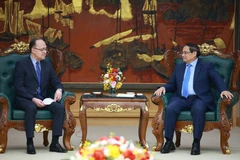
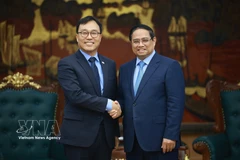
Prime Minister Pham Minh Chinh (R) and Choi Young Sam, Ambassador of the Republic of Korea (RoK) to Vietnam, in Hanoi on April 1. (Photo: VNA)

Vietnam, RoK seek to boost cooperation on energy security

Vietnam and the RoK should work to increase bilateral trade to reach 100 billion USD as soon as possible and aim for 150 billion USD by 2030 in a balanced manner, while encouraging RoK businesses to expand investment in semiconductors, core technologies, renewable energy, and others.

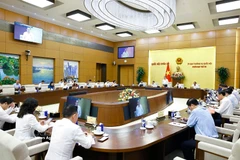
Participants at the 56th session of he National Assembly (NA) Standing Committee on April 1 (Photo: VNA)

NA Standing Committee urges updated macro scenarios amid rising economic risks

The National Assembly (NA) Standing Committee called on the Government to closely monitor global developments, especially in energy markets, taxation policies and international trade, to fully assess their impacts on Vietnam’s economy. It emphasised the need to develop and regularly update macroeconomic management scenarios, clarifying their implications for growth, inflation and major economic balances.

Associate Professor Dr Doan Minh Huan (R), Politburo member and President of the Ho Chi Minh National Academy of Politics, and Australian Ambassador Gillian Bird in Hanoi on April 1. (Photo: VNA)

Vietnam promotes senior official training cooperation with Australia, India

Associate Professor Dr Doan Minh Huan, Politburo member and President of the Ho Chi Minh National Academy of Politics (HCMA), on April 1 held separate meetings with the ambassadors of Australia and India to Vietnam to discuss orientations for strengthening cooperation in research and the training of senior officials.

Chairman Tran Thanh Man speaks at the National Assembly Standing Committee's 56th session on the afternoon of April 1. (Photo: VNA)

NA Standing Committee convenes 56th session

The National Assembly Standing Committee's 56th session will review the key five-year plans for the 2026–2030 period, including the socio-economic development plan, the national finance and public debt management plan, and the medium-term public investment plan.

☕ Afternoon briefing on April 1

☕ Afternoon briefing on April 1

The PM's request for advancing the construction of a crude oil reserve storage in Nghi Son, agro-forestry-fishery exports reaching 16.69 billion USD in Q1, and Vietnam securing nearly 72 million USD in green finance support are among news highlights on April 1.

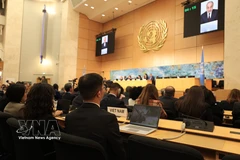
A session of the United Nations Human Rights Council (Photo: VNA)

Vietnam affirms responsible role at UN Human Rights Council

Throughout the session, the Vietnamese delegation participated actively, constructively, and responsibly in consultations on all 38 resolutions while advancing two notable initiatives. Vietnam delivered a joint statement on gender equality in implementing the Sustainable Development Goals (SDGs), co-sponsored by 67 countries, and co-hosted a side event with the Republic of Korea, Japan, and Thailand addressing human rights impacts of online scams.

☀️ Morning digest on April 1

☀️ Morning digest on April 1

A conference reviewing a draft report on the first round of inspection and supervision over the NA Party Committee, Vietnamese diplomats' activities in Laos, France and Greece, and Vietnam's win over Malaysia in the 2027 AFC Asian Cup qualifying round are among news highlights on March 31 evening.

Vietnamese Ambassador to France Trinh Duc Hai (R) meets with Taylan Coskun, Politburo member of the French Communist Party (PCF) overseeing relations with Vietnam. (Photo: VNA)

Vietnam, France bolster Party ties

Vietnamese Ambassador to France Trinh Duc Hai highlighted the need to effectively implement the joint declaration elevating bilateral ties to the Comprehensive Strategic Partnership, with priority given to cooperation in defence-security, energy transition and transport infrastructure.

Prime Minister Pham Minh Chinh, who also serves as Secretary of the Government Party Committee, speaks at the conference. (Photo: VNA)

Draft report on inspection, supervision of Government Party Committee's Standing Board approved

Prime Minister Pham Minh Chinh, who also serves as Secretary of the Government Party Committee, said the Government Party Committee, the Government and the PM had rolled out hundreds of documents, including resolutions, action plans, directives and official dispatches, to drive the study and implementation of the 14th National Party Congress's Resolution, alongside preparations for the election of deputies to the 16th National Assembly and People’s Councils at all levels for the 2026–2031 term.

Vietnamese Ambassador Pham Thi Thu Huong meets with Greek Minister for Migration and Asylum Athanasios Plevris during a working session. (Photo: Published by VNA)

Vietnam, Greece step up labour cooperation

Official figures show that nearly 1,500 Vietnamese workers are currently authorised to work in Greece across both seasonal and long-term roles. Greek employers consistently rate Vietnamese labourers highly for their work ethic, skills, and adaptability.