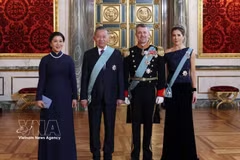
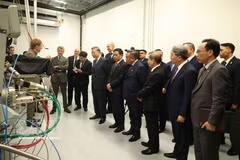
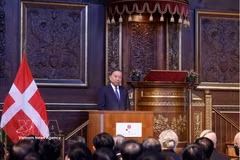
Illustrative photo (Source: VNA)
In an interview granted to the Vietnam NewsAgency on the occasion of the 50th anniversary of the nations’diplomatic relations (February 26, 1973-2023), he further said the changes in Vietnam over the last 32 yearssince he finished his term of office in the country have been dramatic, "almostrevolutionary".
“I am constantly amazed at the physical transformation andthe signs of prosperity I see both in the cities and the rural areas, even inthe mountainous areas with large concentrations of ethnic minority peoples,such as Ha Giang and Mu Cang Chai. I am personally very happy to see thesechanges as I have witnessed much suffering, hunger and poverty from the time Ifirst worked in war-torn Saigon as a young diplomat in 1972 and again in Hanoiin 1978,” said Alliband.
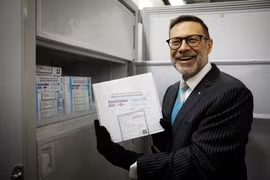
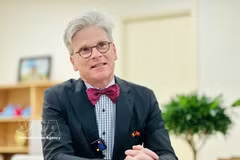
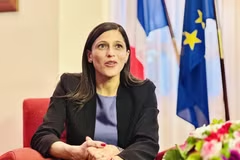
 former Australian Ambassador to Vietnam Graham Alliband (Photo: australiavietnam.org) He went on noting some negative consequences of rapideconomic development, especially pollution and the degradation of Vietnam’sbiodiversity. However, he expressed his confidence that as the Southeast Asiannation becomes richer, and public awareness increases, these negatives will toa large extent be remedied, and current polluted rivers and coastal tracts willbe restored.
Recalling the time he came to Vietnam as ambassador in 1988,two years after the beginning of the Doi Moi (reform), Alliband assessed thatthe process brought a new vigor and dynamism to the country that started tochange in many ways.
“Doi Moi brought hope and aspirations for a better life andencouraged individual initiative and enterprise.”
In his mind, the new, hopeful atmosphere brought about byDoi Moi was symbolised by the sudden appearance one night in 1989 of brightstreetlights throughout Hanoi.
The former ambassador also expressed his unforgettableimpression of the rebirth of the private economy in the form of shops, markets,restaurants and coffee shops. “There was an eager curiosity about the ‘Western’world, including Australia, and how Vietnam could benefit from closer links,” he said.
According to him, an important element of Doi Moi was theimperative for Vietnam to expand its international economic relations. One ofthe moments he was extremely proud of during his tenure was the first directtelephone call he made in 1989 between Ho Chi Minh City and Australia throughthe INTELSAT satellite system, installed in Vietnam by the Australian companyOTCI (now Telstra). “This new telecommunications link symbolised Vietnam’sentry into the broader international community,” he said.
The former diplomat said there were a number of areas where, as Ambassador, hefacilitated to strengthen the relations between Vietnam and Australia. Theyincluded the signing of a bilateral trade agreement and an investment agreement;negotiations for a consular agreement; the promotion of investment byAustralian companies; academic and cultural exchanges; provision of disasterrelief for flood victims in Moc Chau and typhoon victims on Quang Nam's Cu Lao Cham island and in Thai Binh's Tien Hai district; provision of a modest aid programmethrough UN agencies, including English-language training; and the introductionof a scholarship programme at the Australian National University in tertiaryeconomics for researchers at the Central Institute for Economic Management(CIEM) under Vietnam’s Ministry of Planning and Investment.
“In promoting Australian investment, I made speeches at the Australia Chambersof Commerce in both Hong Kong and Bangkok, where I predicted that Vietnam wouldbecome the next Asian ‘Tiger’,” he said.
Sensing the critical importance of expanding the teaching ofEnglish if Vietnam was going to join the international community, he facilitatedthe first Australian volunteer English-language teacher to work in Vietnam and usedthe small Ambassador’s fund to provide equipment and English-language textbooksto foreign language faculties at five universities.
“I also supported with equipment and books the establishmentin mid-1991 of the first semi-independent English language centre in Hanoi(perhaps in all of Vietnam), managed by two English-language teachers from thethen Hanoi University of Foreign Languages (now Hanoi University), who had beentrained in Australia,” he said, adding young Vietnamese people were very keen to learn English.
Given the countries’ celebration of their five-decadediplomatic ties this year, Alliband recalled that in March 2018, the sidessigned an agreement to establish a strategic partnership.
“I am constantly amazed at the physical transformation andthe signs of prosperity I see both in the cities and the rural areas, even inthe mountainous areas with large concentrations of ethnic minority peoples,such as Ha Giang and Mu Cang Chai. I am personally very happy to see thesechanges as I have witnessed much suffering, hunger and poverty from the time Ifirst worked in war-torn Saigon as a young diplomat in 1972 and again in Hanoiin 1978,” said Alliband.
 former Australian Ambassador to Vietnam Graham Alliband (Photo: australiavietnam.org)
Recalling the time he came to Vietnam as ambassador in 1988,two years after the beginning of the Doi Moi (reform), Alliband assessed thatthe process brought a new vigor and dynamism to the country that started tochange in many ways.
“Doi Moi brought hope and aspirations for a better life andencouraged individual initiative and enterprise.”
In his mind, the new, hopeful atmosphere brought about byDoi Moi was symbolised by the sudden appearance one night in 1989 of brightstreetlights throughout Hanoi.
The former ambassador also expressed his unforgettableimpression of the rebirth of the private economy in the form of shops, markets,restaurants and coffee shops. “There was an eager curiosity about the ‘Western’world, including Australia, and how Vietnam could benefit from closer links,” he said.
According to him, an important element of Doi Moi was theimperative for Vietnam to expand its international economic relations. One ofthe moments he was extremely proud of during his tenure was the first directtelephone call he made in 1989 between Ho Chi Minh City and Australia throughthe INTELSAT satellite system, installed in Vietnam by the Australian companyOTCI (now Telstra). “This new telecommunications link symbolised Vietnam’sentry into the broader international community,” he said.
The former diplomat said there were a number of areas where, as Ambassador, hefacilitated to strengthen the relations between Vietnam and Australia. Theyincluded the signing of a bilateral trade agreement and an investment agreement;negotiations for a consular agreement; the promotion of investment byAustralian companies; academic and cultural exchanges; provision of disasterrelief for flood victims in Moc Chau and typhoon victims on Quang Nam's Cu Lao Cham island and in Thai Binh's Tien Hai district; provision of a modest aid programmethrough UN agencies, including English-language training; and the introductionof a scholarship programme at the Australian National University in tertiaryeconomics for researchers at the Central Institute for Economic Management(CIEM) under Vietnam’s Ministry of Planning and Investment.
“In promoting Australian investment, I made speeches at the Australia Chambersof Commerce in both Hong Kong and Bangkok, where I predicted that Vietnam wouldbecome the next Asian ‘Tiger’,” he said.
Sensing the critical importance of expanding the teaching ofEnglish if Vietnam was going to join the international community, he facilitatedthe first Australian volunteer English-language teacher to work in Vietnam and usedthe small Ambassador’s fund to provide equipment and English-language textbooksto foreign language faculties at five universities.
“I also supported with equipment and books the establishmentin mid-1991 of the first semi-independent English language centre in Hanoi(perhaps in all of Vietnam), managed by two English-language teachers from thethen Hanoi University of Foreign Languages (now Hanoi University), who had beentrained in Australia,” he said, adding young Vietnamese people were very keen to learn English.
Given the countries’ celebration of their five-decadediplomatic ties this year, Alliband recalled that in March 2018, the sidessigned an agreement to establish a strategic partnership.
“Subsequently, anambitious Action Plan was agreed to implement the Partnership over the period2020-2023 focusing on three pillars: strengthening economic-trade linkages;deepening strategic-defense-security cooperation; and building knowledge andinnovative partnerships. The Action Plan shows the breadth and depth of theexisting relationship and through its thorough implementation will solidify therelationship even further. The next step would be to raise the relationship toa comprehensive strategic partnership which would intensify the relationshipeven further and expand cooperation in such areas as climate change, greeneconomy and clean energy,” he said.
The former ambassador said fortunately, while the countries have differentpolitical systems, there are no substantive issues causing strain or potentialconflict in their bilateral relations; their shared commitment to a rules-basedinternational order, an open international economic system; their extensivehuman links; and their largely complementary economies foreshadow a veryfruitful and exciting future relationship between the two countries.
“I am very happy to continue to contribute in a very smallway to the burgeoning relationship as a consultant for Australia’s scholarshipprogramme for Vietnam,” Alliband concluded./.
VNA