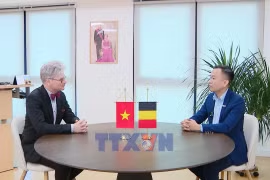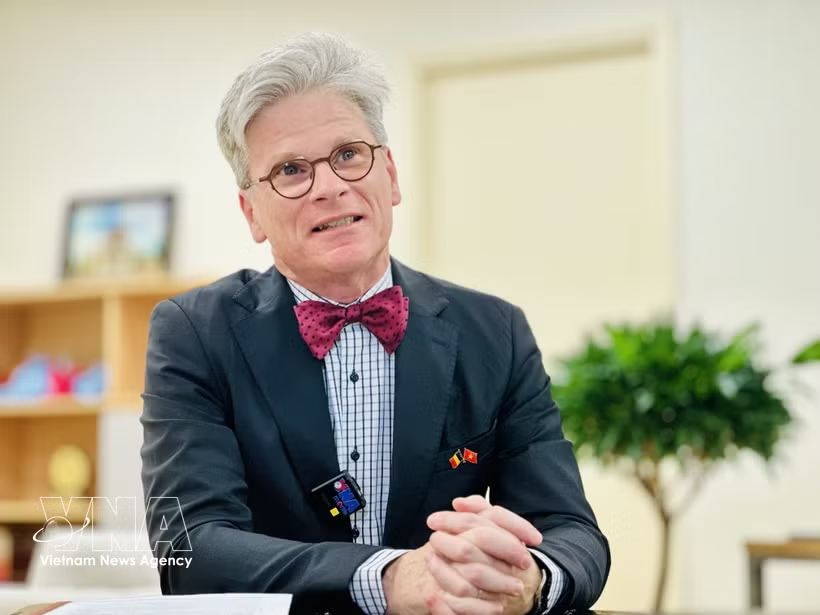
Brussels (VNA) – The Vietnam–Belgium partnership is entering a new phase of strategic significance, with considerable untapped potential for cooperation in renewable energy, green technology, logistics, agriculture, innovation and multilateral diplomacy, Belgian Ambassador to Vietnam Pieter Leenknegt has said.
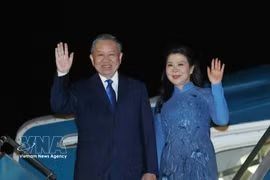
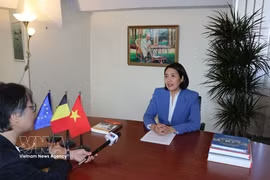
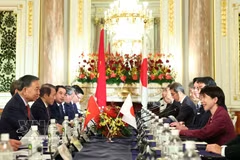
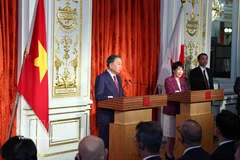
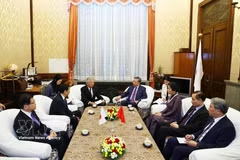
In an interview with the Vietnam News Agency ahead of the official visit to Belgium by General Secretary of the Communist Party of Vietnam Central Committee and President To Lam, his spouse and a high-ranking Vietnamese delegation, the ambassador highlighted the significance of the visit and outlined prospects for expanding bilateral cooperation.
He noted that the visit comes just over a year after the state visit to Vietnam by King Philippe and Queen Mathilde in April 2025.
In terms of tangible outcomes, Leenknegt expected the two sides to sign several new agreements and memoranda of understanding, while updating existing cooperation frameworks to ensure more substantive implementation, with renewed momentum, clearer objectives and a greater sense of urgency.
Cooperation will be pursued through agreements with Belgium’s federal government and regional and community authorities, in line with the country’s institutional structure and division of responsibilities, as well as through partnerships among businesses in the two countries.
The visit will also feature symbolic highlights reflecting shared commitments and achievements in bilateral cooperation. One example is Belgium’s support for Vietnam's victims of Agent Orange/dioxin. In October 2023, the Belgian Parliament adopted a resolution supporting AO victims, giving fresh impetus to assistance efforts involving various Belgian stakeholders, including philanthropists, royal foundations, environmental remediation experts, investors and businesses.
Against the backdrop of Vietnam’s economic growth and relatively high bilateral trade, the ambassador expressed confidence that relations between the two countries would continue to flourish and achieve significant breakthroughs.
He said Vietnam should seek reliable, high-quality international partners for its green transition and and digital transformation, with Belgium and Europe well placed to fulfil that role.
Regarding priorities for cooperation, the ambassador identified green technology, logistics, smart agriculture and aquaculture as areas where the two countries already had substantial experience and could deepen collaboration. He highlighted the green transition and and digital transformation, particularly robotics, renewable energy development, energy storage and the integration of renewable power into industrial production.
Wind energy, he said, is a clear example of the complementary strengths of the two countries. Vietnam surpassed Belgium in total annual wind power generation in 2023, while Belgium retained a leading position in offshore wind power and possessed advanced technologies for connecting electricity generated offshore to industrial parks and factories.
The circular economy, waste management and waste-to-energy conversion also offer significant opportunities, he said, adding that agriculture continues to be a pillar of bilateral relations, with Vietnam and Belgium serving as strategic partners in the sector.
Building on these achievements can help improve livelihoods, Leenknegt said. He suggested that future cooperation focus on high-tech agriculture, climate-resilient production methods, sustainable farming and innovative food processing. From aquaculture and agricultural raw materials to modern food technology, the two countries have complementary capabilities that could generate fresh momentum for growth.
Logistics and maritime connectivity are other promising areas, given the strategic positions of both countries in their respective regions.
The ambassador also highlighted their shared commitment to international law of the sea and marine biodiversity protection. Belgium is seeking to host the secretariat of the Agreement on the Conservation and Sustainable Use of Marine Biological Diversity of Areas beyond National Jurisdiction, also known as the BBNJ Agreement or High Seas Treaty, and hopes to receive Vietnam’s support.
Leenknegt observed that the context for bilateral cooperation has changed significantly since diplomatic relations were established in the 1970s. Vietnam has made rapid and impressive economic progress and is no longer a less-developed country, a development that has also changed the instruments available for cooperation.
Regarding official development assistance (ODA), he urged Vietnam to establish clear priorities and develop a strategy for projects it wishes to pursue with Belgium using concessional financing before it graduated fully from the groups of countries eligible for ODA.
On trade and investment, Leenknegt described these as the foundation of bilateral relations. Belgium is one of Vietnam’s most important economic partners in the European Union (EU), while Vietnam is Belgium’s largest trading partner in ASEAN.
The EU–Vietnam Free Trade Agreement (EVFTA) has delivered positive results, with bilateral trade increasing by more than 40% since the agreement took effect in 2020. Belgium serves both as a gateway to Europe and as a test market for products seeking to enter the wider European market, further enhancing its value as an economic partner for Vietnam.
He also underscored the importance of the EU–Vietnam Investment Protection Agreement (EVIPA), noting that encouraging signals are emerging from parliamentary bodies regarding its ratification.
Other sectors could also become new pillars of bilateral economic cooperation, including green technology, logistics, renewable energy equipment, transport infrastructure, biotechnology, pharmaceuticals, smart agriculture and food production.
Leenknegt noted that Belgium occupies a special position in Europe as the host of the European Commission, the General Secretariat of the Council, and the European Parliament, making it a natural bridge between Vietnam and the EU.
Cultural and educational exchanges constitute another important pillar of bilateral relations, the ambassador said. Within the Francophone community and beyond, artists, architects, musicians, writers and heritage professionals continue to bring the two societies closer together.
People-to-people exchanges have developed through visits, partnerships and professional activities, but there remains considerable room for further expansion.
On international issues, Vietnam and Belgium share a firm commitment to multilateralism and international law. Despite significant differences in geography and history, both countries rely heavily on regional cooperation frameworks, with Vietnam looking to ASEAN and Belgium to the EU.
ASEAN–EU relations are also being strengthened, with the partnership turning 50 in 2027. Against this backdrop, the two countries can work more closely to support a rules-based international order, including through the United Nations Convention on the Law of the Sea, agreements on biodiversity protection, international labour standards and global human rights mechanisms.
He concluded that the visit is not only an opportunity to recognise past achievements but also to establish an ambitious agenda for the future. With considerable untapped potential in renewable energy, climate change adaptation, logistics, agriculture, innovation and multilateral diplomacy, the Vietnam–Belgium partnership is entering a new phase of strategic significance./.
VNA