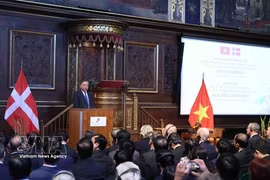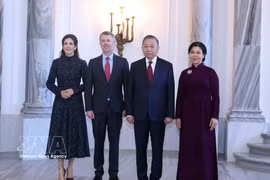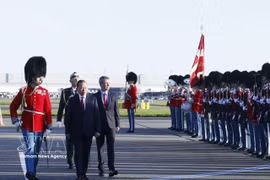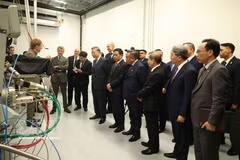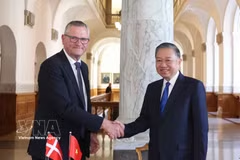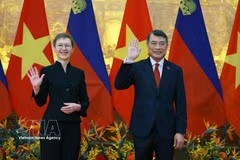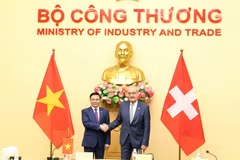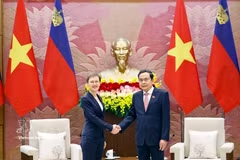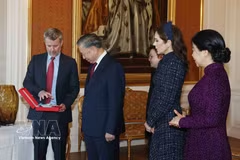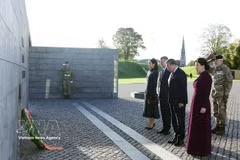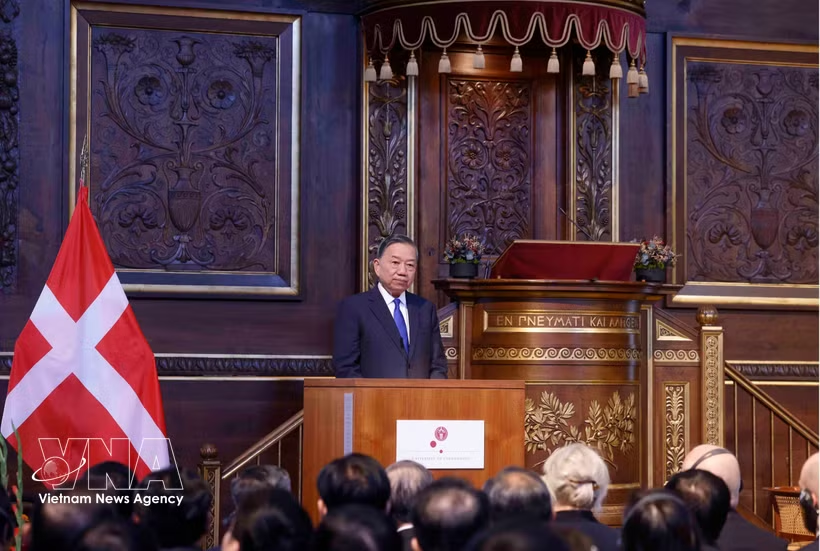
Copenhagen (VNA) - General Secretary of the Central Committee of the Communist Party of Vietnam (CPV) and President To Lam delivered a policy speech at the University of Copenhagen on October 19 afternoon (local time) as part of his state visit to Denmark.The Vietnam News Agency (VNA) respectfully introduces a translation of the speech.
FROM FAIRY TALES TO A HORIZON OF VIETNAM-DENMARK COOPERATION IN A NEW ERA
Dear Speaker of the Danish Parliament,
Minister for Science, Higher Education and Digital Affairs,
Rector,
Distinguished professors, lecturers and scientists, dear students, and cherished friends of Vietnam,
It is my great pleasure to visit the University of Copenhagen, an institution with nearly 550 years of history, in a year when our two countries celebrate the 55th anniversary of diplomatic relations. Here, among those devoted to knowledge and the younger generation, I would like to share my thoughts on the future of Vietnam-Denmark relations.
For many Vietnamese people, Denmark has long felt familiar through Andersen’s fairy tales. We came to know your country through the brave tin soldier and the little match girl with her simple dreams. These stories have accompanied us since childhood and remained in our memories, reminding us to love one another, to hold on to hope, to care for those less fortunate, and to rise above adversity. Denmark’s little match girl also bears a close resemblance to Tam, a heroine of Vietnamese folklore. A tiny seed can grow into an entire world. A single match struck on a cold night can open the door to a warm dream. Danish fairy tales share many similarities with Vietnamese folk tales, including "Su tich cay vu sua" (The Legend of the Milk Fruit Tree), "Cay tre tram dot" (The Hundred-Knot Bamboo Tree), and "Thanh Giong" (Saint Giong). The Danish people have a very beautiful proverb: “The road to a friend’s house is never long.” The nearly 9,000 kilometres between Hanoi and Copenhagen have never been a barrier, as our two nations have always held one another in high regard and shared genuine affection. Today’s meeting with Danish professors, students and friends carries special significance: it is an opportunity to transform the foundation of special friendship into a new model of cooperation for a new era. Ladies and gentlemen,
1. Vietnam’s story of “rising up”
I would like to take a moment to reflect on Vietnam’s development journey, as it opens up new horizons for relations between our two countries.
Having endured a long history of struggles for independence and wars to secure peace, Vietnam has consistently chosen the path of peace, independence, self-reliance and cooperation for shared development. We have pursued the strengthening of our domestic capabilities alongside the expansion of international cooperation, as no country can stand firm on its own in today’s rapidly changing world, where “a day can be worth a hundred years.”
After 81 years since its establishment and 40 years of Doi moi (Renewal), Vietnam has transformed itself from a war-ravaged, impoverished country into a dynamic economy and an important link in global production chains. With GDP exceeding 500 billion USD, Vietnam ranks among the world’s 32 largest economies and is one of the region’s fastest-growing economies. At the same time, it has maintained trade relations with more than 230 economies, has signed 18 free trade agreements (FTAs) with over 60 partners, and ranks among the world’s 15 largest economies in terms of trade volume. From being besieged and isolated, Vietnam has now established diplomatic relations with 194 member states of the United Nations and set up strategic partnerships and comprehensive partnerships with 45 partners. Vietnam is entering a new era of development with two centennial goals: to become an upper-middle-income country with modern industry by 2030, and a developed, high-income country by 2045. These goals reflect our steadfast commitment to independence and self-reliance, placing the people at the centre and taking them as a driving force, as well as harnessing knowledge and learning to narrow the development gap. Our country is also preparing for two further centennial milestones in 2130 and 2145.
No longer relying on cheap labour or natural resources, Vietnam is pursuing a development model that is self-reliant, resilient, creative, humane, sustainable and internationally integrated. Science and technology, innovation and the knowledge economy are its core drivers. The green transition and energy development offer opportunities to restructure the economy without compromising the environment. Education remains a top national priority. The ultimate goal of growth is not merely a set of figures, but rather to ensure that the people truly, fairly, and equitably enjoy its fruits, so that Vietnam can become ever more “dignified and prosperous.”
Vietnam attaches particular importance to Denmark's lessons in social trust, a transparent and accountable public administration, and stable policies. Recognising numerous similarities and complementary strengths, Vietnam regards Denmark as a trusted partner with a strong sense of commitment and genuine friendship to share experience, learn, and create new value for the journey ahead. Ladies and gentlemen,
2. A story of friendship nurtured over the years
In 1971, when Vietnam was still at war and suffering widespread devastation, Denmark was among the first countries in Western Europe to establish diplomatic relations with Vietnam. This invaluable solidarity at a time of great hardship bears witness to the proverb “A friend in need is a friend indeed.” Vietnam has always deeply appreciated and remains sincerely grateful for the support extended by the Danish people, both in our struggle for national independence and in our national reconstruction process.
From these initial connections, bilateral relations have gradually expanded. Today, more than 150 Danish companies are operating in Vietnam, undertaking numerous pioneering and large-scale projects. Over the 55 years since the establishment of diplomatic relations, bilateral cooperation has evolved from one-way assistance into multifaceted, mutually beneficial partnerships in trade, investment, education, healthcare and people-to-people exchanges. It is now continuing to expand into energy, climate and technology.
Looking back on 55 years of friendship, two important lessons stand out:
First, our relationship has been tested through the ups and downs of history, creating a foundation of deep trust - a solid bedrock for a new chapter of development.
Second, the substance of our cooperation must evolve flexibly with the times. Building on the Comprehensive Partnership established in 2013 and the Green Strategic Partnership launched in 2023, our two countries need a new model of cooperation that is “more comprehensive and strategic.” It brings together Denmark’s strengths in science, technology and green transition, and Vietnam’s political determination and potential for rapid and sustainable development.
Ladies and gentlemen,
3. Vietnam, Denmark write the next chapter of shared future
We are living in a world of profound changes, as the international order is being reshaped, strategic trust is eroding, international law is being challenged, and protectionism and unilateralism are on the rise. Yet Vietnam and Denmark share a fundamental common ground: a spirit of self-reliance and resilience; respect for sovereignty and territorial integrity; a commitment to upholding international law and multilateralism, and always keeping the doors wide open to dialogue and cooperation. Regarding Denmark as a trusted friend and an important partner, Vietnam proposes five major directions for future cooperation.
First, Vietnam and Denmark should elevate cooperation from the Green Strategic Partnership to a framework of more comprehensive and strategic relations.
This is an inevitable step towards making bilateral cooperation an exemplary model between a Southeast Asian country and a Nordic partner, enabling each country to serve as a gateway and strategic bridge for the other in the Association of Southeast Asian Nations (ASEAN) and the European Union (EU). Deep political trust, shared values and a similar vision will provide the foundation for opening up broader avenues of cooperation: enhancing regular exchanges through State, parliamentary, political party, locality and business channels; expanding cooperation into areas of significant potential; and working closely together to address global challenges.
Second, we should renew our approach to economic cooperation, shifting from assistance to co-creation to generate new value for both countries.
Vietnam and Denmark are not only complementary in terms of markets, resources and technology, but also share common interests in building secure supply chains and maintaining free trade. For Denmark, Vietnam is a destination for high-quality, long-term investments and a strategic gateway for goods and services to access the 700 million-strong ASEAN market. The EU-Vietnam Free Trade Agreement (EVFTA) offers considerable scope for expanding cooperation in areas where Denmark has strengths, including renewable energy and offshore wind power; maritime transport and green logistics; pharmaceuticals and medical technology, and sustainable agriculture. Meanwhile, Vietnamese businesses are gradually establishing their presence in Denmark in areas such as green transport, digital transformation and artificial intelligence. Connecting infrastructure, logistics and value chains between the two countries will create an important link between Southeast Asia and Northern Europe. Given the considerable untapped potential for expansion, the target of 1 billion USD in bilateral trade should be seen as a starting point rather than an end goal.
Third, the two countries should become each other’s priority partner in science and technology, green transition, just energy transition and climate change response.
Vietnam is pursuing rapid growth but will never sacrifice the environment or accept technological backwardness in the process. Science and technology, green transition and energy transition must therefore become breakthrough areas that serve as defining symbols of bilateral relations.
Scientific and technological cooperation should move beyond one-off exchanges towards a regular mechanism under a bilateral cooperation framework that co-supports research funding, exchanges of young scientists and selective technology transfer. The two sides could promote the establishment of a pilot sandbox at the University of Copenhagen. Beyond technology, research cooperation should also give due attention to economics, social sciences and policy studies to address practical issues, such as the impact of green policies on employment, standards for small businesses and the effectiveness of public resource use, directly supporting policymaking and policy evaluation. As a global pioneer in the green transition and wind energy, Denmark has valuable experience in spatial planning and the marine economy. Vietnam, meanwhile, boasts a coastline of more than 3,200 kilometres and some of the region’s greatest offshore wind power potential. Combining these strengths will not only create a new industry and a model for renewable energy cooperation that contributes to global efforts to address climate change, but also lay the groundwork for Denmark to become a partner of ASEAN in planning the ASEAN Power Grid.
Fourth, people-to-people connections, education and training, and stronger exchanges between the two countries’ people should form the long-term foundation of bilateral relations.
Sustainable development requires a country to build new capabilities. Vietnam has a strong demand for highly qualified human resources, while Denmark boasts an outstanding scientific and educational foundation, exemplified by the University of Copenhagen. Positive cooperation outcomes in health care and the treatment of non-communicable diseases should be expanded to other key fields, including biotechnology, pharmaceuticals, digital technology and artificial intelligence.
To attract and develop talent, Vietnam is working to create a research environment that values quality, integrity and contributions, while expanding international cooperation opportunities for young scientists. The two countries should establish joint research groups, co-supervise doctoral candidates and share infrastructure to nurture a generation of intellectuals committed to long-term collaboration. In particular, Vietnam proposes the University of Copenhagen consider opening a campus in Vietnam and pledges to provide the most favourable possible conditions in terms of taxation and land to serve both Vietnamese students and those from across Southeast Asia. Relations between the two countries can only become truly strong and lasting when nurtured by mutual understanding and friendship between their people. Direct air routes, educational cooperation programmes, scholarships and cultural exchanges are helping to narrow geographical distances. Cooperation between the two countries is vividly reflected in everyday life, from Andersen’s timeless fairy tales and LEGO toys that shape childhood to Pandora products and Carlsberg beer found in households, and from wind turbines powering homes to the melodies of Michael Learns to Rock resonating on Vietnamese stages.
Last but not least, the Vietnamese community in Denmark, particularly experts, scientists, entrepreneurs and students, serves as an important bridge for promoting cooperation opportunities and strengthening ties between the younger generations of both countries.
Fifth, the two countries should work together to contribute to peace, cooperation and development and address regional and global challenges.
In today’s world, no country can tackle global challenges alone, whether climate change, food security, water security or shifts in the international order. As active and responsible members of the international community, Vietnam and Denmark share a belief in multilateralism, international law and settling disputes through dialogue. Here at the University of Copenhagen, I would like to recall Niels Bohr, the scientist who linked his great discoveries with a sense of responsibility for peace. In an open letter to the United Nations in 1950, he called for a more open world in which cooperation and understanding could help prevent the dangers arising from technological progress itself. His message of responsibility for peace remains particularly relevant today, as humanity confronts the rapid development of artificial intelligence and other emerging technologies. Countries need to strengthen dialogue on responsibility, safety and the interests of communities, and Vietnam hopes to work with Denmark to make a practical contribution to this effort.
In addition, the two countries should continue close coordination at the United Nations and other multilateral forums, while promoting substantive ASEAN-Denmark and ASEAN-EU relations. As maritime nations, Vietnam hopes Denmark will support efforts to ensure security, safety and freedom of navigation in accordance with international law, particularly the 1982 United Nations Convention on the Law of the Sea (UNCLOS). By upholding these shared values, Vietnam-Denmark relations can go beyond the bilateral framework and contribute positively to a world of peace, equality and sustainable development.
Ladies and gentlemen,
4. Looking back over the past 55 years, from standing together through difficult times, Vietnam and Denmark have built deep mutual trust, paving the way for a new horizon of cooperation. The Danish people have a saying: “When many people share the burden, it becomes lighter.” We Vietnamese have a similar proverb: “One tree alone cannot make a hill; three trees together form a high mountain.” Amid global upheavals and challenges, it is solidarity, knowledge sharing and standing shoulder to shoulder that will enable our two nations to turn every challenge into an opportunity. In this journey, the students here today are the pioneers who will write even brighter new chapters. Recalling Andersen’s tale of the pea, if the past 55 years have been a journey in which earlier generations sowed the first seeds, today is the time for us to plant new ones. The future story of Vietnam-Denmark relations will be written not by fairy-tale magic alone, but through the trust, knowledge, will and determination of both our nations.
May the friendship and cooperation between Vietnam and Denmark continue to flourish across generations, making positive contributions to peace, prosperity and a better future.
Thank you very much for your kind attention!