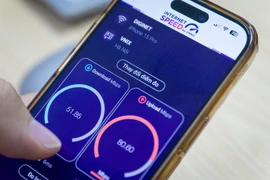
Hanoi (VNA) – Vietnam has moved up from fourth to third place in ASEAN in terms of mobile internet speed, according to the Speedtest Global Index.
Specifically, mobile speeds in Singapore are around 163.29 Mbps, in Malaysia about 163.00 Mbps, and in Vietnam approximately 146.64 Mbps.
Countries such as Thailand, Indonesia and the Philippines all recorded lower mobile speeds than Vietnam.
Latest statistics from the Vietnam Internet Centre show that Vietnam’s average 5G speed has reached 447.03 Mb/s for downloads and 99.26 Mb/s for uploads, with average latency at just 0.024 seconds. These are the highest download, upload and latency figures ever recorded for Vietnam’s 5G networks, marking significant efforts by domestic operators to improve 5G quality and stability.
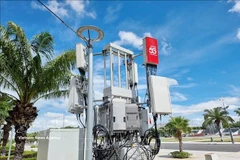
Vietnam’s mobile internet speed has improved thanks to telecommunications infrastructure development policies and investment from network operators. Viettel alone has installed more than 7,000 5G base stations across 34 provinces and cities. The group aims to expand 5G coverage to 99% of the population by 2030, with over 20,000 base stations expected to be completed by the end of 2025./.
See more
Vietnam develops digital infrastructure aligned with demands of AI era
The data centre and cloud computing sector is entering a phase of redefinition. Infrastructure is no longer merely a backbone for data storage and processing, but is evolving into a foundational platform powering complex digital ecosystems—from AI and advanced analytics to real-time applications.
Vietnam turning ideas into value, aspirations into reality
Resolution No. 57 of the Politburo on breakthroughs in science-technology development, innovation, and national digital transformation is being vigorously implemented nationwide. Within this framework, innovation is increasingly recognised as a key engine for rapid and sustainable growth.
MK Smart achieves Common Criteria EAL5+ Certification, expanding opportunities in global digital identity
As countries accelerate the development of digital governments, electronic identification (eID) and electronic passports (ePassport) are becoming essential infrastructure. At the same time, security requirements are becoming increasingly stringent security requirements, particularly for systems that store sensitive data such as citizens’ identity and biometric information.
Deputy PM pushes for swift rollout of strategic technology list
The list will serve as a legal and scientific basis to design policies and incentives to support entities and enterprises engaged in strategic tech development.
Fishermen keep pace with digital technology
Across central coastal provinces, authorities have introduced policies to restructure fleets, reduce vessel numbers, and support fishermen in transitioning to more sustainable livelihoods. Provinces such as Dak Lak and Gia Lai have earmarked nearly 1 trillion VND to support occupational changes and decommission inefficient vessels, while others including Nghe An, Quang Tri, Hue, and Quang Ngai are implementing roadmaps to phase out thousands of underqualified boats.
Vietnam fast-tracks crypto asset market piloting
The Vietnamese Government plans to pilot exchanges for crypto and digital assets starting from the second quarter of 2026, as part of efforts to bring the emerging market into operation.
Ho Chi Minh City becomes first locality to issue comprehensive digital data strategy
To fuel this digital evolution, the city has allocated 12.7 trillion VND (500 million USD) for 2026, representing 4.2% of total budget expenditure.
Hanoi advances technological innovation in key economic sectors
The municipal People's Committee recently issued Plan No. 109/KH-UBND on technological innovation in key economic sectors through 2035, which serves as both a catalyst and a strategic move to systematise, elevate and reinforce the capital’s leading role in the digital era.
Top Vietnamese leader visits China–ASEAN AI Application Cooperation Centre
The China–ASEAN AI Application Cooperation Centre, jointly established by the Guangxi Zhuang Autonomous Region and ASEAN countries, aims to promote inclusive and mutually beneficial development of AI globally. It is regarded as a flagship project in advancing the “Digital Silk Road” initiative in Nanning.
“Made by Vietnam” technology boosts value of agricultural products
Vietnam's agricultural sector is investing more in deep processing technologies, particularly smart drying solutions that help increase product value and ensure compliance with international standards.
Vietnam, Hungary step up cooperation in AI research, application in judicial sector
The Vietnamese Embassy in Hungary pledged to continue serving as a bridge to promote concrete and practical cooperation initiatives in science-technology and innovation, including AI, thereby contributing to Vietnam’s policy-making, digital transformation, and socio-economic development.
UNESCO extends recognition of 2 Category II science centres in Vietnam
The continued operation and enhancement of the two Category II centres under UNESCO’s auspices reflect Vietnam’s policy of positioning science, technology and innovation as key drivers of development, while closely linking scientific advancement with deeper and more substantive international integration in the current context.
China–ASEAN AI cooperation centre drives regional tech cooperation
With strong policy support and growing participation from businesses and research institutions, the China–ASEAN Artificial Intelligence (AI) Application Cooperation Centre is expected to act as a digital bridge, promoting technological integration and opening new avenues for Vietnam–China cooperation in the digital era.
Vietnam, China step up cooperation in science, technology, innovation
Politburo member and Chairman of the Party Central Committee’s Organisation Commission Nguyen Duy Ngoc, who also serves as Standing Deputy Head of the Central Steering Committee for the Development of Science, Technology, Innovation and Digital Transformation, toured the park’s exhibition area and was briefed on the formation and development of Zhongguancun, along with Beijing’s achievements in science, technology and innovation.
Vietnam launches talks to join expanded Information Technology Agreement
Vietnam considers the expanded Information Technology Agreement an important mechanism for promoting trade liberalisation in IT products, reducing costs and improving access to technology, while supporting global innovation.
Vietnam ramps up push for self-reliant semiconductor industry
Building on this foundation, Vietnam aims to capitalise on the global supply chain shift by focusing on specialised chips and science-technology human resources, gradually mastering stages from research, design to packaging and testing.
Swiss–Vietnam dialogue advances cooperation in AI, fintech
Most financial institutions in Vietnam have adopted AI, with investment accelerating amid strong demand for digital banking and high smartphone penetration.
Bac Ninh accelerates development of 5G, data infrastructure
In the first quarter, Bac Ninh’s telecommunications infrastructure continued to develop in a synchronous manner. All communes have been connected to dedicated data transmission networks, and 100% of the population is covered by mobile services.
An Giang identifies key tasks in science-technology development
The priorities focus on four pillars: science and technology, innovation, digital transformation, and real-world applications to boost socio-economic development. These are expected to create breakthroughs in governance, production, and daily life.
Vietnam Research Excellence Fellowship for 2026-2030 approved
Under the Vietnam Research Excellence Fellowship (VREF) for the 2026–2030 period, PhD students are identified as a core research force directly contributing to breakthroughs in sci-tech and innovation. Investing in top-tier doctoral candidates is more than workforce development, but a high-stakes strategic bet to forge a cohort of world-class scientists and technologists who can power Vietnam’s long-term economic ambitions.