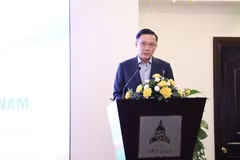
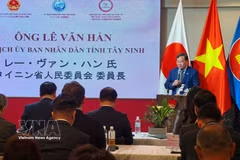
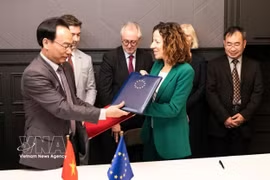
Surajit Rakshit, Head of Global Trade and Receivables Finance, HSBC Vietnam delivers a speech at the forum. — (Photo coutersy of HSBC)
Rakshit made his comments during a business forum on investing and developingthe high-tech agricultural ecosystem in Tay Ninh province. The forum aims atintroducing and promoting the potential, strengths, investment incentives andpolicies of Tay Ninh province while also helping domestic and foreign investorsto access key projects, especially ones in economic zones, tourist resorts andagricultural projects, especially in high-tech agriculture.
Surajit told the forum that agriculture contributes roughly 12.5% of Vietnam’sGDP. Last year, Vietnam’s agricultural sector experienced its highest growth inrecent years of 3.3%. Breaking it down to sub-sectors, farming increased by 2.8%,fisheries increased by 4.4% and forestry increased by 6.1%. The export turnoverof the whole industry was over US$53 billion, up 9.3%. Vietnam currentlyexports a broad range of agricultural products all over the world. Its keyexports are walnuts, coffee, cashew nuts, rice and rubber, accounting for over$10 billion worth of agricultural exports. Many of Vietnam’s agriculturalproducts have gained access to new markets.
Role in global agriculture
Also, Vietnam’s plant-based agriculture is experiencing rapid growth and Vietnamis becoming a key player in global agriculture. The country was selected by theUnited Nations to host the 4th Global Conference of the One Planet Network’sSustainable Food Systems Programme in April this year. This conference broughttogether experts from around the world to discuss how best to develop‘sustainable, resilient, healthy, and inclusive food systems’. At the sametime, the World Economic Forum (WEF) selected Vietnam as one of the first threecountries to pilot the Food Innovation Hub, a flagship initiative of the FoodAction Alliance designed to improve sustainability in food production.
Vietnam has also signed 15 Free Trade Agreements (FTAs), with one more FTAnegotiation completed in April and three others under negotiation. Afterimplementing the Vietnam-Korea Free Trade Agreement (VKFTA), Vietnam has becomethe third largest mango supplier for the Republic of Korea, reaching 1,700tonnes in the January - November period, 2022. This is equal to 7.4 million USD.On the back of the EU-Vietnam Free Trade Agreement (EVFTA), Vietnam has becomethe largest source of cashew nuts for the EU. In the first 10 months of 2022,the country exported 98,900 tonnes of cashews to European markets, worth 699million USD. This represents an increase of 9.8% over the same period in 2021.The EU was also the biggest importer of Vietnamese coffee and accounted for 39%of the exports.
Government support
For Vietnam's agriculture to shine and thrive and for it to continuecontributing to the country's sustainability as well as net zero goals, theGovernment has a critical role to play. Indeed, the country's policymakers havealready been quite active in this space. To support the agricultural sector andrural development, in 2018, the Ministry of Agriculture and Rural Development(MARD) issued a list of key national products, which includes rice, coffee,rubber, cashews, pepper and tea. They are eligible for preferential supportmeasures including exemptions from or reductions in land or water surfacerents, preferential credit and human resources training. Vietnam continues toimplement policies to support the agricultural sector and the restructuring ofagricultural production to improve competitiveness, increase added value andpromote sustainable development. In 2019, the Government introduced ResolutionNo 53/NQ-CP to facilitate access to credit, the agricultural insuranceprogramme, and preferential support measures for enterprises to encourage moreinvestment into the agricultural sector and rural areas.
The Government is also focusing on tackling one of the most pressing challenges– climate change – to help the agriculture sector to thrive sustainably. Due toVietnam's geographic exposure, it is particularly susceptible to climatechange, which has a serious effect on agriculture. In 2016, Vietnam ratifiedthe Paris Agreement on Climate Change, committing to reduce greenhouse gas(GHG) emissions by 8% between 2021 and 2030, and up to 25% depending oninternational support. To realise these goals, the Government issued Decision2053/QD-TTg, including activities for adaptation and mitigation in theagricultural sector.
Following Vietnam's bold net zero commitment at COP26, the Government approvedthe National Green Growth Strategy 2021-2030 with vision to 2050, which is animportant policy document for the country’s economic growth and sustainabledevelopment, with specific goals related to greenhouse gas emission reductions.
The commitment to reduce agricultural GHG emissions has also been affirmed inMARD's Action Plan to implement the National Strategy on Green Growth for the2021-2030 period which was approved in 2022. It is projecting GDP growth of2.5-3% per year for the agriculture sector. The proportion of organic fertiliserproducts among total fertiliser products produced and consumed is expected tobe over 30%. There is a plan to increase the number of biological pesticidesused to over 30%. Also, at least 30% of total shallow crops are expected toapply advanced and water-saving irrigation methods./.
VNA