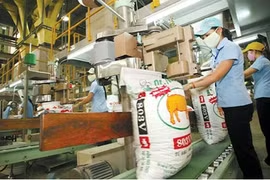
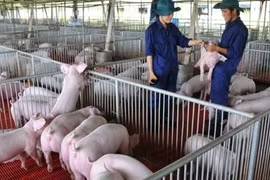
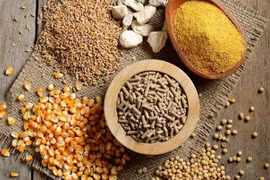
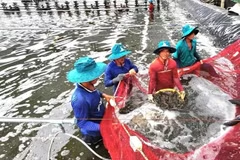
Vietnam had to spend nearly 2.7 billion USD to import corn and soybeans in the first seven months. (Photo baodantoc.vn)
 The Department of Livestock Production of the Ministry of Agriculture and RuralDevelopment said that according to the General Department of Customs, theanimal feed industry had to spend nearly 2.7 billion USD to import corn andsoybeans in the first seven months.
The nation also spent more than 400 million USD to import other raw materials,including oilseed meal, wheat, fish meal, bone meal, animal protein, and amixture of trace elements.
Domestic production of corn and soybeans has met about 37% of the demand fromthe animal feed industry, so in past years, Vietnam had to import a huge amountof corn and soybeans, according to the Department of Livestock Production.
Corn imports reached 5.1 million tonnes in the first seven months of this year,worth 1.8 billion USD. Corn imports declined by 21.9% by volume on year butwere unchanged by value, and corn imports in July reached 500,000 tonnes, worth191.7 million USD.
Soybean imports were 1.3 million tonnes in the first seven months of this year,worth 893.6 million USD, which was the same volume from the same period a yearago but 22.8% more in value. Soybean imports in July reached 250,000 tonnes,worth 189.4 million USD.
Brazil, the United States and Canada were the three main soybean suppliers to Vietnamin the first half of this year, accounting for 99.2% of the imports.
According to the department the COVID-19 pandemic has disrupted the globalsupply chain, including the supply chain of animal feed material. The decreasein supply and higher transportation costs have made the cost of raw materialsand finished products higher.
In addition, the conflict between Russia and Ukraine, the world's largest andfourth largest wheat exporters, respectively, is having a great impact onglobal food supply and prices, directly affecting corn prices.
On the other hand, the United States has increased production of bioethanolfrom corn, while South American countries, such as Argentina and Brazil, havelost crops due to drought. This has caused a sharp drop in corn exports on theglobal market, pushing up corn prices.
Meanwhile, some countries recently suspended food exports to ensure domesticfood security. That will reduce the food supply, further pushing the price offeed materials up.
It has also caused many difficulties for businesses and breeders due to higherproduction costs while the selling price of livestock products has tended todecrease.
According to the General Department of Customs, from 2013 to now, Vietnam'simport value of animal feed and raw materials increased every year, excluding2017 and 2019.
Deputy Minister of Agriculture and Rural Development Phung Duc Tien said that Vietnam'scorn and soybean productivity was low, while production costs were high andprofits were less attractive than other crops.
According to Nguyen Xuan Duong, vice chairman of the Vietnam Animal FeedAssociation, that almost all imported corn is genetically modified corn. Vietnamhas also allowed the cultivation of genetically modified maize for many years,but the area where genetically modified maize is planted is still low.
According to the agricultural restructuring project implemented by the Ministryof Agriculture and Rural Development in the past 10 years, the agriculturesector has targeted converting a part of the land area cultivating crops withlow economic value to planting crops for feed material.
At the same time, the sector is focused on researching corn and soybeanvarieties to improve productivity. However, until now, the area growing thesecrops has not increased.
Tran Lam Sinh, deputy director of the Department of Agriculture andAgricultural Development of Dong Nai province, said that the domestic livestockindustry needed to study the use of agricultural by-products for processinganimal feed, such as beer residues, coconut flour, duckweed and rice bran.
Deputy Minister Tien said the sector was developing the region producing animalfeed material to reduce dependence on imports.
De Heus Group (the Netherlands) is coordinating with the Department of CropProduction and Department of Livestock Production to build cooperatives growingcassava and maize in western provinces for the production of animal feed.
The output of animal feed in the first half of 2022 reached 10.5 milliontonnes, equal to the volume in the first six months of 2021, of which 55% wasfor pigs, 40% for poultry, and 5% for other animals, according to the Departmentof Livestock Production./.
VNA