Vietnam-Singapore economic ties enter new phase of cooperation

As complementary economies, Vietnam and Singapore have promoted the implementation of trade agreements to strengthen bilateral economic ties. Both members of the Comprehensive and Progressive Agreement for Trans-Pacific Partnership (CPTPP) and the Regional Comprehensive Economic Partnership (RCEP), the two countries have effectively tapped the benefits offered by these free trade agreements.

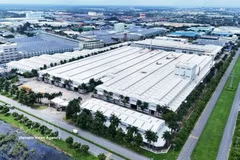
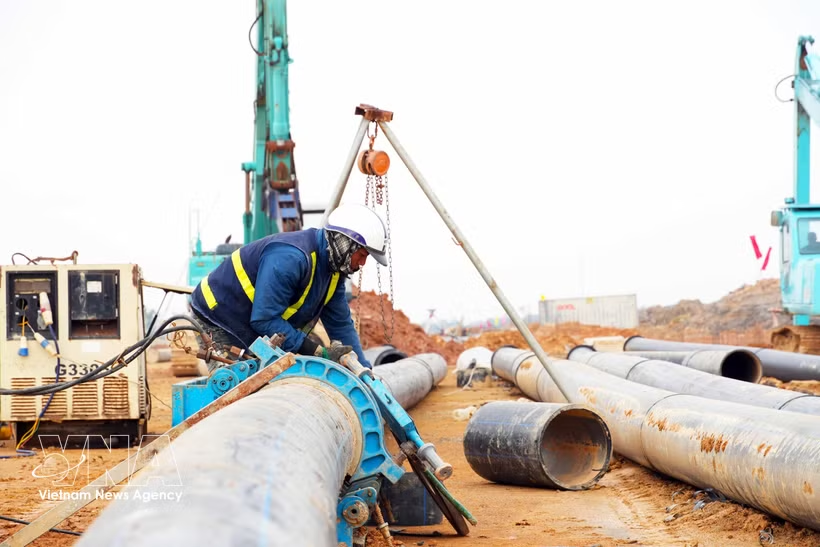
The total investment for VSIP Ha Tinh is more than 1.5 trillion VND (57.4 million USD) (Photo: VNA)

Hanoi (VNA) – Politburo member and Standing Member of the Secretariat of the Communist Party of Vietnam (CPV) Central Committee Tran Cam Tu’s official visit to Singapore and his co-chairing of the first Vietnam-Singapore Strategic Dialogue on August 24-25 are expected to inject fresh momentum into trade, investment and emerging areas of cooperation between the two countries.

A model of cooperation

As complementary economies, Vietnam and Singapore have promoted the implementation of trade agreements to strengthen bilateral economic ties. Both members of the Comprehensive and Progressive Agreement for Trans-Pacific Partnership (CPTPP) and the Regional Comprehensive Economic Partnership (RCEP), the two countries have effectively tapped the benefits offered by these free trade agreements.

Singapore is among Vietnam’s leading economic partners in investment, trade and human resource training. It is currently Vietnam’s second-largest foreign investor, with more than 4,500 valid projects and total registered capital of nearly 97 billion USD. Its projects span processing and manufacturing, infrastructure, logistics, real estate, finance, high technology and modern services, contributing to economic growth, job creation and economic restructuring.

A prominent symbol of bilateral cooperation is the network of Vietnam-Singapore Industrial Parks (VSIPs). Since the first VSIP was launched in 1996, the network has grown to 22 parks in localities nationwide, becoming not only an effective economic cooperation model but also a symbol of trust, long-term vision and strategic connectivity between the two countries.

Cao Xuan Thang, Trade Counsellor at the Vietnamese Trade Office in Singapore, said Vietnam-Singapore economic and trade ties have made strong progress over the past half century, becoming a successful model of cooperation in Southeast Asia.

According to Singapore’s Enterprise Singapore (ESG), in the first seven months of 2026, Vietnam remained Singapore’s 10th-largest trading partner, with two-way trade reaching nearly 33 billion SGD, up 43.1% year-on-year. Singapore’s exports to Vietnam stood at 17.8 billion SGD, up 9%, while imports from Vietnam surged 126.8% to 15.1 billion SGD, highlighting the significant role of transit and re-export activities.

New room for cooperation

The two economies are highly complementary, with Singapore serving as a leading regional hub for finance, logistics and innovation, while Vietnam offers a dynamic market, a young workforce and growing integration into global supply chains.

Their economic ties are also shifting from traditional cooperation towards technology, innovation and green development. Recent initiatives include a memorandum of understanding between the Quang Trung Software City Development Co. Ltd. and the Singapore Semiconductor Industry Association (SSIA) to connect the two countries’ semiconductor ecosystems and promote investment, R&D, technology transfer and human resource training.
vnanet-sing2.jpg
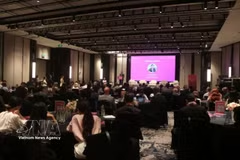
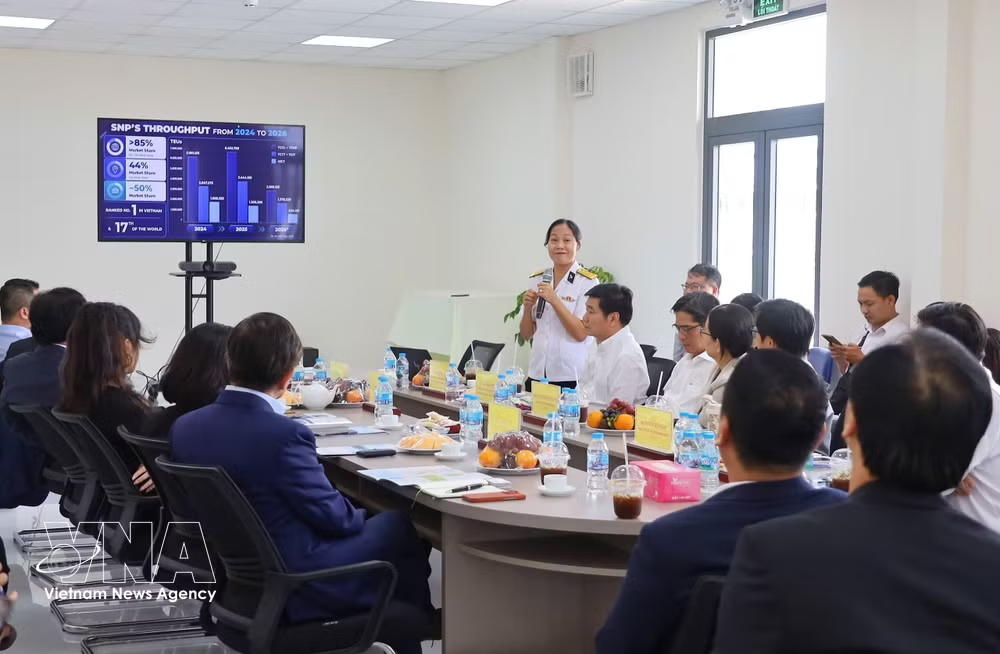
Singaporean businesses listen to a presentation about the investment environment at VSIP Can Tho. (Photo: VNA)

Singaporean businesses are also showing growing interest in investment opportunities in Can Tho and Quang Ngai, particularly in manufacturing, logistics, food processing, digital transformation, energy and sustainable supply chains.

Thang said digital economy, innovation and green transformation offer substantial room for expanded cooperation. The two sides could develop next-generation VSIPs featuring smart, low-emission models integrating data centres, green logistics and renewable energy.

High-tech fields such as artificial intelligence, fintech, semiconductors, cybersecurity, e-commerce and cross-border payments are also expected to become new growth drivers.

“Singapore has strengths in capital, technology, management and international financial networks, while Vietnam has advantages in its market, production capacity and high growth,” Thang said, stressing that the complementary strengths would create new opportunities in high technology, logistics, clean energy and green manufacturing.

The Vietnamese Trade Office in Singapore will continue updating market information and policies, supporting business connections, trade promotion and access to Singapore’s distribution and e-commerce networks, while helping Singaporean businesses seek Vietnamese suppliers and investment opportunities.

Thang recommended that Vietnamese enterprises leverage Singapore’s strengths in innovation, finance and logistics and strengthen links with business associations, distributors and investors to expand markets and pursue long-term cooperation./.

VNA

See more

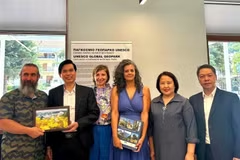
Lang Son's delegation works with the management board of the Chelmos-Vouraikos Global Geopark to exchange experiences regarding the management, conservation, and promotion of the global geopark's values. (Photo: Embassy of Vietnam in Greece)

Vietnam, Greece step up subnational cooperation

Addressing the event, Vietnamese Ambassador to Greece Pham Thi Thu Huong stressed that as a bridge between Vietnamese localities and partners in host countries, the embassy’s organisation of the dialogue was among its key economic diplomacy activities in 2026. The initiative aims to support localities in strengthening ties with Greek partners, particularly businesses, thereby contributing to their socio-economic development and that of the country as a whole.

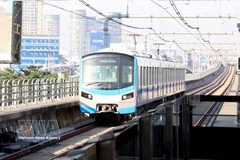
The Ben Thanh–Can Gio metro line will run alongside Rung Sac road, helping lay the foundation for the green transition of Can Gio. (Photo: VNA)

Vietnam seeks to unlock 700 billion USD for green transition

To fulfil its commitment to achieve net-zero emissions by 2050, Vietnam needs to mobilise around 700 billion USD over the course of its long-term transition. The scale of the funding requirement highlights the need to expand sources beyond the State budget, particularly private and international capital.

Cast of the 2026 edition of “Anh trai vuot ngan chong gai”. (Photo: Yeah1)

Efforts needed to unlock copyright to drive cultural industry development

As Vietnam’s economy grows and living standards improve, demand for cultural products such as publications, music and films has increased strongly. Domestic products are also becoming increasingly competitive with foreign counterparts, with a number of Vietnamese films and music programmes achieving impressive commercial success.

Representatives of C.P. Vietnam, the Ministry of Agriculture and Environment, the Embassy of the Republic of Korea (RoK) in Vietnam and the Animal Husbandry Association of Vietnam attend a ceremony marking the export of the country’s first shipment of processed chicken to the RoK. (Photo: VNA)

Vietnam exports first shipment of processed chicken to RoK

Vietnam and the RoK announced the opening of the Korean market to processed chicken from Vietnam on April 22 this year. C.P. Vietnam became the first company to meet the requirements to ship Vietnam’s first consignment of processed chicken to the market.

A view of Vinh Loc 2 Industrial Park in My Yen commune, Tay Ninh province (Photo: VNA)

FDI surge fuels new real estate demand

According to Savills experts, FDI continues to flow into manufacturing, logistics, technology and digital infrastructure, changing property requirements for investors.

Lien Chieu Port is under construction in central Da Nang city. (Photo: VNA)

Energy infrastructure underpins marine economy development

The integrated investment in energy infrastructure will provide a vital infrastructure foundation for effectively harnessing the marine potential, helping realise the goal of making Vietnam a strong maritime nation and achieving sustainable and prosperous development from the sea./.

The Australia-Vietnam Policy Institute Forum in Ho Chi Minh City on August 25, 2026 discusses how Australian expertise, partnerships and capital can support Vietnam's growth, and how to build stronger connections between the two countries' business communities. (Photo: VNA)

Vietnam, Australia seek new space for economic cooperation

The Australia–Vietnam Policy Institute Forum was held in Ho Chi Minh City on August 25, bringing together policymakers, businesses, and organisations for discussing how the business communities of Australia and Vietnam can build stronger connections.

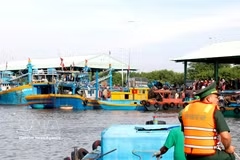
Officers from Thanh Hai Border Guard Station (Phu Thuy ward, Lam Dong province) patrol and monitor fishing vessels entering and leaving the port. (Photo: VNA)

Lam Dong province deploys 10 key measures to combat IUU fishing

The measures target key gaps, including ineligible fishing vessels, port controls, electronic fishing-trip data, seafood traceability and vessel monitoring system (VMS) violations. Authorities will also act against vessels detained by foreign authorities, submit weekly progress reports and draw up specific action plans.

Speakers at the seminar (Photo: VNA)

Legal transparency key to making VIFC more attractive: experts

Dominic Scriven, Chairman and Founder of Dragon Capital, said legal clarity, consistency and predictability are essential to strengthening investor confidence, enabling long-term business planning and encouraging firm capital commitments to Vietnam.

Illustrative photo (Photo: VNA)

Vietnam promotes cooperation to remove barriers to rice trade with Philippines

Vietnam proposed studying a higher-level cooperation framework on rice trade to provide a more stable and long-term foundation for Vietnam-Philippine rice trade while balancing the interests of farmers, businesses and consumers, and providing sustainable livelihoods for rice growers and stable living conditions for Philippine consumers.