Vietnam tourism maps out long-term growth scenarios for 2026-2031

According to VNAT, shifting global travel trends present both opportunities and challenges.

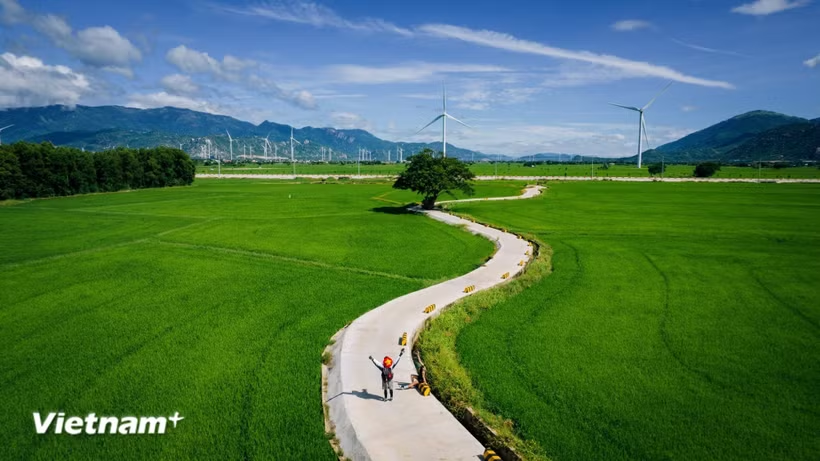
A wind farm in former Ninh Thuan province, now part of Khanh Hoa province. (Photo: VietnamPlus)

Hanoi (VNA) – Vietnam’s tourism sector has developed growth scenarios for 2026 and the 2026-2031 period as it seeks to sustain momentum despite mounting global uncertainty, according to Director of the Vietnam National Authority of Tourism (VNAT) Nguyen Trung Khanh.

The industry recorded its strongest-ever first-quarter performance, welcoming more than 6.7 million international visitors, up 12.4% year-on-year, while domestic tourism reached an estimated 37 million trips. Total tourism revenue was estimated at 267 trillion VND (over 10 billion USD).

However, Khanh noted that the sector continues to face external headwinds. Geopolitical tensions in the Middle East have raised fuel prices, increasing air transport and tourism costs. Although indirect, these developments have affected consumer confidence, travel spending, and tourism business.

According to VNAT, shifting global travel trends present both opportunities and challenges. International tourists are increasingly favouring destinations that are safe, affordable, and closer to home, creating opportunities for Vietnam to attract more visitors from nearby markets and strengthen its image as a friendly and attractive destination.

At the same time, the sector faces rising airfares, disruptions to international flight routes, tighter global spending patterns, and intensifying competition from regional rivals, particularly in visa policies, tourism promotion, and demand-stimulation programmes.

Based on these factors, VNAT has developed two growth scenarios for 2026.

Under the optimistic scenario, assuming global conditions stabilise and support measures prove effective, Vietnam aims to achieve the Government’s target of welcoming 25 million international visitors, serving 150 million domestic tourists, and generating tourism revenue of 1.13 quadrillion VND.

greg.jpg
Tourism Ambassador Greg Norman promotes Vietnam’s golf tourism and enhances the country’s image as a global destination. (Photo: VietnamPlus)

VNAT projects that international arrivals will reach approximately 5.6 million in both the second and third quarters and 7 million in the fourth quarter. Domestic tourism is forecast at 44 million trips in the second quarter, 45 million in the third, and 24 million in the final quarter.

Under a more conservative scenario, prolonged geopolitical conflicts, global economic slowdown or natural disasters and disease outbreaks could reduce international arrivals to around 22.5 million and domestic visitors to 130 million.

Looking further ahead, VNAT has prepared three growth scenarios for the 2026-2031 period.

The cautious scenario targets annual international visitor growth of 8-10%, reaching 35-38 million arrivals by 2030. The baseline scenario envisages annual growth of 12-15%, with international arrivals climbing to 40-45 million. Under the high-growth scenario, supported by breakthroughs in visa policy, aviation connectivity and digital transformation, international arrivals could expand by 15-18% annually, reaching 45-50 million by the end of the decade.

To realise these targets, Khanh said the tourism sector will implement a comprehensive set of short-, medium- and long-term measures.

In the near term, priorities include implementing the Politburo’s Resolution No. 08 on developing tourism into a spearhead economic sector, accelerating revisions to the 2017 Tourism Law and related regulations, and finalising a new tourism development scheme for the coming period.

The sector will also review and adjust the Vietnam Tourism Development Strategy to 2030 in line with post-pandemic realities, strengthen branding, diversify source markets and accelerate digital transformation, particularly through the development of a tourism digital data ecosystem in line with the spirit of the Politburo’s Resolution No. 57-NQ/TW on science, technology, innovation and digital transformation.

In the medium and long term, efforts will focus on improving institutions, developing infrastructure, strengthening tourism product linkages, promoting green and digital transitions, and enhancing the competitiveness of tourism enterprises.

According to Khanh, Vietnam currently has more than 4,000 international travel companies, but over 90% are small and micro-sized enterprises, highlighting the need for larger firms capable of competing globally.

Restructuring system, renewing mindset

Addressing the sector’s future growth strategy, Deputy Minister of Culture, Sports and Tourism Ho An Phong called for a restructuring of tourism products towards higher-quality segments.

He urged greater emphasis on four- and five-star accommodation, premium resort tourism, high-quality entertainment services, specialised tourism transport and value-added services.

According to the deputy minister, creating high-value tourism products from existing resources would not only improve economic efficiency but also reduce pressure on infrastructure and the environment, supporting sustainable development.

A key priority, he said, is the development of a new statistical framework capable of fully measuring tourism’s contribution to the economy. This should capture not only accommodation revenue but also spillover effects on aviation, transport, telecommunications, finance, retail, real estate, food services and related sectors.

thap-ba-ponagar-2-khanh-hoa.jpg
A tourist visits Ponagar Tower 2 in Khanh Hoa province. (Photo: VNA)

On market development, Phong stressed the importance of maintaining a diversified international market strategy while continuing to view domestic tourism as a major driver of consumption and local economic activity.

He noted that Vietnam has gradually expanded its reach into promising markets such as South America, South Asia and other emerging destinations. India continues to record rapid growth, Russia is recovering strongly, while Northeast Asia – particularly China, the Republic of Korea, Japan and Taiwan (China) – remains the backbone of Vietnam’s international tourism market.

The deputy minister also highlighted the positive impact of Vietnam’s more open and flexible visa policies, describing them as a key lever for market expansion. He stressed that any further visa liberalisation proposals should be carefully prepared, with detailed assessments of specific markets and visa categories to ensure effectiveness./.


VNA

See more

Thailand has become the sixth international destination of Vietnam's newest carrier, Sun PhuQuoc Airways. (Photo: The courtesy of Sun PhuQuoc Airways)

Thailand is sixth international destination of Vietnam's newest airline

Speaking at the recent launch event for the Bangkok route, La Vinh Nam, the airline's Deputy Commercial Director, said the full-service carrier, owned by Vietnam's Sun Group, views Thailand as an important partner in promoting two-way tourism and attracting international transit passengers, rather than as a competitor.

Vietnam Railways has introduced a range of tourism, heritage and dedicated train services, attracting growing numbers of passengers. (Photo: VNA)

Railways reinvent themselves with tourism, heritage trains

One of the most notable successes is the premium Hoa Phuong Do (Flamboyant Flower) train operating between Hanoi and Hai Phong city. Since entering service in May 2025, the train has completed nearly 3,000 trips and carried around 1.33 million passengers.

A rammed-earth house of the Mong ethnic community in the mountainous province of Tuyen Quang. (Photo: VNA)

Heritage fuels distinctive destination brands across Vietnam

As localities move beyond resource-based tourism towards value-driven cultural development, they are creating distinctive destination brands while reinforcing Vietnam's position as a culturally rich and compelling destination on the global tourism map.

Foreign tourists explore Hoi An ancient town in Da Nang city. (Photo: VNA)

Tourism sector pivots to quality-led growth in second half of 2026

According to the Vietnam National Authority of Tourism (VNAT), Vietnam welcomed 12.3 million international visitors in the first six months of 2026, up 15% year-on-year. The figure is the highest first-half number in recent years and puts the country close to halfway towards its target of 25 million foreign arrivals this year.

Travel guide Lonely Planet describes Da Nang as an outdoor lover’s paradise. (Photo: VNA)

Da Nang proves Lonely Planet right as Asia’s must visit summer destination

According to Lonely Planet, Da Nang stands out for its harmonious blend of beautiful beaches, an energetic yet relaxed lifestyle, a rich culinary scene and a diverse range of experiences spanning nature, culture, leisure and entertainment. The city is also praised as an ideal gateway to central Vietnam, offering convenient access to Hoi An, Hue and My Son Sanctuary.

Sun PhuQuoc Airways' new aircraft livery (Photo: Sun Group)

Vietnam's newest airline races from Phu Quoc onto the global stage

Sun PhuQuoc Airways, the airline of Sun Group, officially launched in October 2025 and began commercial flights the following month, entering a Vietnamese aviation market riding a wave of post-pandemic recovery, but also grappling with rising costs, fleet constraints, talent shortages, infrastructure pressure, and intensifying service competition. Less than a year in, this newcomer has already made its presence felt.

A Korean tourist family poses for a photo in the coastal city of Da Nang. (Photo: VNA)

Vietnam remains second most popular destination for Korean tourists

Japan remained the top destination, attracting about 951,000 Korean visitors, accounting for 40.6% of total outbound tourists. Vietnam ranked second with approximately 278,000 visitors, followed by the US with 100,000, Taiwan (China) with 79,000, Thailand with 64,000, the Philippines with 61,000 and Hong Kong (China) with 59,000.

Tourists explore a tourist attraction in Hue city. (Photo: VNA)

Wellness tourism helps Hue shape identity as Asia’s emerging "healing city"

The development of wellness tourism is also aligned with the Politburo's Resolution No. 57-NQ/TW on breakthroughs in science and technology development, innovation and national digital transformation. For Hue, the strategy provides an opportunity to combine modern medicine with traditional healthcare, biotechnology, indigenous medicinal herbs and tourism to create high-value services.

Keo Hanh Thien Pagoda is recognised as a special national relic in 2016. (Photo: VNA)

Digitalising rural heritage to boost tourism

Authorities in Xuan Hong commune of the northern province of Ninh Binh are leveraging digital technology to preserve cultural heritage and promote rural tourism, with the centuries-old Keo Hanh Thien Pagoda serving as the centrepiece of the initiative.

Discover Moscow offers a comprehensive hub of practical travel information, seasonal itinerary ideas and useful tips for visitors planning a trip to the Russian capital. (Screenshot)

Discover Moscow debuts Vietnamese-language tourism platform

Accessible at https://discover.moscow/vi, the platform provides a one-stop source of travel information, featuring practical guidance, seasonal itineraries and planning tips for visitors. It showcases the city's key attractions, cultural routes, parks, events, restaurants, shopping destinations and family-friendly activities, enabling travellers to organise their trips before arriving in Moscow.

Boat tours in Cam Thanh village, Da Nang city, generate significant income for local residents. (Photo: VNA)

Rural tourism draws strength from indigenous culture

Vietnam currently has more than 600 agricultural and rural tourism models, generating over 25 trillion VND (956 million USD) in annual revenue. The sector has become an important source of income for many rural communities seeking to diversify their livelihoods.

Located about 200 km from Hanoi, Ta Xua in Son La province is widely regarded as one of the most spectacular cloud-hunting destinations in northern Vietnam. (Photo: VNA)

Ta Xua sets sights on sustainable tourism

Ta Xua is rolling out a campaign titled “Bringing Ta Xua to the world” and aims to establish the image of “Ta Xua - a sea of clouds, majestic nature and Mong cultural identity” during the 2028-2030 period.